Pineapple and Cilantro Scent: Why Contrast Works
Pineapple and cilantro sounds like an odd couple, but there is something to it. The popular story is that they share aldehydes. Pineapple does not actually work that way, and the real reason the pairing can work is more interesting: contrast.
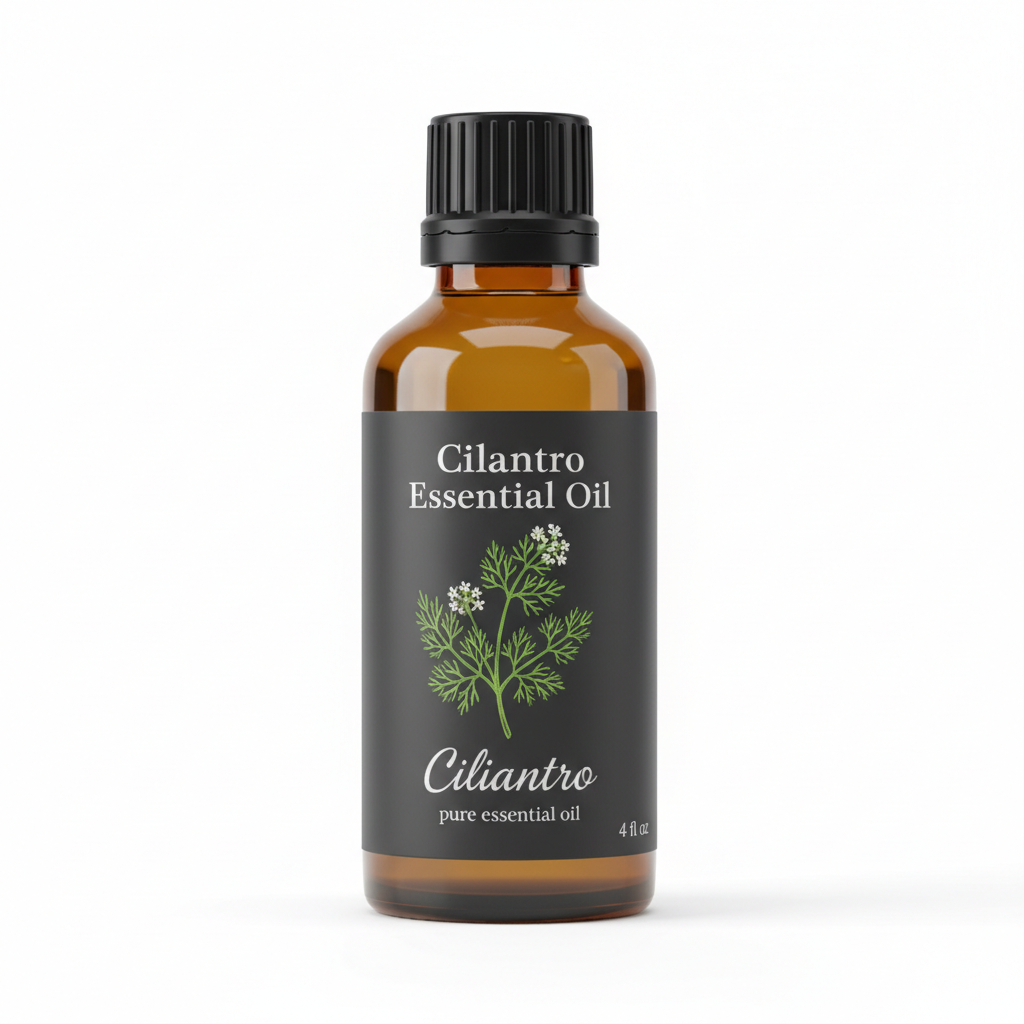
Cilantro Essential Oil
Our own Cilantro Essential Oil, in sizes from 0.5 oz to bulk.
From $13.99
Shop Now →Pineapple is esters and lactones
A 2018 study profiled six Malaysian pineapple varieties by gas chromatography with olfactometry and a sensory panel. Of 59 volatile compounds found, eight drove the aroma: fruity methyl esters, a caramel-like furanone and a pair of delta-lactones. The panel's words were sweet, floral, fruity, fresh, green, woody and apple-like (Lasekan and Hussein, Chem Cent J, 2018). Notice that "green" and "fresh" are on that list. That one shared word is the honest bridge to cilantro.
Cilantro leaf oil is waxy, citrusy green
The steam-distilled leaf oils in Kumar et al. (2022) were led by four long-chain aldehydes, about 59% to 66% of each oil, with no sign of the fruity esters that make pineapple what it is. So our cilantro oil, which we describe as green, bright and herbaceous with a citrusy edge, brings bite and lift rather than sweetness. It is not a pineapple note and it is not trying to be one.
Why contrast works
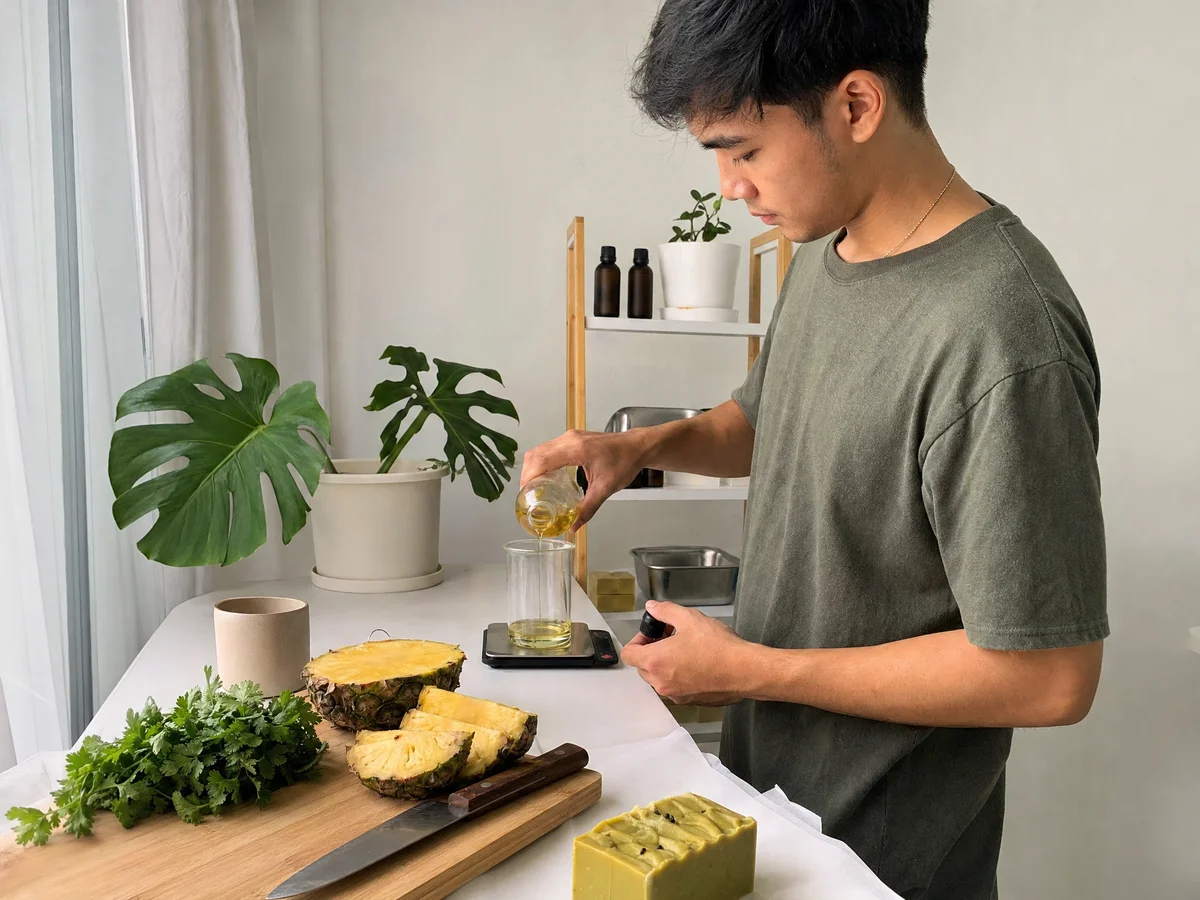
This is reasoning from the two profiles, not a study of smellers, but it holds together well:
- Lift against sweetness. A little sharp aldehydic green can stop a sweet fruit note from tipping into candy and make it read as fresh-cut fruit.
- A shared green, fresh quality. Overlapping descriptors are not overlapping chemistry, but they give the nose a way to connect the two.
- Strength mismatch. Cilantro oil is pungent and dominates a blend quickly, so in a fruity scent it should be the seasoning, not the star.
Picture the pairing
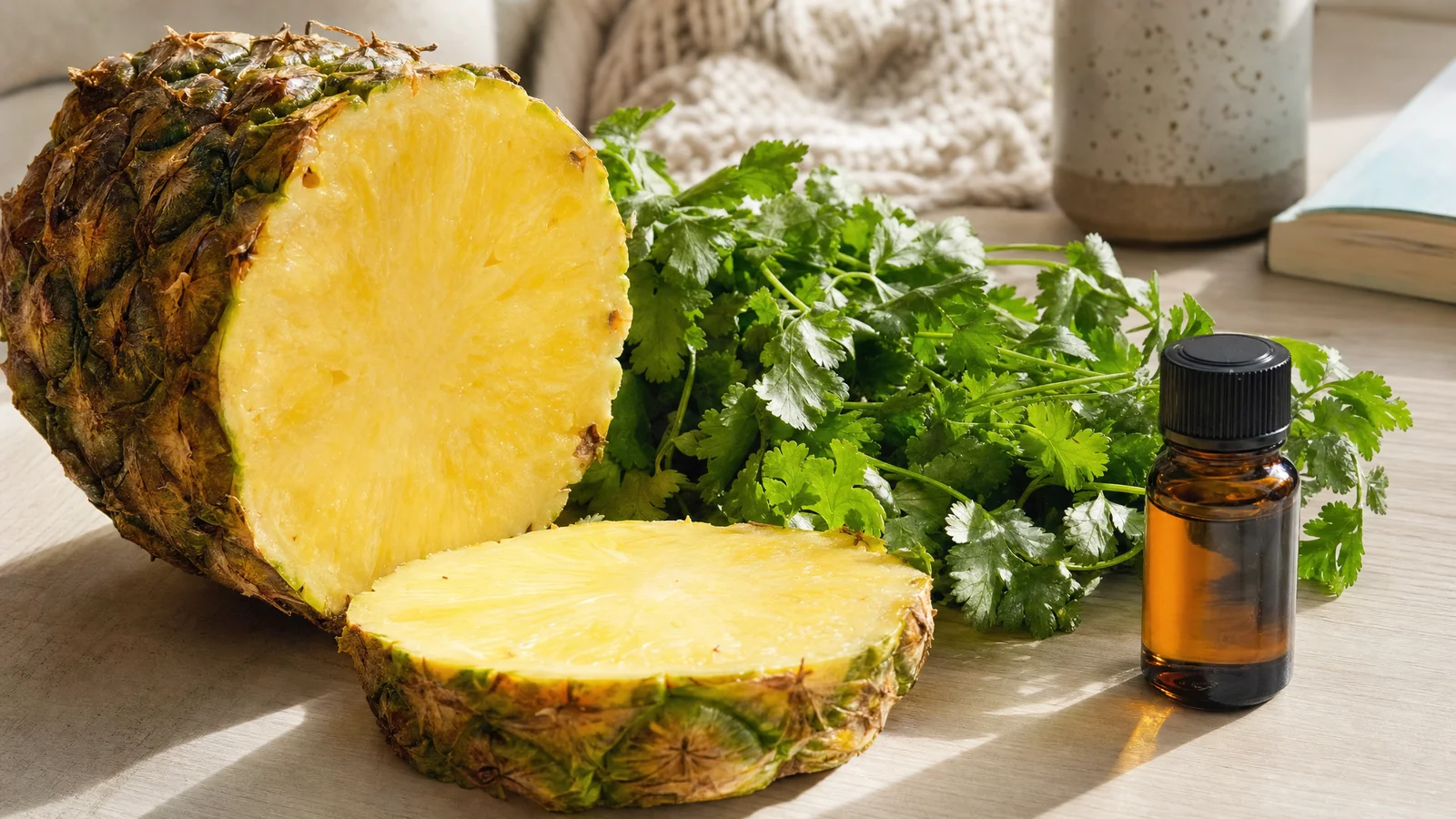
Think of a bowl of fresh pineapple with a few torn herbs scattered over it. The herb is not what you taste, but it changes how the fruit feels: sweeter things come across cleaner and brighter. The same idea applies to scent. The cilantro is there to lift, not to be noticed as itself.
The pineapple half
We sell cilantro oil only, so the pineapple material comes from elsewhere. Pineapple scent in a bottle is usually a fragrance oil, which is a different category from an essential oil (our post on fragrance oil versus essential oil explains the difference). Whatever you choose, follow that supplier's usage rate and safety documents for your use, whether it is a diffuser, candle or soap, and read the ingredient list rather than the name.
A paper strip ladder
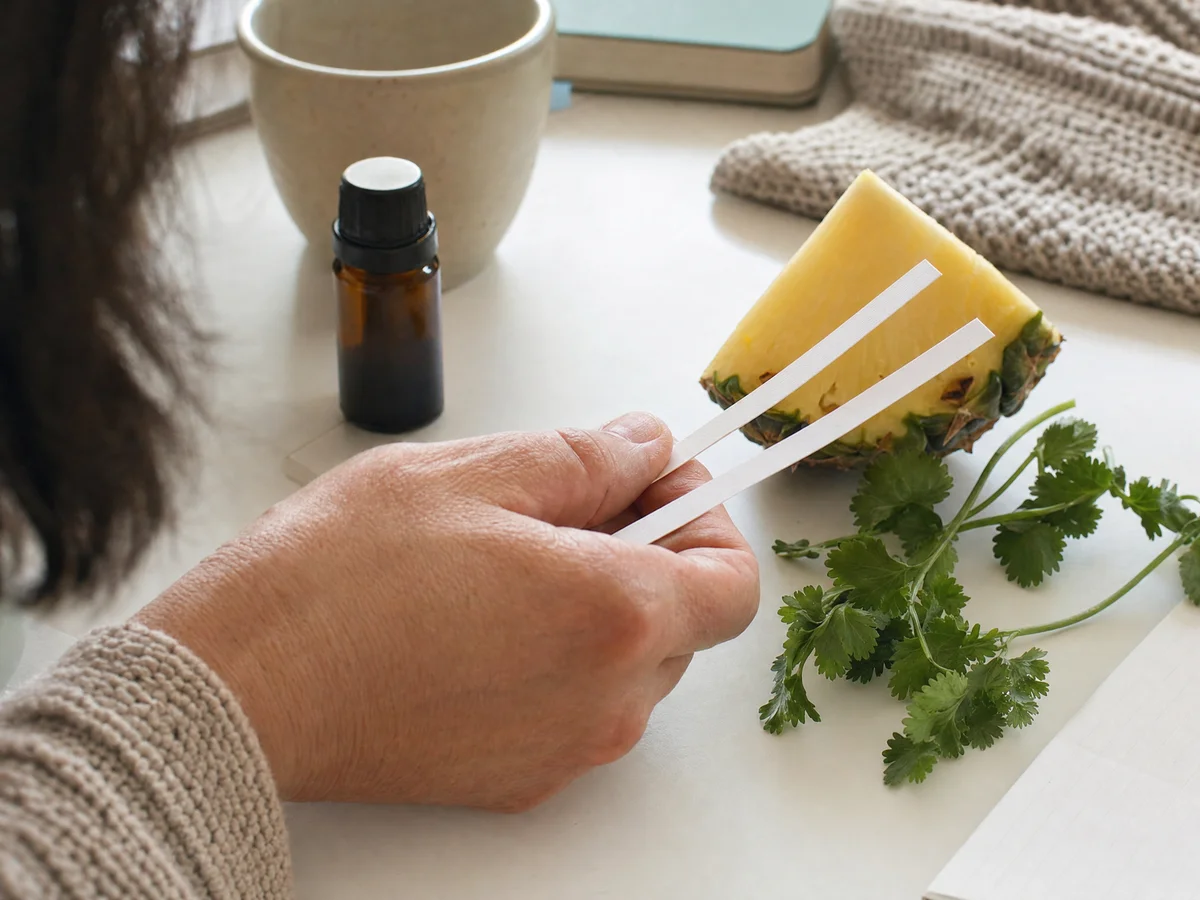
The cheapest way to find the sweet spot is a ratio ladder on scent strips. At the common convention of about 20 drops per ml (a rough figure that varies with the dropper), one drop is roughly 0.05 ml. Make three small mixes by drops of pineapple material to cilantro oil: 20 to 1, 10 to 1 and 5 to 1. Smell each at arm's length, then again after an hour, because aldehydes and esters fade at different speeds and the first sniff misleads. Our expectation is that the 20 to 1 mix reads closest to fresh fruit and the 5 to 1 mix reads as herb with fruit, but your nose is the judge.
Reading your strips
- Right away: the sharp green lift is loudest, and the sweetness is quiet.
- After ten minutes: the fruit starts to come forward as the quick notes settle.
- After an hour: what is left is the real balance, and it is the one to judge by.
Keep the strips in a row, labeled, and write the ratio on each one. It is easy to forget which was which after a quick break.
If you want to add a bridge, our recommended partners for cilantro are lime, lemongrass, black pepper, ginger, petitgrain and bergamot; the diffuser post covers how little to start with. For anything on skin we recommend diluting to 0.5% to 2% in a carrier and patch testing first; the perfume maths walks through it.
One caution: if cilantro tastes like soap to you, an aldehyde-rich oil may push a fruit blend toward detergent, so try a strip before building anything bigger. We sell an external cosmetic and aroma oil, and nothing here is a health claim.
Pineapple and cilantro is a contrast pairing, and like most contrast pairings it rewards a small, patient test.
Cilantro Essential Oil
Cilantro Essential Oil from our own shop, in sizes from 0.5 oz to bulk.
From $13.99
Shop Now →Sources & Further Reading
- Lasekan O, Hussein FK, 2018. Classification of different pineapple varieties grown in Malaysia based on volatile fingerprinting and sensory analysis. Chem Cent J 12:140. pubmed.ncbi.nlm.nih.gov/30569201
- Kumar S et al., 2022. Chemical composition of fresh leaves headspace aroma and essential oils of four coriander cultivars. Front Plant Sci. pubmed.ncbi.nlm.nih.gov/35251089