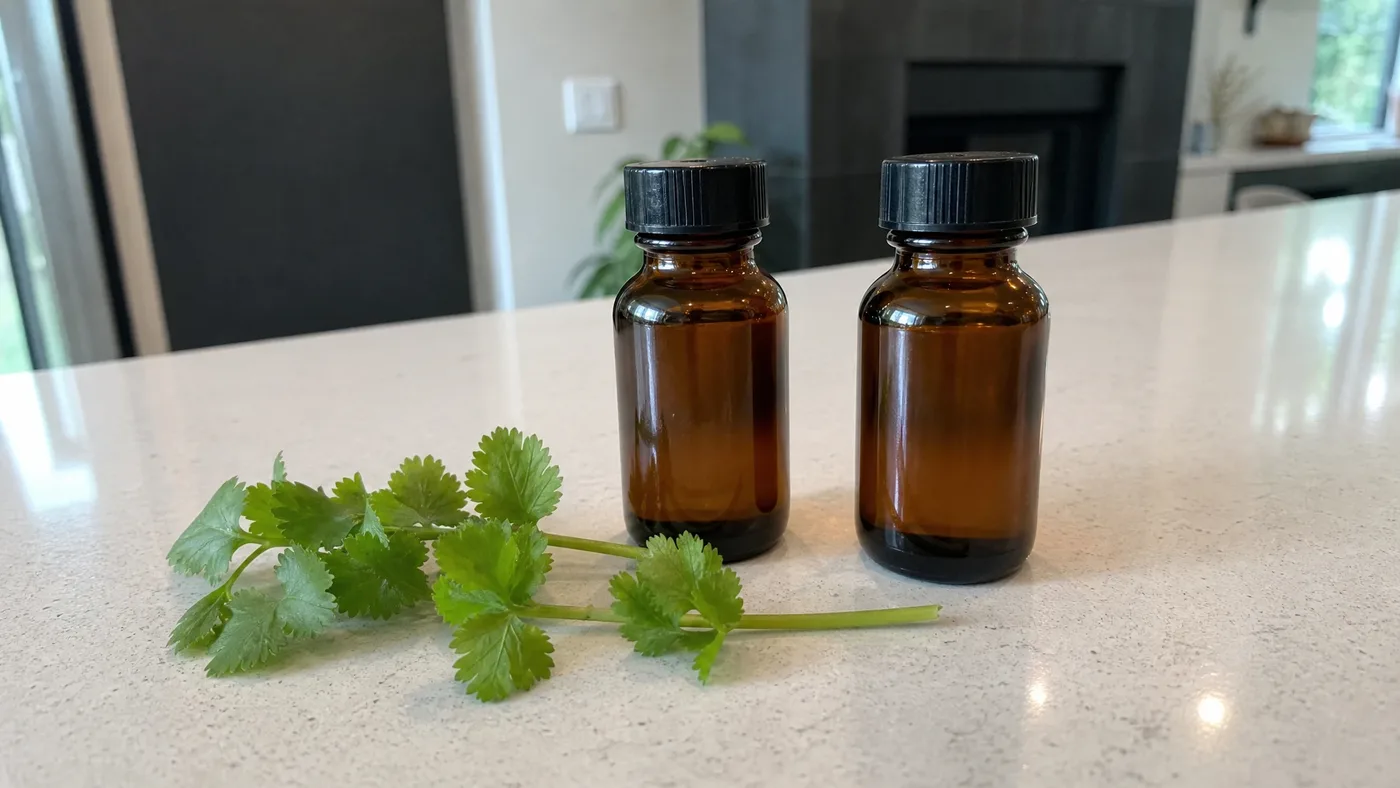
DIY Cilantro Perfume: The Dilution Maths Comes First
A cilantro leaf perfume made the way a department-store perfume is made would break our own skin guidance by roughly ten times. Our shop page gives 0.5% to 2% for skin, and a conventional eau de parfum is described as 15% to 20% aromatic material. So the honest DIY version is a scented skin oil or a light alcohol mist in which cilantro is one voice among several, and this article is the arithmetic for building that.
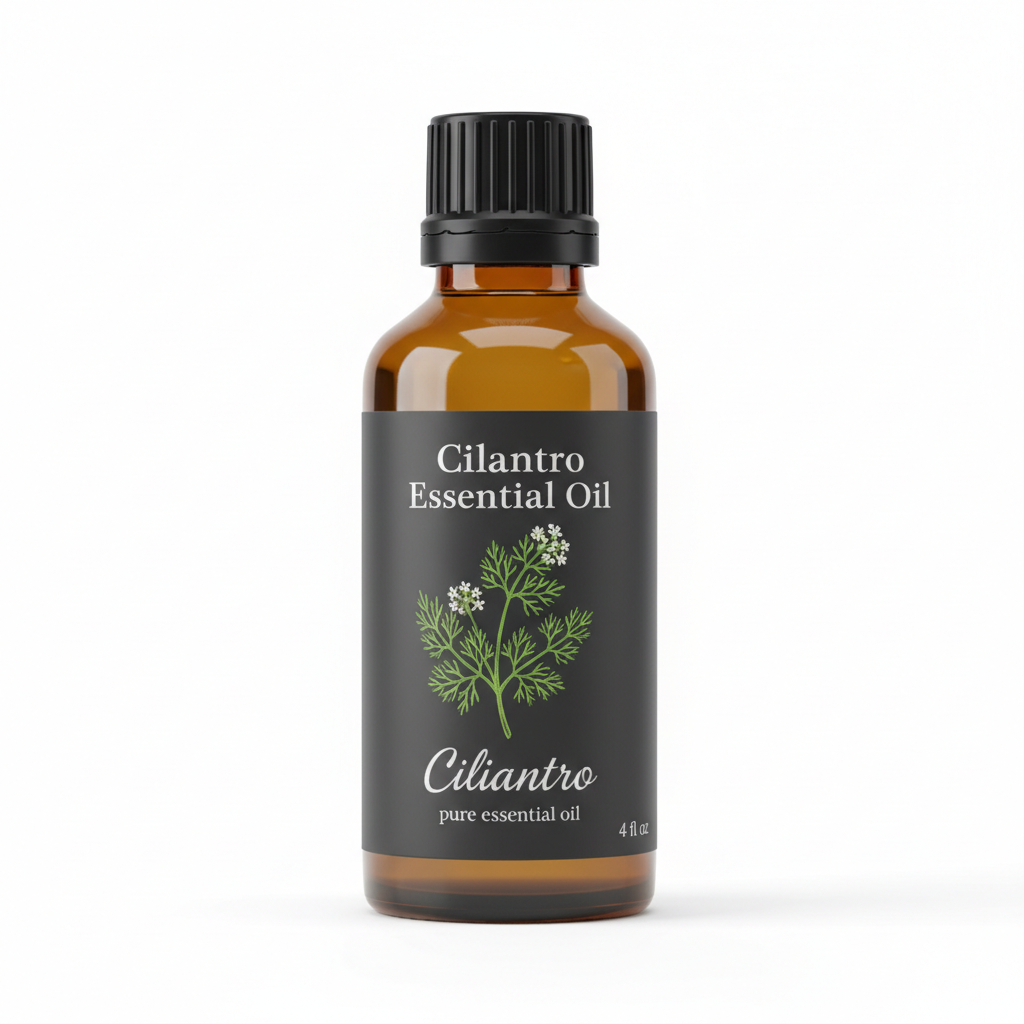
Cilantro Essential Oil
Our own Cilantro Essential Oil, in sizes from 0.5 oz to bulk.
From $13.99
Shop Now →Start with the percentages, because they decide the format
The conventional concentration bands, as summarised in Wikipedia's perfume entry (a secondary source; we read it, and its concentration terms rest on a newspaper article and a glossary, so treat the numbers as trade convention, not a standard): parfum 15% to 30%, eau de parfum 15% to 20%, eau de toilette 5% to 15%, eau de cologne 2% to 3%. The same entry says houses assign these inconsistently, so one house's toilette can be stronger than another's parfum.
Now set that against what we publish for our oil. The shop page says to dilute to 0.5% to 2% in a carrier oil, which we translate as roughly 3 to 12 drops per ounce of carrier. That 2% ceiling is at or below the cologne band, the weakest named category. Our leaf oil is sold undiluted, so you hold the whole dilution decision.
The independent safety authority we lean on for skin percentages, the Tisserand Institute dilution page, lists 1% to 3% for leave-on body products, 0.5% to 1.2% for face products and deodorants, and 0.2% to 1% for sensitive or damaged skin. Our shop's 2% sits inside their body range, above their face range. We cannot reconcile those by averaging: if you are scenting anything near the face or neck, take the lower Tisserand figure.
What this means in drops
Our shop's 3 to 12 drops per ounce implies about 20 drops per millilitre (3 drops at 30 ml is 0.5%: 3 / 20 = 0.15 ml, and 0.15 / 30 = 0.5%). Tisserand's page itself says that drop conversions "are always approximate", so use a scale or graduated pipette if you can, and treat the figures below as arithmetic, not a tested recipe. We have not made or worn any of these.
- 10 ml roll-on at 1%: 0.1 ml of total fragrance oil, about 2 drops.
- 10 ml roll-on at 2%: 0.2 ml, about 4 drops.
- 30 ml (1 oz) at 2%: 0.6 ml, about 12 drops.
- 10 ml at a 15% eau de parfum level: 1.5 ml, about 30 drops, seven to eight times the 2% ceiling.
The cap applies to the whole fragrance load on the skin, not to cilantro alone. Reasoning from how percentages add, if your blend is 4 drops of cilantro plus 8 drops of other oils in 30 ml, you are at 2% total, and each other oil has its own limit besides. We sell no other oils, so check each supplier's limits and sources for those.
Why the format is a roll-on or a light mist, not a splash
Two practical bases are common. A carrier-oil roll-on keeps the oil on skin and cannot be sprayed into the air or onto eyes; it is the base our percentages were written for. A perfumer's alcohol base spreads and evaporates fast, but we have no source on how much oil an alcohol mist should carry for skin, and no source for how long a blend should rest before wearing, so we are not giving a maceration time. Use the same 2% ceiling for alcohol, keep it off the face, and note that alcohol is flammable. We do not sell alcohol or carrier oils; any reputable cosmetic supplier will, and check what it is labelled for.
Cilantro is a top note, and that is a structural problem
Perfume is described in layers: top notes are small, light molecules that evaporate quickly and shape the first impression, heart notes follow, base notes are heavier and slower to leave (same Wikipedia summary, which gives no inline citation for this passage). Our oil's own listing is a perfumery top note: green, bright, herbaceous with a citrusy edge.
Reasoning from that, a blend that is mostly cilantro should be expected to lose its character first, leaving whatever you built under it. We have not tracked a drydown and will not describe one. What follows practically is that cilantro should be the accent on a base you already like, not the whole structure. Our scent profile describes the aroma, green notes explained covers the vocabulary, and the blending shortlist already lists partners, so we will not repeat that list. Our own advice from the oil page applies: it dominates a blend quickly, so start with less than you expect.
The bergamot trap, since it tops every citrus-green list
Our shop page lists bergamot among the oils that blend well with cilantro. Cold-pressed bergamot is also the best-documented photosensitiser in this territory. A 2001 report in the Journal of the American Academy of Dermatology by Kaddu, Kerl and Wolf described two patients with blistering phototoxic reactions 48 to 72 hours after exposure to bergamot aromatherapy oil and then UV light, one after a sauna and a tanning bed with no direct skin contact. It is a two-patient case report, not an incidence figure, and it does not say your blend will do this. It does say the mechanism is real: bergamot contains furocoumarins, mainly bergapten (5-methoxypsoralen). If you add bergamot to a leave-on scent worn on sunlit skin, check your supplier's statement on whether the oil is furocoumarin-free and what limit applies. If you cannot find one, leave it out.
Who should skip this
Anyone with eczema, a history of fragrance reactions or reactive skin should talk to a dermatologist before wearing any new scent on skin, ours included. We are a shop, not a clinic. Do not wear it on broken skin, near eyes, or on children, and ask a paediatrician or pharmacist before using essential oils around a baby. If you are pregnant, ask your OB-GYN or midwife. Our patch test guide covers the test that comes first, and the safety overview covers the wider picture.
If you sell what you make, labelling and allergen-declaration rules differ by country; one German market survey found that up to 83% of 374 deodorants listed at least one of the EU's 26 declarable fragrance allergens (Klaschka, Int J Hyg Environ Health, 2012), which shows how routine declaration is. Ask a cosmetic regulatory adviser for the rules in your market.
The short version of how we would build it
Pick a 10 ml roll-on, choose a total fragrance load of 1% to 2% (lower near the face), and spend only 1 or 2 of the drops on cilantro leaf oil, which is our oil and which we sell undiluted. Patch test on the inner forearm as our patch test article describes before wearing it anywhere else.
Cilantro Essential Oil
Cilantro Essential Oil from our own shop, in sizes from 0.5 oz to bulk.
From $13.99
Shop Now →Sources & Further Reading
- Tisserand Institute. Essential oil dilution. tisserandinstitute.org/safety/dilution
- Kaddu S, Kerl H, Wolf P, 2001. Accidental bullous phototoxic reactions to bergamot aromatherapy oil. pubmed.ncbi.nlm.nih.gov/11511848
- Klaschka U, 2012. Contact allergens for armpits: allergenic fragrances specified on deodorants. pubmed.ncbi.nlm.nih.gov/22261297
- Wikipedia. Perfume (secondary source for concentration bands and note structure). en.wikipedia.org/wiki/Perfume