Cilantro Essential Oil Safety: Who, How Much, Where, Next
Our cilantro leaf oil is sold undiluted, so the first safety fact is a plain one: the liquid in the bottle is not the liquid that goes on skin. The dilution maths is yours, the patch test is yours, and for several groups of people the right move is to ask a professional before you ask a shop. This guide puts those decisions in the order you actually face them: who you are, how much, where, and what to do if the skin objects.
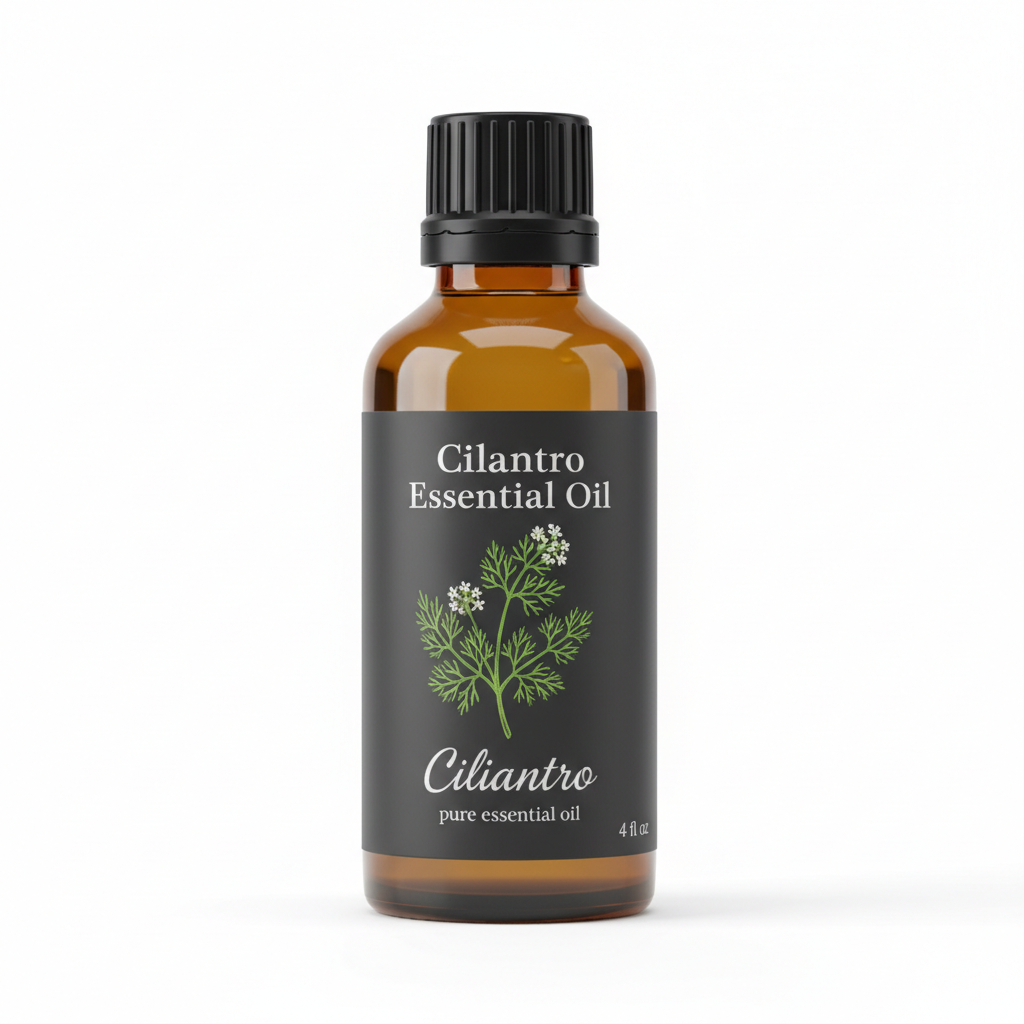
Cilantro Essential Oil
Our own Cilantro Essential Oil, in sizes from 0.5 oz to bulk.
From $13.99
Shop Now →Start with what nobody can tell you
You will not find a verified "safe" number for cilantro leaf oil on this page, and you should be wary of any page that offers one. The Tisserand Institute's safety guidelines page (read for this article) does not list coriander or cilantro in its text, and its dilution tables are published as images, so we could not read a coriander row even if one exists. The only coriander skin-tolerance study we found used seed oil, not leaf oil: Casetti et al., Phytotherapy Research, 2012 put creams and lotions with 0.5% and 1.0% coriander fruit (seed) oil on 40 healthy volunteers under an occlusive patch and saw no irritation by photometric measurement. That is two concentrations, healthy skin and a different plant part. Applying it to leaf oil is an inference, and an allergic reaction (which needs repeated exposure) is not what that design looks for.
So the position of this shop is narrow. We publish a dilution range, we say patch test first, and we do not claim the oil is harmless to anyone. Everything below is built on that.
Who: decide whether you ask a professional first
If you are in any row below, the question belongs with the named professional. The "what the source says" column reports only what we fetched; where we found nothing specific to cilantro oil, it says so.
| Who you are | What the sources we read say | Who to ask |
|---|---|---|
| Pregnant or breastfeeding | Tisserand Institute advises seeking a doctor's or suitable practitioner's advice before using essential oils in pregnancy. We found no cilantro-leaf-specific data. | Your OB-GYN or midwife |
| Parent of a baby or child | The National Capital Poison Center notes that children have thin skin and immature livers, which might make them more susceptible to toxic effects than adults. | Your pediatrician |
| Pet owner | The poison center advises keeping essential oils out of the sight and reach of pets. We found no data on cilantro oil and animals. | Your veterinarian (ASPCA Poison Control: (888) 426-4435) |
| Eczema, broken skin, or a past reaction to fragrance | The poison center says not to use essential oils on damaged skin. A formal patch test is the dermatologist's tool. | A dermatologist |
| Allergic to coriander, celery, or mugwort pollen | Case reports link coriander allergy to mugwort and other Apiaceae. No data exist on the essential oil specifically. See our allergy guide. | An allergist |
Our pregnancy, children and pets guides (pregnancy, kids, pets) go deeper on each. None of them replaces the professional in the right-hand column.
How much: the number we give, and the number we would start at
The shop page lists 0.5% to 2% in a carrier oil for skin, roughly 3 to 12 drops per ounce of carrier. Here is the arithmetic behind that, so you can check it. One ounce is about 29.6 ml. Assuming the common 20 drops per ml (drop size varies with bottle and oil, and we have not measured ours), an ounce is about 590 drops. Then 0.5% is about 3 drops, 1% about 6 drops, and 2% about 12 drops, which matches the shop range. Reasoning from that, the drop count is only an estimate, so a measured syringe or pipette beats counting drops if you want accuracy. Our dilution guide has the full chart; we will not repeat it here.
Now the disagreement we cannot resolve for you. The Tisserand Institute's skin irritation and allergy page says its highest-risk oils carry a dermal maximum of 1.5% or less, and suggests anyone at high risk start around 1% and raise the concentration in 0.5% steps. We could not confirm which class a coriander leaf oil falls into, because it is not listed in the text we could read. Our shop range tops out at 2%, which is above that 1.5% line. Our recommendation, reasoned from that gap: start at 0.5%, stay at or under 1.5% until a dermatologist or pharmacist tells you otherwise, and do not read 2% as a target. The same page says to avoid using one oil or blend above 5% for long periods, which is far above anything we sell for skin use.
Why this oil gets extra caution: the aldehydes
Leaf oil is dominated by aldehydes, the decanal family (the independent lab analysis behind each batch is what confirms leaf; see inside the bottle). Aldehydes matter for skin because of chemistry: a 2002 review in Contact Dermatitis, Patlewicz et al., grouped fragrance aldehydes into saturated ones, which form Schiff bases with skin proteins, and alpha,beta-unsaturated ones, which react by Michael addition. Both routes are how a small molecule becomes an allergen. The Research Institute for Fragrance Materials has published safety assessments for decanal (Api et al., Food and Chemical Toxicology, 2025) and for the unsaturated relative 2-decenal (Api et al., 2022). RIFM is the fragrance industry's own research institute, and we could not retrieve the full records, so we do not quote their sensitization thresholds. Our skin sensitivity guide covers the irritation-versus-allergy mechanism.
Oxidation is the second reason. A 2019 clinic study by Dittmar and Schuttelaar patch tested 821 dermatitis patients and found 9.4% reacted to limonene hydroperoxides and 11.7% to linalool hydroperoxides. Those are oxidation products of citrus and lavender terpenes, not of cilantro aldehydes, so the figure is a warning about air exposure in general, not a measurement on our oil. The practical consequence we draw: cap the bottle, keep it away from heat and light as the shop page says, and do not use an old, open bottle on skin. See our storage guide.
Where: eyes, damaged skin, the air
- Eyes. Tisserand states undiluted oil dripped into the eyes causes a chemical burn, and notes diluted oils may be used close to the eyes. Our own copy is stricter: keep it away from eyes. Wash hands after handling.
- Broken skin. The poison center says not to use essential oils on damaged skin and to stop at once if a rash appears.
- Diffusers. Tisserand suggests diffusing 30 to 60 minutes, then 30 to 60 minutes off, with some fresh air exchange. We found no cilantro-specific inhalation study, so treat that as general guidance.
Swallowing: no
This is not a food flavoring, and our label says not for internal use. Sources disagree on the general case: Tisserand's guidelines page says one or two drops of most essential oils can be taken in a day but also says not to ingest them unless advised by a qualified practitioner, and it does not name cilantro. We side with the stricter half. If anyone swallows the oil, call poison control at 1-800-222-1222 (US, 24 hours a day, per the National Capital Poison Center). Our ingestion guide has the detail.
What next: a reaction, and a clear patch test
If a rash, burning or swelling appears, stop, wash the area, and see a dermatologist if it persists. Allergic reactions are delayed: DermNet's patch test page says they usually take 48 to 96 hours to develop. That is why a clear patch test after the first hour proves little, and why a clear one at day four still does not prove the oil is fine for repeated use. The test itself is covered step by step in our patch test guide.
Limits of this guide
We sell one oil and have no clinicians, no customer-outcome data and no tested recipes, so nothing here is a medical judgment. The sources are a mix of regulator-style guidance, case reports and a few lab studies, many of them about other oils or other plant parts, and we have said where that is so.
If you are healthy, adult, not pregnant, and willing to patch test and dilute to 0.5% first, the remaining risk is mostly the one nobody can rule out in advance: your own immune response. Everyone else in the table above should hear from their professional before the oil is opened.
Cilantro Essential Oil
Cilantro Essential Oil from our own shop, in sizes from 0.5 oz to bulk.
From $13.99
Shop Now →Sources & Further Reading
- Tisserand Institute, undated (read 2026). Safety Guidelines. tisserandinstitute.org/safety-guidelines
- Tisserand Institute, undated (read 2026). Skin irritation and allergy. tisserandinstitute.org/safety/irritation-allergic-reactions
- Casetti F et al., 2012. Antimicrobial activity against bacteria with dermatological relevance and skin tolerance of the essential oil from Coriandrum sativum L. fruits. pubmed.ncbi.nlm.nih.gov/21815228
- Patlewicz GY et al., 2002. Structure-activity relationships for selected fragrance allergens. pubmed.ncbi.nlm.nih.gov/12492521
- Api AM et al., 2025. RIFM fragrance ingredient safety assessment, decanal. pubmed.ncbi.nlm.nih.gov/39694132
- Api AM et al., 2022. RIFM fragrance ingredient safety assessment, 2-decenal. pubmed.ncbi.nlm.nih.gov/35341827
- Dittmar D, Schuttelaar MLA, 2019. Contact sensitization to hydroperoxides of limonene and linalool. pubmed.ncbi.nlm.nih.gov/30378131
- National Capital Poison Center, undated (read 2026). Essential oils. poison.org/articles/essential-oils
- DermNet, undated (read 2026). Patch tests. dermnetnz.org/topics/patch-tests