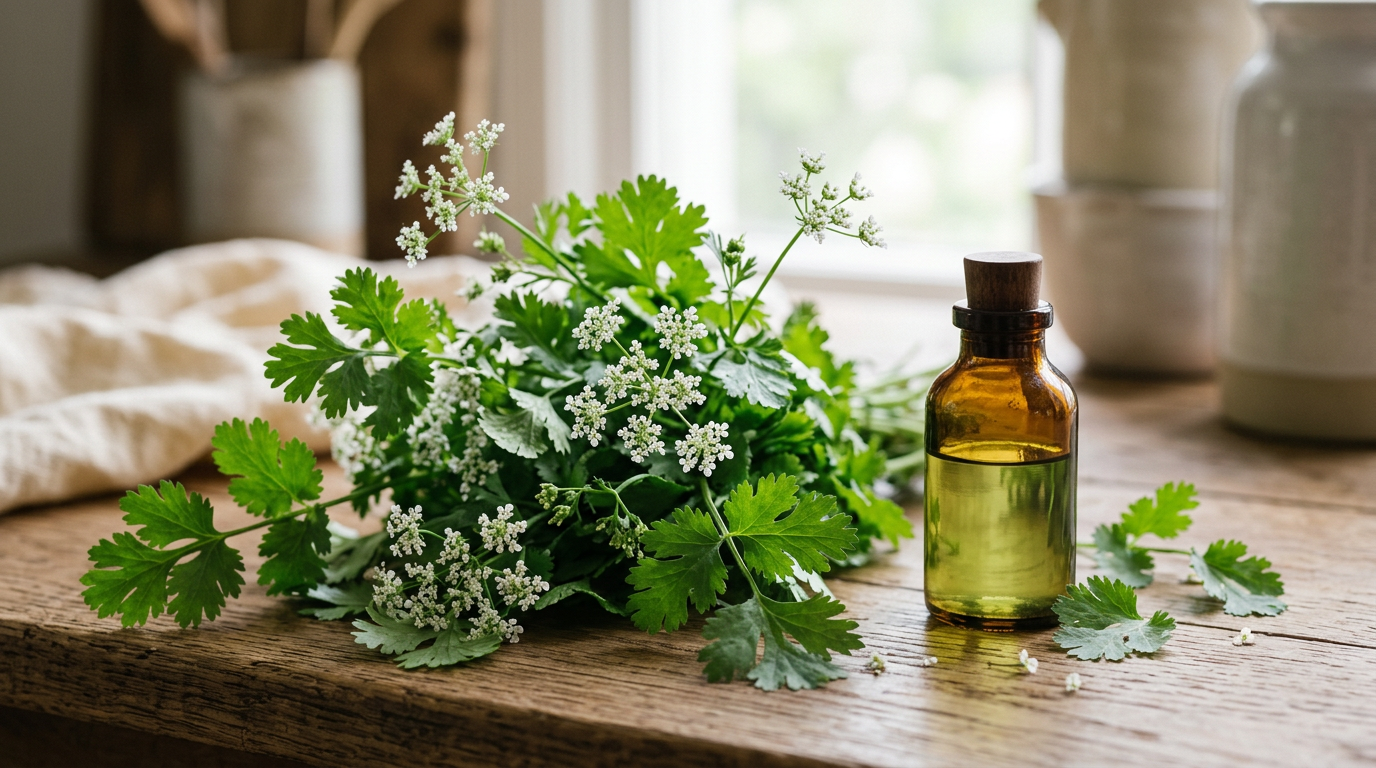
Inside the Bottle: The Aldehydes Behind Cilantro Essential Oil's Scent
Crack open a bottle of cilantro essential oil and the first thing that hits you isn't floral, isn't woody, isn't sweet. It's green, sharp, almost soapy at the top, with something crushed-leaf and citrus-adjacent underneath. That signature comes down to chemistry. Cilantro essential oil, steam-distilled from the fresh leaves and stems of Coriandrum sativum, carries a chemical fingerprint dominated by a class of compounds called aldehydes, and understanding that fingerprint explains almost everything about how the oil smells, how it ages, and how it should be handled.
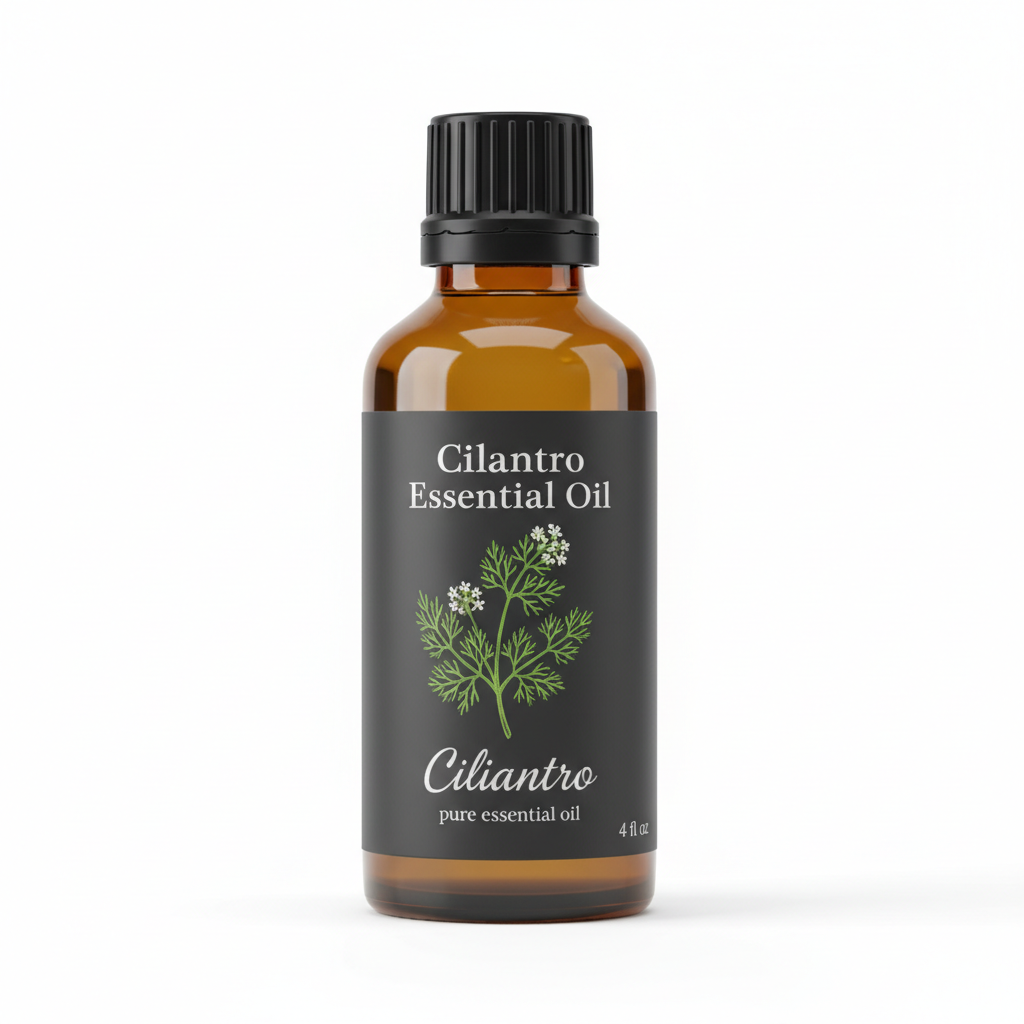
Cilantro Essential Oil
Our own Cilantro Essential Oil, in sizes from 0.5 oz to bulk.
From $11.99
Shop Now →This piece is a deep dive into cilantro essential oil chemical composition: what's actually in the bottle, what current research has observed about it, how to think about safety and dilution, and what separates a well-sourced batch from a mediocre one. None of what follows is medical advice, and none of it should be read as a claim that this oil is a substitute for guidance from a qualified healthcare provider.
What Is Cilantro Essential Oil, Chemically Speaking?
It helps to clear up a naming confusion first, because it matters for composition. The same plant, Coriandrum sativum, produces two very different essential oils depending on which part is distilled. Oil pressed from the dried seeds is usually labeled coriander seed oil, and it's linalool-dominant, soft, and slightly spicy. Oil distilled from the fresh leaves and stems is what's usually sold as cilantro essential oil (sometimes labeled coriander leaf oil), and it belongs to a different chemical family entirely: aldehyde-dominant, sharp, and unmistakably green.
That leaf-versus-seed split is the single most important thing to know before reading any GC-MS report. A supplier selling "coriander oil" without specifying plant part could be shipping either profile, and they smell nothing alike. If green, herbaceous, slightly pungent is what you're after, you want the leaf-derived oil.
The Aldehyde Profile: What Makes Cilantro Oil Smell Green
Aldehydes are a class of organic compounds recognized by a distinctive carbon-oxygen-hydrogen arrangement (a carbonyl group bonded to a hydrogen). In essential oil chemistry, aldehydes are frequently responsible for sharp, fresh, sometimes fatty or citrus-like top notes, and cilantro leaf oil is one of the more aldehyde-heavy oils in general aromatic use.
Gas chromatography-mass spectrometry (GC-MS) analyses of cilantro leaf essential oil, published across a range of agricultural and food-chemistry journals, consistently identify a cluster of long-chain aliphatic aldehydes as the majority constituents. The exact percentages shift by growing region, harvest timing, and distillation method, but the general pattern holds across most published profiles:
| Compound | Typical Range | Aromatic Contribution |
|---|---|---|
| (E)-2-Decenal | ~15-30% | Green, fatty, cilantro-characteristic |
| Decanal | ~10-20% | Waxy, citrus-adjacent, slightly soapy |
| Dodecanal | ~5-15% | Rounder, softer green note |
| (E)-2-Dodecenal | ~3-10% | Sharp, vegetal edge |
| Undecanal / Tetradecanal | trace to ~5% combined | Waxy background depth |
| Linalool | trace to ~5% | Soft floral undertone |
Taken together, these aldehydes in cilantro oil can make up well over half the total oil by volume in a well-preserved batch. That's unusually concentrated for a single chemical family, and it's the reason cilantro leaf oil smells so distinct from almost anything else in a botanical lineup. Most florals lean on esters or terpene alcohols; cilantro leans almost entirely on aldehydes.
Beyond Aldehydes: The Supporting Cast
The aldehydes carry the top note, but a handful of secondary constituents round out cilantro essential oil constituents as a whole. Small amounts of monoterpenes such as alpha-pinene and beta-pinene contribute a faint woody or resinous undertone. Trace linalool softens the sharpness slightly. Some batches also show measurable amounts of 1-decanol and other fatty alcohols, which tend to mellow with time as the oil oxidizes.
That oxidation point is worth pausing on. Aldehydes are chemically reactive; exposed to air, light, and heat over months, they slowly convert into carboxylic acids. A bottle of cilantro oil that smelled bright and green on the day it was distilled can smell duller, slightly rancid, or more acidic a year later if it wasn't stored cold, dark, and tightly capped. This isn't a flaw unique to cilantro oil, but because its scent profile depends so heavily on one reactive chemical family, the shift is more noticeable here than in oils built around more stable terpenes.
Why It Smells the Way It Smells to You Specifically
One of the more interesting threads of research into what makes cilantro oil smell green isn't about the plant at all. It's about the person smelling it. Cilantro (and by extension cilantro leaf oil) is famous for a polarized reaction: some people describe it as bright and citrusy, others describe the same compound profile as soapy or unpleasant. Genetic research published in the early 2010s pointed to variation near an olfactory receptor gene, often referenced as OR6A2, as a contributing factor in how strongly people perceive the aldehyde notes, particularly the soapy character associated with compounds like decanal and (E)-2-decenal.
This research doesn't settle the question entirely (taste and smell perception is layered, and cultural exposure plays a role too), but it does help explain why the exact same GC-MS profile can read as "fresh and green" to one nose and "like dish soap" to another. If you're formulating a blend for a wider audience, it's worth sampling reactions before committing to a large batch, since this isn't a universally loved note the way something like lavender tends to be.
How Growing Conditions and Distillation Shift the Numbers
Published chemical composition studies on cilantro leaf oil rarely agree down to the decimal point, and that's expected rather than concerning. Aldehyde percentages have been observed to shift with:
- Growing region and climate. Comparative studies across different countries of origin show meaningfully different ratios of (E)-2-decenal to decanal, likely tied to soil, water availability, and temperature during the growing season.
- Harvest timing. Leaves harvested at different growth stages show different aldehyde concentrations; younger, more tender growth tends to skew the profile differently than more mature stems.
- Distillation method and duration. Because aldehydes are volatile and reactive, steam distillation time and temperature affect yield. Overly aggressive distillation can degrade the more delicate aldehyde fraction, while too short a run can under-extract it.
- Post-harvest handling. Time between harvest and distillation matters. Fresh-cut cilantro left to wilt before processing has been observed to yield a noticeably different, often duller, aromatic profile than material distilled promptly.
None of this means one batch is "wrong" and another "right." It means cilantro essential oil chemical composition is genuinely variable by nature, which is exactly why a batch-specific GC-MS report matters more for this oil than for some of the more chemically stable botanicals.
Research Observations: Reading the Literature Honestly
A fair amount of published research on cilantro leaf oil focuses on compositional profiling itself (identifying and quantifying constituents across different sourcing conditions), which is the material summarized above. A smaller body of laboratory research has looked at how isolated compounds from the oil behave in controlled lab settings, including some work on the aldehyde fraction's activity in petri-dish and cell-culture conditions.
It's worth being precise about what that kind of research does and doesn't tell us. Laboratory findings involving isolated compounds in a dish are a starting point for scientific curiosity, not evidence of what a diluted essential oil does when applied to skin or diffused into a room. Extrapolating lab-bench findings to real-world use is a common misstep in essential oil marketing, and it's one worth actively avoiding.
Where cilantro leaf oil research is genuinely strong is on the compositional side: what's in it, how much, and how that varies by origin. Where it's thinner and far more preliminary is on anything resembling human outcomes. If a product description cites a study, it's reasonable to ask whether that study tested the actual essential oil on humans, or an isolated compound in a lab dish, because those are very different kinds of evidence.
Safety Profile and Considerations
Because cilantro leaf oil is aldehyde-heavy, it sits in a category of essential oils that tends to be more likely to cause skin sensitivity than gentler, alcohol-dominant oils. That's a general pattern across aldehyde-rich oils as a class, not a claim specific to any outcome, and it's a good reason to be conservative with dilution.
- Dilution. For topical, cosmetic use, a common starting point among formulators is 0.5% to 1% in a carrier oil for leave-on applications, occasionally slightly higher for rinse-off products like soap. Undiluted (neat) application directly to skin is not recommended.
- Patch test first. Apply a small diluted amount to the inner forearm and wait 24 to 48 hours before wider use. Discontinue if you notice redness, itching, or irritation at the site.
- Keep away from eyes and mucous membranes. Aldehyde-rich oils can be more likely to cause stinging or discomfort if they contact sensitive tissue.
- Pregnancy, nursing, and children. Essential oil use during pregnancy or with young children should only happen after a conversation with a qualified healthcare provider, since dilution needs and individual sensitivities vary widely.
- Existing skin sensitivity. People with generally reactive or sensitive skin may want to start at the lower end of any dilution range, or avoid leave-on applications altogether in favor of diffusion.
- Pets. Diffusing around cats and dogs warrants caution and ideally a conversation with a veterinarian, since animal sensitivity to essential oil compounds differs from human sensitivity.
- Storage. Keep the bottle capped tightly, away from light and heat, ideally refrigerated after opening, both to preserve the aroma and to limit oxidation byproducts that can be more irritating than the fresh oil.
If you take any prescribed medications or manage an ongoing health condition, check with your healthcare provider before adding cilantro essential oil to your routine, and never substitute an essential oil for guidance or care from a qualified professional.
Sourcing and Quality Indicators
Given how much cilantro essential oil chemical composition varies batch to batch, sourcing transparency matters more here than with many other oils. A few concrete things worth checking before buying:
1. A batch-specific GC-MS report
A reputable supplier should be able to provide a Certificate of Analysis showing the actual gas chromatography-mass spectrometry results for the specific batch or lot you're purchasing, not a generic "typical profile" pulled from a reference database. Look for the aldehyde fraction (decanal, (E)-2-decenal, dodecanal, and related compounds) clearly listed and totaling a substantial share of the composition. A report with unusually low aldehyde content, or one that's suspiciously heavy in linalool, may indicate the product is actually coriander seed oil mislabeled, or a diluted or adulterated batch.
2. Clear plant-part labeling
The listing should specify "leaf" (or "herb") rather than leaving it ambiguous, and ideally state "steam distilled" as the extraction method. Ambiguous labeling is the single most common source of buyer confusion in this category.
3. Botanical name and origin
Look for the full Latin binomial, Coriandrum sativum, along with a stated country or region of origin. Given how much growing conditions shift the aldehyde ratios discussed above, origin transparency is a reasonable proxy for a supplier that takes consistency seriously.
4. Color and viscosity as rough field checks
Fresh cilantro leaf oil tends to run pale yellow to nearly colorless and thin in viscosity. A batch that's notably darker or thicker than expected may be older stock further along in the oxidation process described earlier, even if it's technically still within a printed expiration window.
5. Packaging that protects against light and air
Amber or cobalt glass, a tight-fitting cap, and ideally a reducer or dropper insert that limits air exposure each time the bottle is opened. Given how reactive the aldehyde fraction is, packaging quality has a real, measurable effect on how the oil smells six months from now.
How to Read a Cilantro Essential Oil Chemical Composition Report
If you're handed a GC-MS printout for the first time, it can look like a wall of numbers. A practical way to read one for cilantro leaf oil:
- Scan for the aldehyde names listed in the table earlier in this article. Together, they should represent a clear majority of the identified peaks, commonly somewhere in the range of 50 to 70% combined, though exact figures vary by batch.
- Check that (E)-2-decenal and decanal specifically appear, since these two are generally the most consistently reported major constituents across published profiles of leaf-derived oil.
- Note the linalool percentage. A small trace amount is consistent with leaf oil. A high linalool percentage (double digits) suggests the sample may actually be seed-derived coriander oil rather than cilantro leaf oil, regardless of how it's labeled.
- Look at the report date relative to the distillation date. A GC-MS run close to distillation tells you about the fresh oil; one run much later partly reflects however much oxidative drift has already happened in storage.
None of this requires a chemistry background to use practically. It's mostly pattern recognition once you know which handful of compound names to look for.
The Takeaway on Composition
Cilantro essential oil's identity is really the identity of a handful of aldehydes: (E)-2-decenal, decanal, dodecanal, and their close relatives, showing up in high enough concentration to define almost the entire scent experience. That's unusual among essential oils, and it explains both the oil's most-loved trait (that unmistakable green, fresh-cut brightness) and its most polarizing one (the soapy note some noses pick up more strongly than others). Understanding the chemistry doesn't just satisfy curiosity. It's genuinely useful: it tells you what to look for on a Certificate of Analysis, why storage conditions matter more here than with sturdier oils, and why a little caution with dilution is a reasonable default rather than an overreaction.