
Cilantro Oil Skin Sensitivity: Irritation vs Allergy Explained
When skin reacts to an essential oil, two quite different things can be happening, and they call for different responses. One is irritation: a direct, dose-driven insult that tends to show up fast and fade. The other is sensitization: the immune system learning to recognize a molecule, after which even small amounts can provoke a rash. Cilantro leaf oil is rich in aldehydes, a chemical family with a documented history in contact allergy, so it is worth knowing which is which before you decide how to use it.
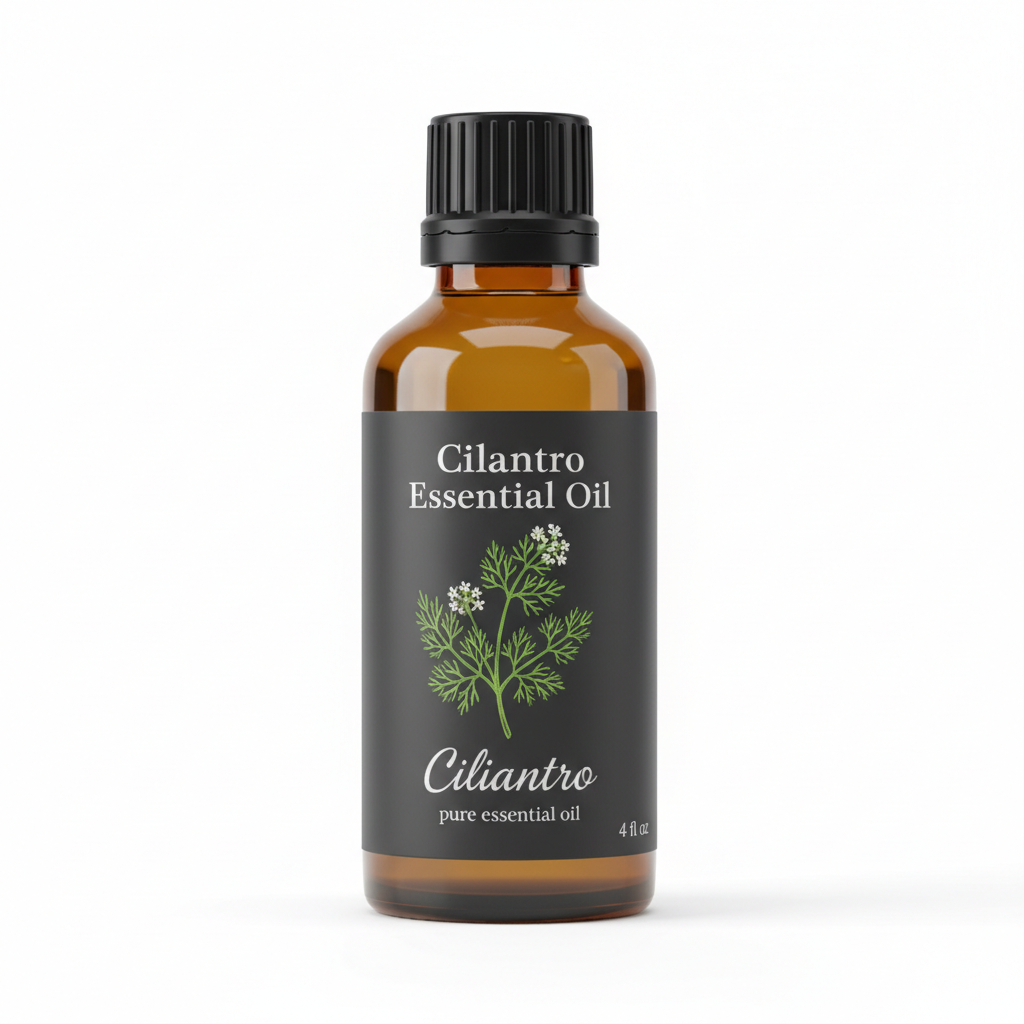
Cilantro Essential Oil
Our own Cilantro Essential Oil, in sizes from 0.5 oz to bulk.
From $13.99
Shop Now →Two clocks, two mechanisms
The Tisserand Institute's skin irritation and allergy page describes irritant contact dermatitis as "the least problematic type of skin reaction", usually resolving within a few hours, while allergic reactions can last days or weeks. It also makes a point of vocabulary: "sensitization" is often misused as if it were a kind of reaction, when it names the priming of the immune system that makes a later allergic reaction possible. That distinction matters in practice. Nobody feels themselves becoming sensitized. The first sign is usually the first reaction, on a later use, in a spot that looked fine before.
The Research Institute for Fragrance Materials (RIFM) puts the second half plainly: sensitization can develop "over time and after repeated exposure", and once someone is sensitized "they may continue to experience an allergic reaction to it, sometimes at lower levels of exposure." Keep that second clause in mind; it explains why dilution helps less than people hope.
Why aldehydes are on the watch list
A fragrance molecule becomes an allergen by binding to a skin protein. Uter's 2017 review of fragrance contact allergy calls such molecules haptens: "most fragrances are haptens, which, after binding to proteins, become allergens." It also lists cinnamal and citral, both aldehydes, among established human allergens with high numbers of reported cases, and it records that an aldehyde fragrance ingredient, HICC, reached almost 20% sensitization prevalence in central Europe in 2011, after which the author recommended abandoning its use. These are other aldehydes, not cilantro's; they show the family is not hypothetical, not that our oil behaves the same way.
The chemistry is more specific. Patlewicz and colleagues (Contact Dermatitis, 2002), a group that included Unilever scientists, examined mouse local lymph node assay data for two sets of fragrance aldehydes. Saturated aliphatic aldehydes appeared to react with proteins by forming Schiff bases; alpha,beta-unsaturated aldehydes by Michael addition. They reported that simple reactivity models might predict potency, and said an expanded set was being tested, so this was an early-stage finding, not a ranking of oils. Decanal, the aldehyde our batches' laboratory analysis puts at the head of the leaf profile (see inside the bottle), is a saturated aliphatic aldehyde. 2-Decenal is its unsaturated relative.
RIFM has published a safety assessment for each: decanal (Api et al., Food and Chemical Toxicology, 2025) and 2-decenal (Api et al., 2022). Neither record has a public abstract, and the full documents were blocked to us, so we cannot report what they concluded about sensitization and we will not guess at a threshold. Two caveats apply to the whole line of work: RIFM staff are among the authors and, per the conflict-of-interest statement on the decanal paper, its expert panel receives an honorarium from RIFM, though the panel includes academic dermatologists. These assessments concern single fragrance ingredients, not a whole distilled oil with dozens of constituents.
Where regulators set limits, and what that tells you
RIFM says its quantitative risk assessment produces a No Expected Sensitization Induction Level, the amount someone can apply to skin without sensitization being expected, and that the International Fragrance Association uses the resulting figures for its Standards, which "may ban, limit, or set criteria for using certain ingredients." The point for a home user: these limits are set per ingredient and per product type, for products made by manufacturers who control how much goes in. An essential oil you dilute yourself has no such limiter between the bottle and your skin. We did not verify whether European fragrance-allergen labelling rules name any cilantro constituent, so we make no claim either way.
Oxidation: the variable that changes with time
The oxidation evidence is for terpenes. Uter reports that oxidized terpenes are "markedly more potential allergens than the nonoxidized raw substances", with hydroperoxides the commonest reaction product. A Dutch clinic study (Dittmar and Schuttelaar, 2019) patch tested 821 consecutive patients and found 9.4% reacted to limonene hydroperoxides and 11.7% to linalool hydroperoxides. Uter adds that aldehydes can themselves appear as secondary products of oxidation and add to sensitizing potential. For cilantro oil the leap is ours: an aldehyde-rich oil is already made of the molecule class involved, so its oxidation behaviour deserves respect, but we found no study that measured sensitization to aged cilantro oil. Reasoning from that, the practical rule is storage discipline: our shop page gives a typical 1 to 2 year shelf life unopened, tightly capped, away from heat and sunlight. Our storage guide covers it, and an old opened bottle is a poor candidate for skin.
What dilution does and does not do
Tisserand's page says "the more dilute an essential oil is, the lower the risk." That is the dose logic for irritation, and for the chance of becoming sensitized in the first place. It does not reverse sensitization once it exists, for the reason RIFM gives: a sensitized person can react at lower levels. Worked through, a person sensitized to an aldehyde in the oil gains less from dropping from 2% to 0.5% than a person who is not yet sensitized. Our shop range is 0.5% to 2% (roughly 3 to 12 drops per ounce); the Tisserand figure for its highest-risk oils is a dermal maximum of 1.5% or less, and we could not confirm which class leaf oil belongs in, so our reading is to start at 0.5% and stay at or below 1.5%. The dilution guide has the chart.
Cumulative exposure is the other half. Tisserand advises against using one oil or blend above 5% for long periods, but a low concentration used daily on the same patch for months is exactly the "repeated exposure" in the RIFM quote. We have no data on how many exposures matter for cilantro oil. A reasoned habit: rotate the area, avoid daily leave-on use of one oil, and run the patch test before starting rather than after a problem.
When to see a dermatologist
Go if a rash lasts beyond a few days, spreads past where you applied it, blisters, or returns each time you use the oil. DermNet notes patch testing is the tool for allergic contact dermatitis and is not useful for irritant dermatitis, so the visit is how you learn which one you had. People who have already reacted to a fragrance product should ask before using any aldehyde-rich oil. The wider safety guide lists the other groups to ask first.
Limits
We sell one oil, have no customer reaction data and no clinician on staff, and the cilantro-specific evidence on skin sensitization is, as far as we could find, absent. What is above is the general science of fragrance aldehydes, applied by reasoning. It is not a prediction that you will react, and "natural" is not a reason to expect you will not.
The risk is manageable and dose-dependent, and it is also not zero. Dilute first, patch test, store the bottle properly, and take a rash that lingers to a dermatologist as information.
Cilantro Essential Oil
Cilantro Essential Oil from our own shop, in sizes from 0.5 oz to bulk.
From $13.99
Shop Now →Sources & Further Reading
- Tisserand Institute, undated (read 2026). Skin irritation and allergy. tisserandinstitute.org/safety/irritation-allergic-reactions
- RIFM, undated (read 2026). What is skin sensitization and why study it? rifm.org
- Uter W, 2017. Contact allergy to fragrances: current clinical and regulatory trends. Allergologie Select. pmc.ncbi.nlm.nih.gov/articles/PMC6040011
- Patlewicz GY et al., 2002. Structure-activity relationships for selected fragrance allergens. pubmed.ncbi.nlm.nih.gov/12492521
- Api AM et al., 2025. RIFM fragrance ingredient safety assessment, decanal. pubmed.ncbi.nlm.nih.gov/39694132
- Api AM et al., 2022. RIFM fragrance ingredient safety assessment, 2-decenal. pubmed.ncbi.nlm.nih.gov/35341827
- Dittmar D, Schuttelaar MLA, 2019. Contact sensitization to hydroperoxides of limonene and linalool. pubmed.ncbi.nlm.nih.gov/30378131
- DermNet, undated (read 2026). Patch tests. dermnetnz.org/topics/patch-tests