Can You Ingest Cilantro Essential Oil? What GRAS Omits
No. Do not swallow the cilantro essential oil in a bottle sold for aroma, in water, on a sugar cube or in a capsule. Our leaf oil is sold undiluted, our shop copy says not for internal use, and nothing on our pages labels it for flavor. The rest of this page explains why the "it's on the FDA's GRAS list" argument does not change that, and what to do if a swallow has already happened.
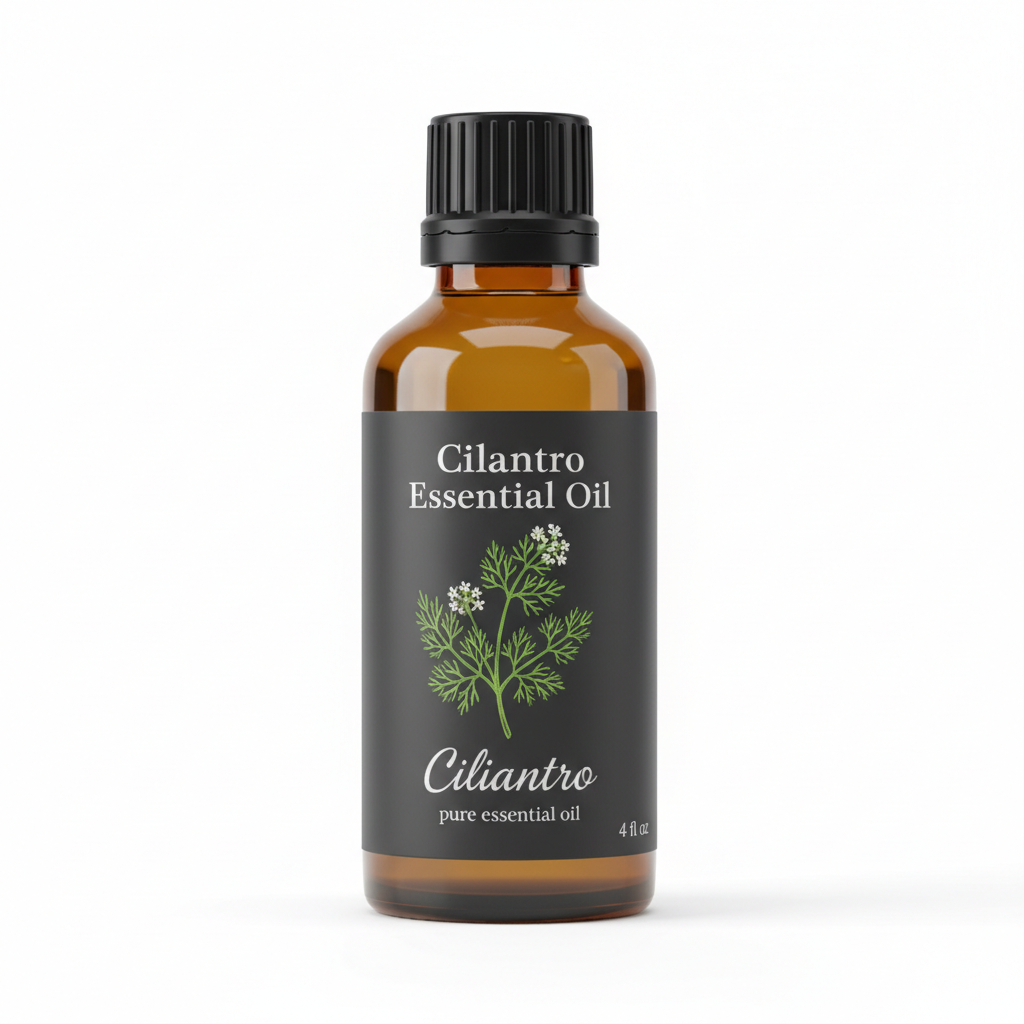
Cilantro Essential Oil
Our own Cilantro Essential Oil, in sizes from 0.5 oz to bulk.
From $13.99
Shop Now →Is coriander not on the FDA's GRAS list?
Coriander is on it, and the entry is narrower than the internet makes it sound. I read the current 21 CFR 182.20 text: the section is headed "Essential oils, oleoresins (solvent-free), and natural extractives (including distillates)", and it lists those substances "that are generally recognized as safe for their intended use". The table has two columns, common name and botanical name. The coriander row reads "Coriander" and "Coriandrum sativum L.". Section 182.10, the spices list, carries the same two-column entry for the plant itself.
Three things are missing from that row, and each one matters to a buyer:
- No plant part. The row names the species, not leaf or seed. Seed oil and leaf oil are chemically different oils (one of our sibling posts, coriander seed vs cilantro leaf oil, covers the split).
- No product. A regulation listing a substance does not certify any particular bottle. It says nothing about who distilled it, what it was cut with, or what the label may claim.
- No dose. The phrase that does the work is "for their intended use". FDA's own GRAS page frames the exemption as expert consensus that a substance is adequately shown to be safe "under the conditions of its intended use". The intended use in a flavor context is a trace amount inside a food, made and labelled as a flavoring.
An aroma bottle with a dropper is a different intended use. Our oil is an essential oil for diffusing and diluted skin use. Reasoning from the FDA wording, the listing supports "a flavoring made for food, used as labelled", not "any coriander-derived oil, swallowed in any amount".
How much plant is in one drop?
The concentration is the practical problem, and it can be put in numbers. A drop is roughly 0.05 mL: the midwifery dilution table in NHS Lanarkshire's 2025 aromatherapy guideline counts 1 drop for a 1% blend in 5 mL of carrier, which is 0.05 mL, or 20 drops per mL. (Our shop page's 3 to 12 drops per ounce for 0.5% to 2% works out the same way.)
For the plant side, a 2022 paper, Abbas et al., Dose Response, extracted oil from coriander leaves in Pakistan and reported a hydro-distillation yield of 0.12%. The abstract does not say whether that is by weight or volume, or whether it is fresh or dried leaf, and it is a different method from steam distillation of fresh tops, so treat the next step as a rough order of magnitude. Reasoning from 0.12 mL per 100 g, one 0.05 mL drop is the oil of roughly 40 g of leaf. A single drop is therefore the volatile fraction of a pile of herb nobody would eat in one bite, with the water, fibre and everything that buffers a salad removed.
That same abstract is also a warning about composition. The leaf oil it studied was linalool-dominant (61.78% by hydro-distillation), while a 2026 scoping review of coriander essential oil on Candida says decanal and related compounds predominate in leaf extracts. Leaf oils from different sources and harvest stages are not one standard material, which is one reason we point buyers to the Certificate of Analysis published on our shop page rather than to a generic profile.
What happens to the mouth and stomach?
Oil and water do not mix. A drop stirred into a glass of water floats as droplets, and the first thing to touch the mouth and throat is still concentrated oil. The Tisserand Institute's safety guidelines say not to take essential oils undiluted or mixed in water because of the risk of mouth and stomach irritation. The same page does allow oral use when a practitioner qualified to advise it recommends it, and I am not going to repeat the dose it gives, because that is a judgment for a licensed professional who knows you.
That is a real disagreement between sources, and it should be stated plainly. The Tisserand Institute treats oral use as something a trained practitioner may direct. Nationwide Children's Hospital says essential oils should never be taken by mouth, with the exception of a trained specialist's advice, and says not to put them in food or drinks. The NHS Lanarkshire midwifery guideline lists "Do not ingest essential oils" under essential oil safety. All three agree on the part that applies to a shopper: no self-directed swallowing.
There is also no study to lean on for cilantro leaf oil. I found no human trial or case series of swallowed coriander leaf essential oil, so any dose a website offers for it is invented. What exists is poison-center material on other oils. The Tennessee Poison Center's 2016 summary notes that essential oils are thin hydrocarbons and that "aspiration of as little as 2mL may produce chemical pneumonitis", meaning oil that goes down the wrong way can reach the lungs. Those figures describe eucalyptus, camphor, clove and others, not cilantro, so they show the mechanism, not a threshold for our oil.
What if a child, or an adult, has already swallowed some?
Call Poison Control in the US at 1-800-222-1222. Poison Control's essential oils page says to contact them right away if someone swallows an essential oil, that help is free, confidential and available 24 hours a day, and that an allergic reaction with difficulty breathing is a medical emergency. Have the bottle with you, and know the approximate amount and the person's age. Do not wait for symptoms.
Children are the group that ends up on those calls. In a 2020 retrospective study of 4,412 essential oil exposure calls to the NSW Poisons Information Centre between July 2014 and June 2018, 63% involved children under 15, and 365 cases (8.3%) were referred to hospital. The authors noted severe toxicity can occur with as little as 5 mL in a child and called for flow restrictors and child-resistant closures. Our sibling post on cilantro essential oil and kids covers storage in more detail.
Where does it leave a person who wants cilantro flavor?
Use cilantro. Fresh leaf, or a culinary product made and labelled for food by a maker who sells it that way, is the route. The live post Cilantro Oil for Cooking: Which Bottle? covers infused kitchen oils and how they differ from ours. We sell one product, the leaf essential oil, and no flavorings, extracts or food oils.
If the question behind the search is digestive or medical, that belongs with a physician or pharmacist, and the claims side of it is in essential oil cosmetic vs drug claims. We sell an aroma oil and make no medical claims for it.
Cilantro Essential Oil
Cilantro Essential Oil from our own shop, in sizes from 0.5 oz to bulk.
From $13.99
Shop Now →Sources & Further Reading
- US Government, current. 21 CFR 182.20, Essential oils, oleoresins (solvent-free), and natural extractives. ecfr.gov/21 CFR 182.20
- US Government, current. 21 CFR 182.10, Spices and other natural seasonings and flavorings. ecfr.gov/21 CFR 182.10
- FDA. Generally Recognized as Safe (GRAS). fda.gov/GRAS
- Abbas et al., 2022. Supercritical fluid and hydro-distilled coriander leaves essential oil. PubMed 36387777
- 2026. Coriandrum sativum essential oil on Candida in oral infection: scoping review. PubMed 42214910
- NHS Lanarkshire, 2025. Guideline: Aromatherapy. rightdecisions.scot.nhs.uk
- Tisserand Institute. Safety Guidelines. tisserandinstitute.org/safety-guidelines
- Nationwide Children's Hospital. Aromatherapy: Essential Oils. nationwidechildrens.org
- Tennessee Poison Center, 2016. What are the commonly used but potentially toxic essential oils? vumc.org/poison-control
- Poison Control. Essential oils: Poisonous when misused. poison.org/articles/essential-oils
- Lee, Harnett and Cairns, 2020. Essential oil exposures in Australia, Med J Aust. mja.com.au