Cilantro Oil and Bacteria: What Lab Studies Show
Cilantro leaf oil has a good lab reputation. In one well-known study it was singled out as especially effective against Listeria in a test tube, and that sentence travels a long way once it hits the internet. Here is what such studies measure, and why the number belongs to the plate it was measured on.
Cilantro Essential Oil
Our own Cilantro Essential Oil, in sizes from 0.5 oz to bulk.
From $13.99
Shop Now →The leaf oil headline
The study behind most of the buzz is Delaquis et al., 2002. The team distilled dill, coriander (seeds), cilantro (the leaves of immature plants) and eucalyptus oils, split each into fractions, ran them through GC-MS and measured the lowest concentration that stopped bacteria and one yeast from growing. Cilantro oil was particularly effective against Listeria monocytogenes, which the authors tied to its long-chain alcohols and aldehydes, the same family that gives our oil its aroma.
Two further details from the abstract are the more interesting part. Fractions often outperformed the crude oils, and mixing fractions sometimes added up, sometimes multiplied and sometimes cancelled out depending on the organism. An essential oil is not one active ingredient; it is a crowd of molecules, and the crowd behaves differently from any single member.
It is worth saying that we find this kind of research fascinating. A tiny test well, a drop of oil and a patient scientist can tell us a lot about how aroma molecules behave. The skill is in reading it fairly.
Most of the rest is seed oil
Much of the "coriander oil fights bacteria" literature uses seed oil, which is built on linalool rather than the aldehydes of leaf oil. A seed oil study from Iran and Iraq compared nine populations against Staph aureus, E. coli and Pseudomonas, and reported growth inhibition only at 100% oil concentration (Talebi et al., 2024). A 2025 systematic review that began with 1,374 records and kept 7 studies on coriander oil and foodborne bacteria concluded that the oil showed activity against both Gram-positive and Gram-negative bacteria of food origin (Farias et al., 2025). Those are the facts, and they are all about dishes and broths.
Why plate numbers stay on the plate
A lab plate is a tidy place: a clean liquid, a known number of microbes, a fixed temperature, a sealed well. Real surfaces and real skin have fats, proteins, dirt and short contact times, and the air in a room holds oil at very low concentration. A classic review of essential oils in food puts the gap in numbers. Lab MICs ran from 0.2 to 10 microlitres per millilitre, while foods needed around 0.5 to 20 microlitres per gram, and the author's conclusion was that a higher concentration is needed in foods to get the same effect (Burt, 2004). That review covers essential oils in general, not coriander, but it shows the pattern: results travel badly from the dish to the real world.
A sensible way to read the next headline
The next time you see a headline about an oil that fights germs, slow down and look for a few simple things. Is the study in a dish, a food or a person? Which plant part was used? How much oil, and for how long? A headline rarely answers these, but the abstract usually does, and it takes only a couple of minutes to read. You will find that most of the excitement fades when the details come into focus, and what is left is more honest and more useful.
That habit is worth more than any single result. It will serve you with every bottle you ever buy.
What we say about our oil
We sell cilantro essential oil for its fresh, green, citrus-edged aroma, for diffusing, for diluted skin use at 0.5% to 2% in a carrier with a patch test first, and for craft projects. We make no germ-control or cleaning claim for it, and nothing in these studies gives us one. If a seller quotes a paper to back a hygiene claim, three questions sort it out quickly: which part of the plant, which organism and what concentration, and was it done in a dish or on a surface?
For a wound, a skin problem or an infection, see a physician or pharmacist and not an essential oil. For food safety, follow USDA and FDA handling guidance; our food preservation post explains why the plate numbers do not carry over to a kitchen.
Why we enjoy this kind of reading
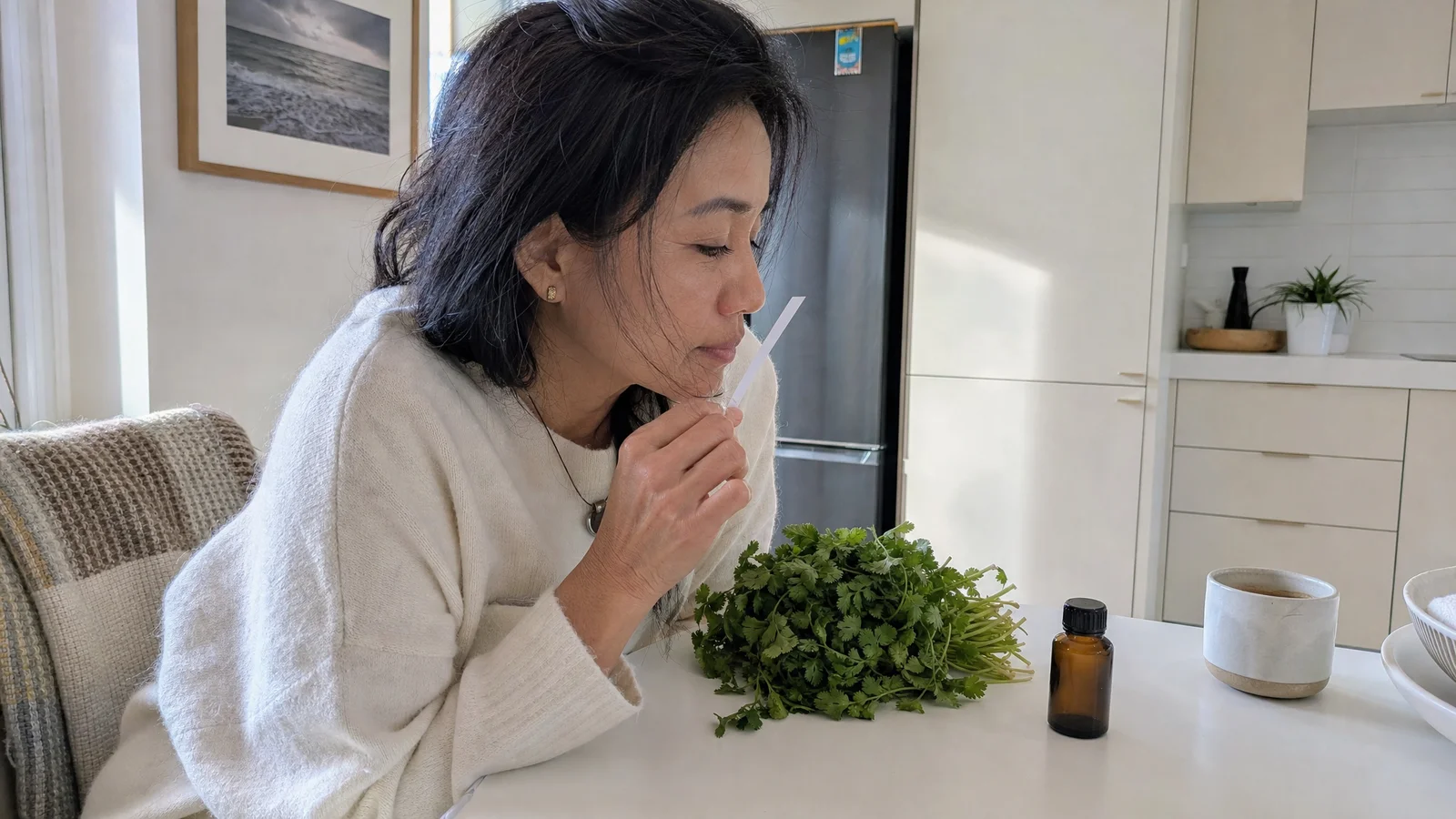
Looking at studies like these changes how you smell a bottle. The same long-chain molecules that researchers measure in a dish are the ones giving the oil its waxy, citrus-edged character in your diffuser. You do not need a lab to appreciate that. Sit with a strip of paper, notice the opening and the dry-down, and let the science stay in the background where it belongs.
Where to go from here
If the chemistry is what draws you in, our aldehyde chemistry article and the broader research roundup are a good next stop. Both are about what is actually in the bottle, which is a more satisfying question than any single MIC.
The nice thing about a lab result is that it makes a good story, and the better story is the chemistry behind it.
Cilantro Essential Oil
Cilantro Essential Oil from our own shop, in sizes from 0.5 oz to bulk.
From $13.99
Shop Now →Sources & Further Reading
- Delaquis et al., 2002. Antimicrobial activity of dill, cilantro, coriander and eucalyptus oil fractions
- Talebi et al., 2024. Coriander seed oils from Iran and Iraq
- Farias et al., 2025. Coriander oil against foodborne pathogens: systematic review
- Burt, 2004. Essential oils: antibacterial properties and potential applications in foods