Why Cilantro Oil Smells Different From the Leaf
Open a bottle of cilantro essential oil expecting a bowl of salsa and you will be surprised. The oil smells waxy, citrusy and a little fatty, and plenty of people say "soap" before they say "herb". There is a good chemical reason, and once you know it the oil makes a lot more sense.
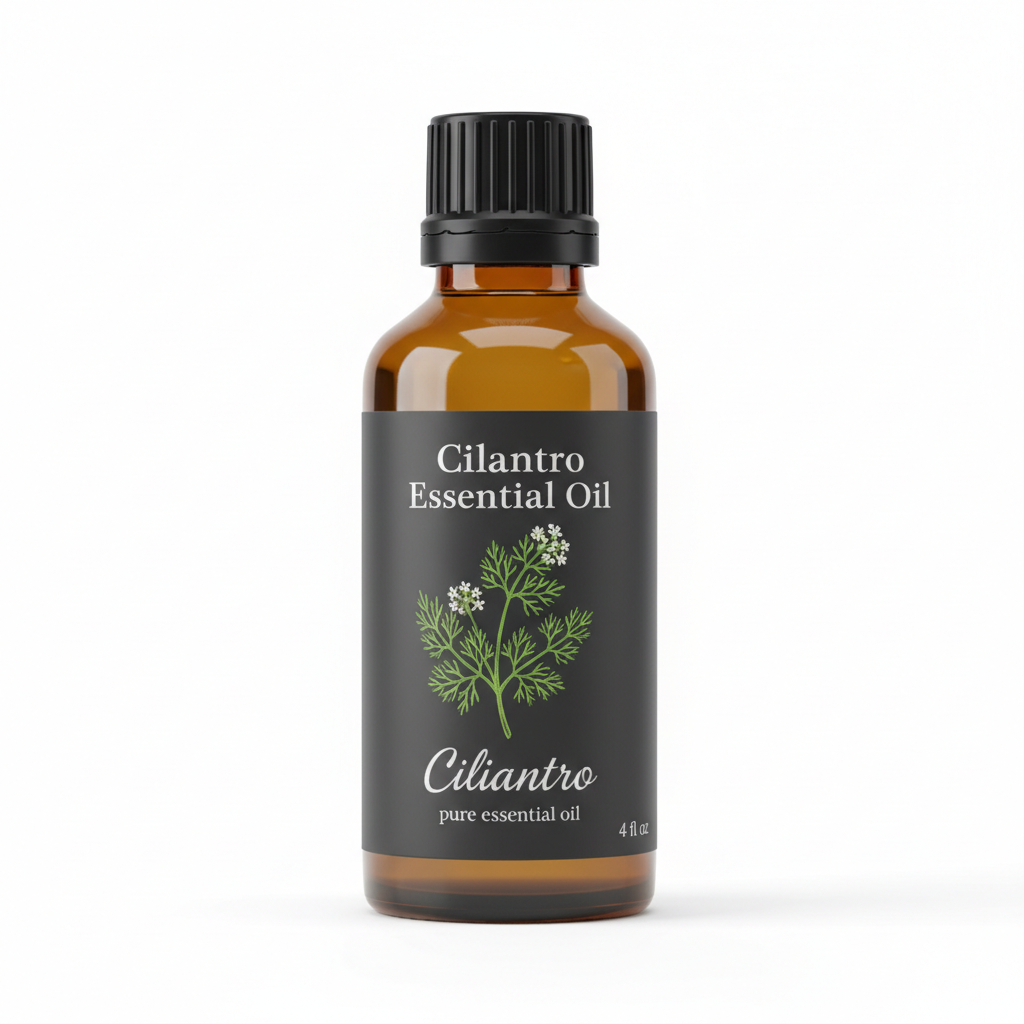
Cilantro Essential Oil
Our own Cilantro Essential Oil, in sizes from 0.5 oz to bulk.
From $13.99
Shop Now →The leaf and the bottle are two different materials
The sharp, cut-grass freshness of a chopped cilantro leaf comes from small, very volatile molecules. In a 2022 study of four coriander cultivars, the air above freshly chopped leaves was roughly two thirds (Z)-3-hexenyl acetate, a leaf-green ester, with a smaller share of (Z)-3-hexenol. When the same kind of leaves were steam-distilled, that ester was largely gone from the oil. What came through instead were long-chain aldehydes: decanal, (E)-2-decenal, (E)-2-dodecenal and (E)-2-tetradecenal, which together made up about 59% to 66% of each oil (Kumar et al., Front Plant Sci, 2022). The authors suggest some of those aldehydes may even form during distillation through heat and oxidation of fatty acids in the leaf. In other words, the oil is a product of the still as much as of the plant.
That is why we describe our oil as green, bright and herbaceous with a citrusy edge, and as a top note, rather than as "fresh cilantro in a bottle". We steam-distill from the leafy tops, and what you smell is the aldehyde side of the plant.
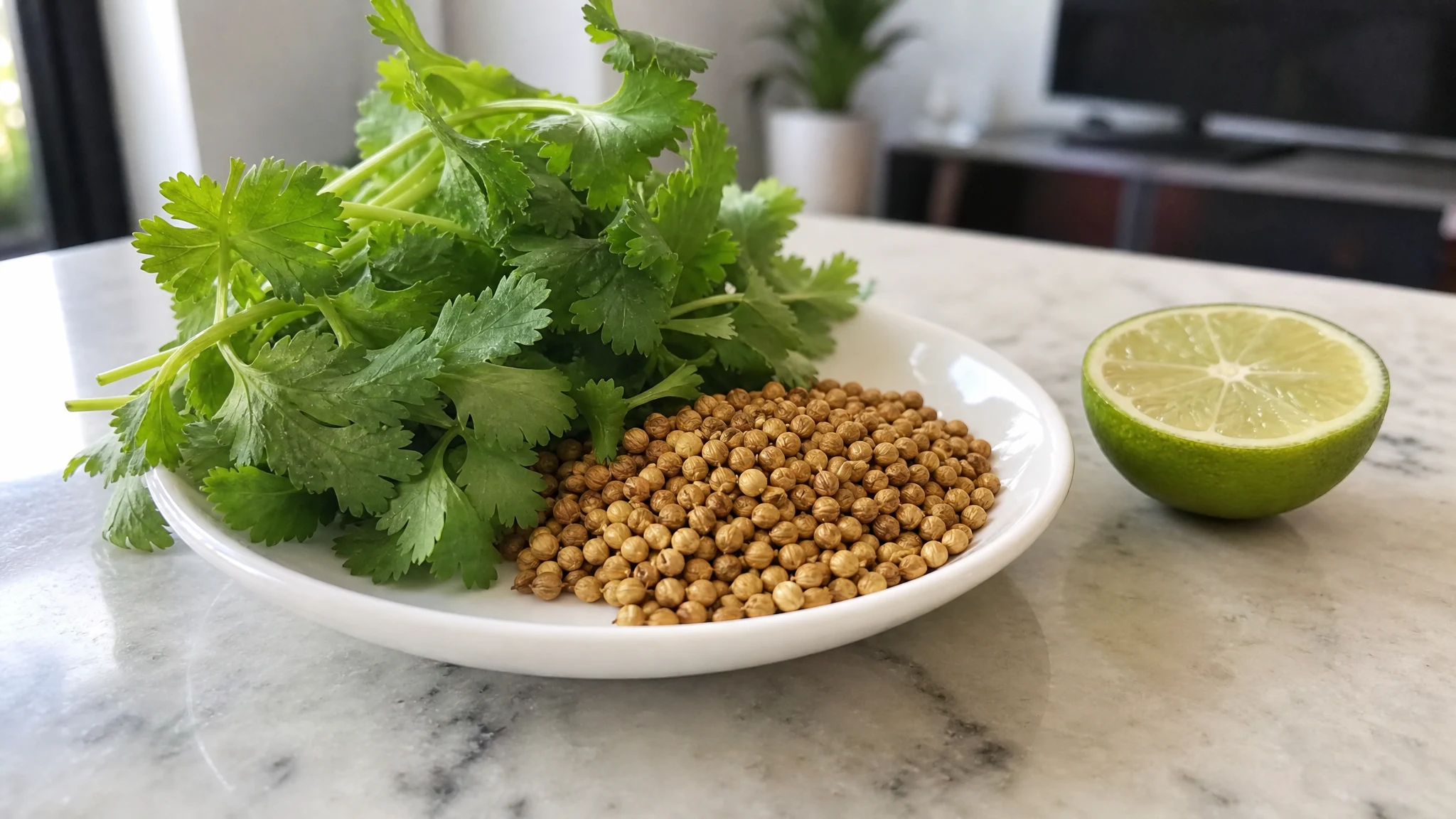
If you have ever cooked with cilantro and then smelled a bottle of the oil, you know the surprise. The herb on the cutting board is soft and green and almost sweet. The oil is waxy, citrusy and a little bold. Neither is wrong. They are two portraits of the same plant, painted with different tools.
What aldehydes smell like
Decanal is a good guide. Reference works collected on PubChem describe it as citrus, floral and fatty, and one flavor handbook calls it penetrating, sweet and waxy, with a floral character that develops on dilution (PubChem, decanal). That last detail is useful in practice. The same molecule can read harsh at full strength and much rounder when it is spread out in air or in a blend, which is why we suggest smelling the oil on a paper strip rather than straight from the bottle.
So where does the soapy note come from?
A 2026 structural study showed that a human olfactory receptor, OR6A2, picks out medium-chain aldehydes, and that it sits in a receptor cluster genetically associated with finding cilantro soapy (Wang et al., Cell, 2026). That is an association in receptor biology, not a test on essential oil, but it fits the picture neatly: an oil built from aldehydes is going to be more of a Rorschach test than the herb itself. If you already find cilantro soapy, try a strip before you commit to a bottle. We cover the people side in why cilantro smells like soap to some people.
Why no two cilantro oils read the same
If you go looking for "the" composition of cilantro oil you will find a spread. A survey of 48 coriander accessions grown at one site in Korea averaged about 45% (E)-2-decenal, with linalool anywhere from none to 61% depending on the accession (Kim and Kim, Molecules, 2026). A Saudi leaf oil was led by 1-decanol, and a Korean leaf-and-stem oil by cyclododecanol and tetradecanal (Foudah et al., 2021; Chung et al., 2012). Variety, growth stage, region and distillation all move the numbers.
The practical lesson is that a figure in a paper tells you about that paper's sample, not about your bottle. The Certificate of Analysis we publish for one batch lists relative density, refractive index and optical rotation. If you need GC-MS figures, such as aldehyde or linalool shares, for a perfume or a product you plan to make, ask us in writing through the contact page before ordering.
A little tasting session for your nose
The best way to understand all this is to smell it. Put a drop on a paper strip and wave it gently. Notice the first impression, which tends to be sharp, then the second, a minute later, when it turns waxier and softer. Try the strip again after a quarter of an hour. Smell a handful of fresh leaves in between and compare. You will see that the oil shares some of the leaf's character and leaves out the rest.
That gap is what makes the oil interesting in a blend. It does not try to be a salsa. It gives a bright, slightly fatty green top that sits above citrus and spice.
What this means for how you use it
Decanal and (E)-2-decenal both appear in chemical hazard notifications as skin and eye irritants, so we treat the oil with respect: we recommend diluting to 0.5% to 2% in a carrier oil, patch testing first and keeping it away from eyes. Our dilution guide does the arithmetic. Store the bottle capped, cool and shaded, and if you want to know how the smell reads next to other greens, green notes explained separates the leaf-alcohol green from the aldehydic kind.
Once you stop expecting the herb and start smelling the oil for what it is, a sharp, waxy, citrus-edged green, it is a surprisingly distinctive top note.
Cilantro Essential Oil
Cilantro Essential Oil from our own shop, in sizes from 0.5 oz to bulk.
From $13.99
Shop Now →Sources & Further Reading
- Kumar S. et al., 2022. Chemical composition of fresh leaves headspace aroma and essential oils of four coriander cultivars. Front Plant Sci. pubmed.ncbi.nlm.nih.gov/35251089
- Kim and Kim, 2026. Coriander accessions essential oil variation. Molecules 31(11):1950. pmc.ncbi.nlm.nih.gov/articles/PMC13257553
- Foudah A.I. et al., 2021. Cilantro leaf oil, Al-Kharj. Saudi J Biol Sci. pubmed.ncbi.nlm.nih.gov/34121885
- Chung I-M. et al., 2012. Coriander leaf oil composition. Immunopharmacol Immunotoxicol. pubmed.ncbi.nlm.nih.gov/21692682
- Wang et al., 2026. OR6A2 and medium-chain aldehydes. Cell 189(5):1451. pubmed.ncbi.nlm.nih.gov/41570822
- PubChem, decanal (CID 8175). pubchem.ncbi.nlm.nih.gov/compound/8175
- PubChem, (E)-2-decenal (CID 5283345). pubchem.ncbi.nlm.nih.gov/compound/5283345