Why Does Cilantro Taste Like Soap?
For a lot of people cilantro is the freshest thing on the plate. For a stubborn minority it tastes and smells like soap, and no amount of insisting that it is delicious will change that. The reason seems to start in the nose, with a family of receptors that notice a specific kind of molecule, and it matters if you are thinking about buying the oil.
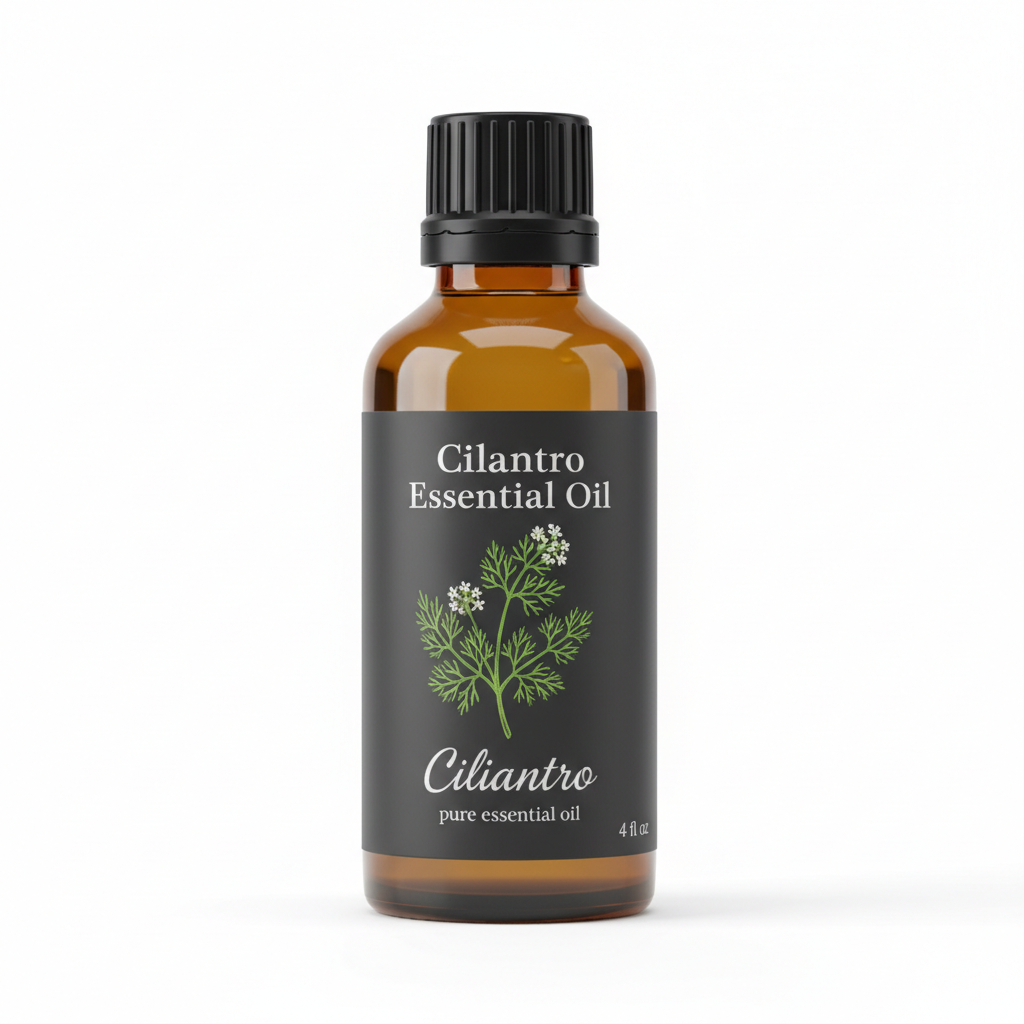
Cilantro Essential Oil
Our own Cilantro Essential Oil, in sizes from 0.5 oz to bulk.
From $13.99
Shop Now →What science has pinned down
A 2026 paper in Cell by Wang and colleagues solved structures of an engineered version of the human receptor OR6A2 bound to aldehydes, and reported that it selectively senses medium-chain aldehydes. The abstract adds that OR6A2 sits in a cluster of receptors genetically associated with the soapy perception of cilantro. That is a genetic association together with a structural finding about what the receptor grabs onto. It does not prove that this receptor causes the soapy impression, and it does not tell us what share of people are affected.
A 2013 review of taste and smell genes and eating adds a sensible caution. It lists cilantro among perceptions linked to gene variants, but warns that an effect seen in a laboratory dish may not decide what people actually choose to eat. Genes are one input, not a verdict.
Why the oil is a bolder test than the herb
Here is where it gets interesting for us. A study of four coriander leaf varieties by Kumar and colleagues found that steam-distilled leaf oil was dominated by four long-chain aldehydes, together roughly 59% to 66% of each oil. The headspace of chopped fresh leaf told a different story: mostly green-smelling hexenyl acetate and hexenol, with the aldehydes a minor part. If the aldehydes are what some noses read as soap, the oil serves up that fraction in far greater proportion than a handful of leaves does. That is our reasoning rather than a tested result, since we have not found a study comparing soap-sensitive people's reactions to leaf and oil. But it suggests two things: someone who loves the herb may still not love the oil, and someone who dislikes the herb may find the oil even more pronounced.
This is part of why we describe our oil honestly: it is green, bright and herbaceous with a citrusy edge, it is a top note, and it is genuinely divisive. We would rather you start with our smallest size.
If you are in the soapy camp, you are in good company, and you probably have strong opinions at the dinner table. If you are in the other camp, you might be the one who adds a big handful to everything and does not understand the fuss. Both are completely normal ways to experience the same plant.
A cheap way to find out
A single sniff from the bottle is a poor test, because perception shifts with concentration. Here is a routine we would suggest, based on how smell works rather than on a validated method:
- Put one drop on a paper smelling strip.
- Smell it at arm's length, then about ten centimeters away, then again after ten minutes and after an hour.
- Repeat on another day.
If a soapy edge shows up only up close and fades at arm's length, the oil may work at the low levels typical of a blend. If it is the first thing you notice at arm's length, a bigger bottle will not change that. If you are making something for other people, ask three or four of them to smell a strip blind and tell you what it reminds them of before you mention cilantro.
If it is not for you
That is a perfectly good outcome. Parsley is a different kind of green, and our cilantro versus parsley comparison and substitutes guide are good next stops. If you want to know what the oil actually smells like before deciding, read what cilantro oil smells like. And if you formulate, the perfume dilution maths shows how little it takes to carry the note.
A small experiment for a group
It can be fun to try this with family or friends. Put out a few paper strips, one with the oil and a couple of other herb oils or just a lime peel, and ask everyone to jot down what each reminds them of. No peeking at labels. You will be surprised how differently people describe the same thing, and you may find a new member of the household who loves the oil even though they hate the herb.
Soapy is not the same as spoiled, or allergic
Three common mix-ups are worth clearing. A soapy impression does not mean the herb or the oil has gone off, because it describes how a receptor reads aldehydes and says nothing about quality. It is not an allergy either; allergy is an immune reaction, and if you suspect one, our allergy post and an allergist are the right route. And a soapy note does not tell you whether a bottle is leaf or seed, which is why we look at the plant part and the report for the lot. Likewise, whether you like the smell says nothing about how your skin will respond, so our usual guidance holds: dilute to 0.5% to 2% in a carrier oil and patch test first, using the sensitivity guide if you want the background.
The simplest honest answer to "will it smell like soap to me?" is that nobody can tell you in advance. One paper strip costs next to nothing and answers it.
Cilantro Essential Oil
Cilantro Essential Oil from our own shop, in sizes from 0.5 oz to bulk.
From $13.99
Shop Now →Sources & Further Reading
- Wang T et al., 2026. Structural decoding of reversible covalent linkage of odorants in human olfactory receptor OR6A2. Cell 189(5). PubMed 41570822
- Hayes JE et al., 2013. Do polymorphisms in chemosensory genes matter for human ingestive behavior? Food Qual Prefer. PubMed 23878414
- Kumar S et al., 2022. Chemical composition of fresh leaves headspace aroma and essential oils of four coriander cultivars. Front Plant Sci. PubMed 35251089