Cilantro Oil and Pregnancy: What to Ask Your Midwife
If you are pregnant and curious about cilantro oil, the useful answer starts with a gap: we found no authority that has published a pregnancy position on cilantro leaf essential oil, for or against. We sell it as an aroma and diluted skin oil and not as a pregnancy product. What we can do is show you the general guidance that exists, do the arithmetic on dilution, and give you good questions to take to the person who knows your chart.
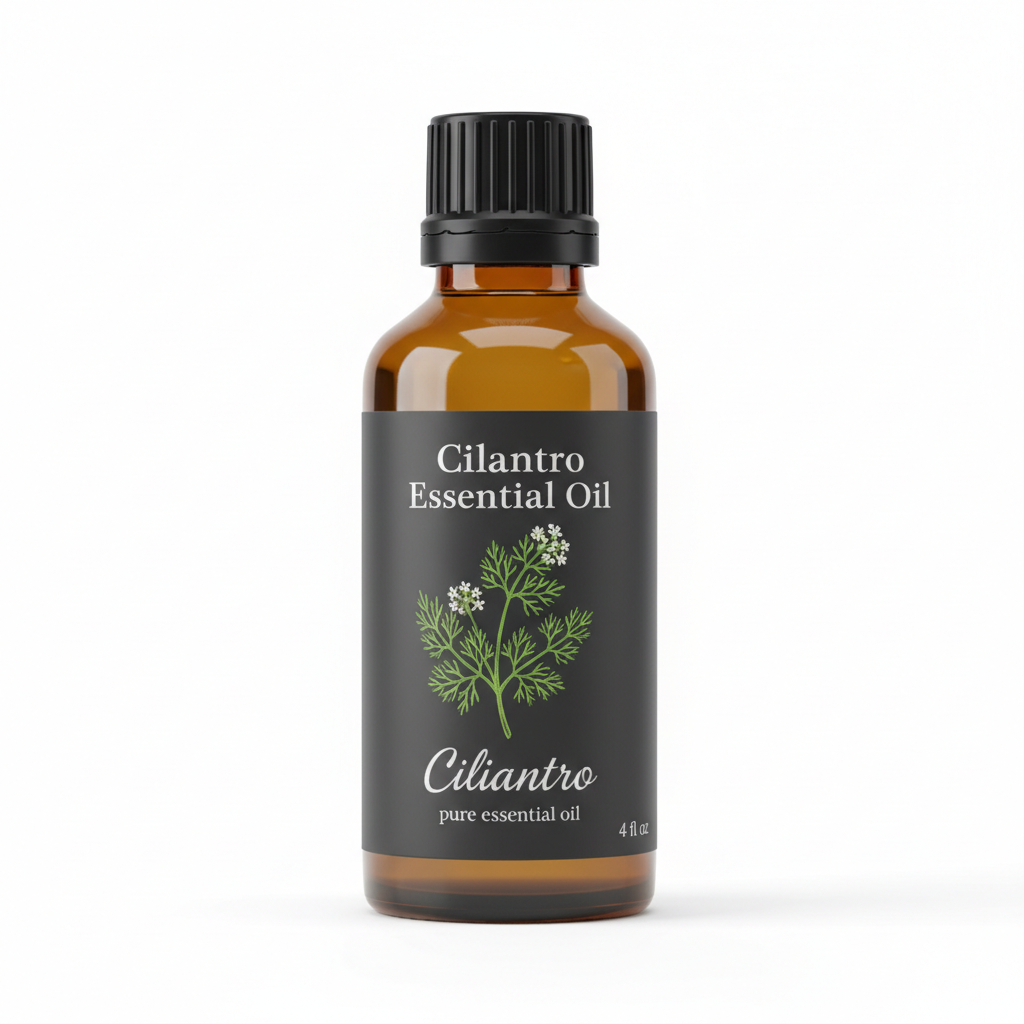
Cilantro Essential Oil
Our own Cilantro Essential Oil, in sizes from 0.5 oz to bulk.
From $13.99
Shop Now →What the general guidance looks like
Two NHS documents give a feel for how cautious the field is. A patient leaflet from the East and North Hertfordshire NHS Trust (2017 version) describes aromatherapy as potentially beneficial in pregnancy after 12 weeks, warns that some essential oils may be harmful, and recommends a qualified aromatherapist or a midwife with complementary-therapy training. The NHS Lanarkshire guideline (2025), written for registered midwives who have completed accredited training, sets pregnancy blends at 1% with a maximum of 1.5%, tells users not to ingest essential oils, and lists exclusions that include epilepsy, hypertension, severe asthma, anticoagulant use and skin allergies. Neither document names coriander or cilantro.
The two are not saying quite the same thing. One treats the second trimester as the open door, the other is a clinical protocol with a long list of reasons to hold off. The shared message is that pregnancy is a time to ask a professional first.
How our dilution range compares
We recommend 0.5% to 2% in a carrier oil for skin, roughly 3 to 12 drops per ounce. The Lanarkshire guideline's conversion is 1% in 5 mL of carrier equals one drop, so 20 drops per mL. In a 30 mL bottle, about an ounce, that gives:
- 1% is 0.3 mL, about 6 drops.
- 1.5% is 0.45 mL, about 9 drops.
- 2%, the top of our range, is 0.6 mL, about 12 drops.
So the top of our range sits above the only pregnancy figure in these documents. That is arithmetic, not advice: the Lanarkshire figure is a protocol for trained midwives, and whether any percentage suits you is for your midwife or OB-GYN to say. Because we sell the oil undiluted, the mixing is yours, and the method is in how to dilute cilantro essential oil.
The plant as food is not the oil
Pregnancy searches tend to blur three things: eating cilantro, taking coriander seed products, and using a leaf essential oil. The nearest authoritative text we found is the NIH LactMed entry on coriander, which is about seeds and extracts rather than leaf oil. It notes that no scientifically valid clinical trials support coriander as a milk-supply booster, that coriander is generally recognized as safe as a food but allergic reactions, photosensitivity and contact dermatitis have been reported, and it describes one case of a nursing mother who drank a large daily amount of a water extract for a week and later developed adrenal dysfunction (the entry notes the verification method was not stated).
That is a case report on a water extract, not a statement about an essential oil, but it illustrates why "it is a food herb" is not the same as "any amount is fine" once a plant is concentrated. The food listing is also about food use; we explain what it does and does not cover in why we say not to swallow cilantro oil.
Skin, air or mouth
- Swallowed: every guidance document here says no unless a qualified practitioner directs it, and we do not offer our oil for that.
- On skin: a dilution your midwife agrees with, a patch test first (see our patch test guide), and her view on where on the body.
- In the air: the least studied route in these documents. Our oil has a strong, divisive aroma that dominates a blend quickly, and if scents already bother you in pregnancy, skipping it is a perfectly good decision.
A few ordinary-life notes
Pregnancy has a way of making familiar smells feel new. A scent you liked last month can turn on you, and one you never noticed can suddenly fill the room. If that sounds like you, treat cilantro oil the way you would treat any strong smell: leave the bottle capped, keep it in a drawer, and revisit it when your nose has settled.
It also helps to keep the whole decision slow. Nothing about a bottle of oil is urgent, so you can jot down your questions, bring them to your next appointment, and let the answer come from someone who knows your history.
Questions to bring to an OB-GYN, midwife or pharmacist
- Is there anything in my history that rules out essential oils altogether?
- Does my trimester change whether you would advise any skin application?
- If I do use a blend, what maximum percentage do you want, and where on the body?
- Does any medication or supplement I take make an aromatic oil a bad idea?
- If I am breastfeeding, should I wait?
- Who should I call if I get a rash, headache or nausea afterward?
A lactation consultant is the right person for the milk-supply questions that coriander products raise. For babies, see our kids guide, and for the wider picture cilantro essential oil safety.
Because the aroma divides people, we suggest the smallest bottle first for anyone, and that holds double during pregnancy: a few minutes with a smelling strip will tell you whether you want it around at all.
Cilantro Essential Oil
Cilantro Essential Oil from our own shop, in sizes from 0.5 oz to bulk.
From $13.99
Shop Now →Sources & Further Reading
- NHS Lanarkshire, 2025. Guideline: Aromatherapy. rightdecisions.scot.nhs.uk
- East and North Hertfordshire NHS Trust, 2017. Aromatherapy and massage (patient information). enherts-tr.nhs.uk
- NIH LactMed. Coriander. PubMed 30000851