
Cilantro Essential Oil Benefits: What the Evidence Covers
The honest answer to "what are the benefits of cilantro essential oil?" is that nobody has shown any for the leaf oil we sell. What exists is a pile of studies on neighbouring things: coriander seed oil, herb extracts, tea, and test-tube work on leaf oil. This page sorts that pile by what was actually tested, so you can see how far each finding travels before it reaches a bottle of steam-distilled cilantro leaf oil.
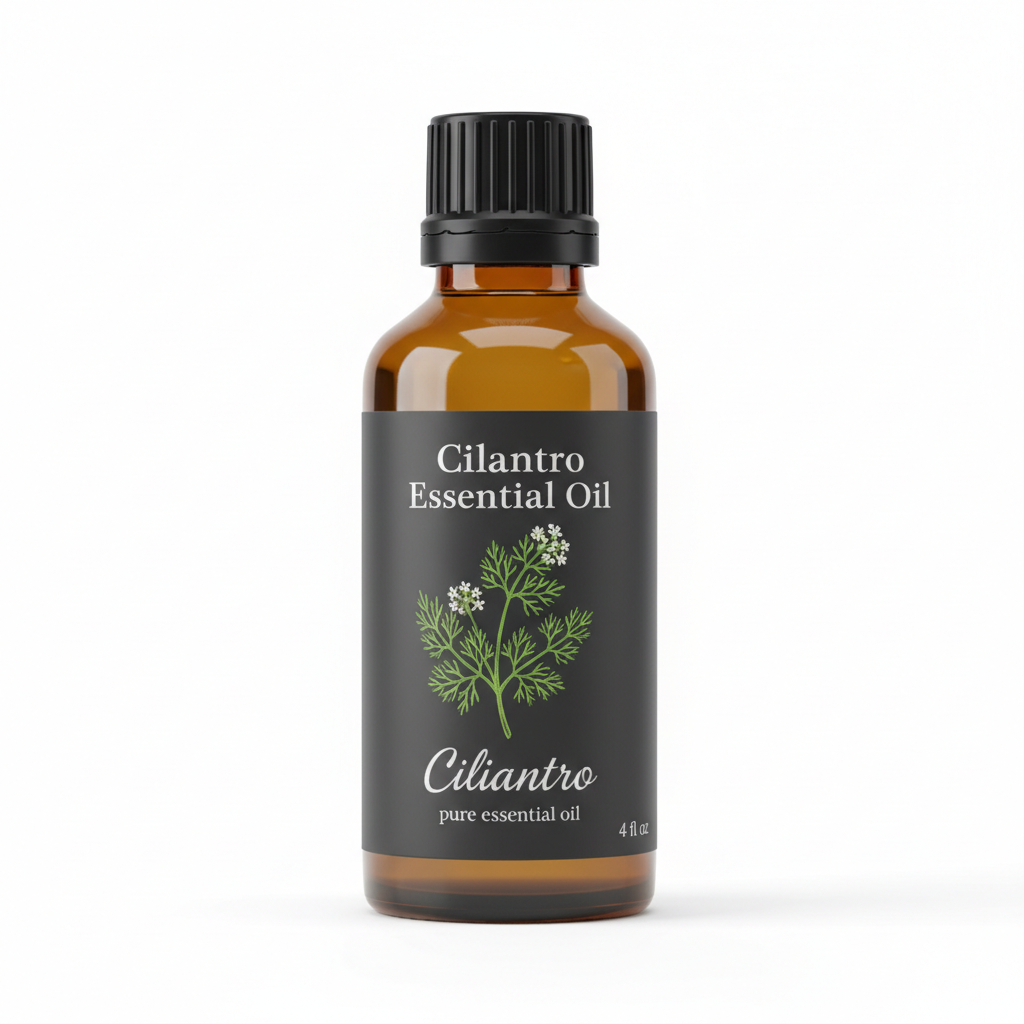
Cilantro Essential Oil
Our own Cilantro Essential Oil, in sizes from 0.5 oz to bulk.
From $13.99
Shop Now →Four different products share one name
Most "coriander" research is not about our oil. Our product is essential oil steam distilled from the fresh leafy tops of Coriandrum sativum, sold undiluted, and we sell it as leaf oil, never seed. Four things get blurred together in search results:
- Leaf essential oil (ours): an aldehyde-led distillate. Our batch analysis, per our oil page, shows decanal and its relatives dominating with a low linalool share.
- Seed essential oil: a different chemistry, dominated by linalool according to the Sahib et al., Phytotherapy Research, 2013 review, which also describes an essential oil from the aerial parts.
- Seed fatty oil: a pressed oil rich in petroselinic acid. It is not an essential oil at all.
- Whole herb, extracts and tea: what people eat or drink, with the plant's proteins and polyphenols intact.
A result for one of these tells you nothing guaranteed about another. We sell only the first.
A grading rubric, and it is ours
There is no official scale for this, so I built a plain one. It is a judgment tool, not a published standard. Grade a claim by walking down this list and stopping at the first "no":
- Was it done in humans?
- Was the material the same plant part and the same kind of preparation as ours (leaf essential oil)?
- Was it applied the way you would use it (diffused or diluted on skin, not swallowed or injected)?
- Was there a control group, and did the report give sample size and dose?
Almost every cilantro or coriander finding fails at step one or two. Here is the map, one row per study I read.
| What was tested | Design | What was reported | Where it stops |
|---|---|---|---|
| Leaf and seed essential oil against five food-borne bacteria (Rezaei et al., West Indian Medical Journal, 2015) | Laboratory dishes, steam-distilled oil | Antimicrobial activity across a range of 2.5 to 320 µg/mL | Not in a person, not skin bacteria, a food-preservation question |
| Leaf and stem oil composition and mosquito larvae (Chung et al., Immunopharmacology and Immunotoxicology, 2012) | GC-MS analysis plus larvicide assay, Korean plants | Leaf oil LC50 of 26.93 ppm against Aedes aegypti larvae | Larvae, not people; also a leaf oil whose reported decanal share was only 2.33%, whereas decanal and its relatives dominate in our batch analysis, per our oil page |
| A coriander preparation on mouse skin (Park et al., Journal of Medicinal Food, 2014) | Mice, 0.5 to 1% applied to dorsal skin | Fewer contact-dermatitis-like lesions and lower inflammatory markers | Mice; the abstract does not say it was a leaf essential oil |
| 6% coriander oil in an ointment base for athlete's foot (Beikert et al., Dermatology, 2013) | Human pilot, 40 participants, half-side comparison with placebo | Clinical signs improved (p < 0.0001); fungal cultures only tended to fall (p = 0.0654) | Medical condition; the abstract does not name the plant part; 3 times our top skin dilution |
| Coriander seed (fatty) oil, 200 mg a day by mouth for 28 days (Kern et al., Food & Nutrition Research, 2022) | Randomized, double-blind, placebo-controlled pilot, women with reactive skin | Lower redness after a stripping stress and lower itch after a stinging stress | Swallowed, pressed seed oil, not an essential oil; authors work for the company that filed patents on it |
Read that last column. Only one row involves leaf essential oil and every result for it came from a dish or a larva. The human trials used something else: an ointment of unspecified coriander oil at a strength we would not recommend, and a swallowed seed fat.
What the broad reviews really say
The Sahib review lists a long set of activities attributed to the coriander plant as a whole: antimicrobial, antioxidant, blood-sugar, mood and inflammation effects, and more, and even lead-detoxifying potential. Notice the phrase "attributed to". A review of this type pools animal, cell and some human work across seed, leaf, extract and oil, and it is a catalogue of leads, not a verdict. I would not quote that list to justify buying any oil, and I would not quote it about ours. Our safety guide covers the other side of the ledger.
The systematic review of aromatherapy trials by Cooke and Ernst, British Journal of General Practice, 2000 is older, but its finding about the whole field is a fair sanity check: 12 randomized trials, six of them without independent replication, and the authors concluded that effectiveness for any indication beyond a mild, transient relaxing effect from massage was not supported by rigorous trials. The U.S. National Cancer Institute's aromatherapy summary (updated September 2023) says much the same: studies of aromatherapy "have shown mixed results." Neither document mentions cilantro or coriander leaf oil. That absence is itself the finding.
What this means when you decide to buy
Reasoning from the table above, the defensible reasons to buy our oil are the ones we can state without a study: it has a green, bright, herbaceous aroma with a citrusy edge, it works as a perfumery top note, and it can go into a diffuser, a diluted body oil, cold-process soap or a candle. The reasons to be wary are the ones the evidence map shows: a wellness claim built on seed-oil or herb data does not belong on a leaf-oil bottle.
Where this connects to the spokes: for what a lab dish says about microbes, see the bacteria research write-up and the fungus research write-up; for skin, see cilantro essential oil for skin; for hair, cilantro essential oil for hair; for the digestive reputation, cilantro essential oil and digestion. Each takes the same rubric and applies it to one claim.
Who should skip this oil, and where to go instead
- Anyone looking for something for a medical condition (a fungal foot infection, a skin disease, a digestive complaint): see a physician, dermatologist or pharmacist. Our oil is sold with no medical claims.
- Anyone intending to swallow it: do not. The seed-oil trial above used a pressed seed fat, which is a different substance from an essential oil, and our oil is not for internal use.
- Anyone pregnant, nursing, or buying for a baby or pet: ask your OB-GYN, midwife, pediatrician or veterinarian first. I am not going to guess on their behalf.
The shop page states a skin dilution of 0.5% to 2% in a carrier oil, roughly 3 to 12 drops per ounce, with a patch test first. Because the oil is sold undiluted, the dilution maths is yours, and the aroma is strong enough that we suggest the smallest size first.
Cilantro Essential Oil
Cilantro Essential Oil from our own shop, in sizes from 0.5 oz to bulk.
From $13.99
Shop Now →Sources & Further Reading
- Sahib NG et al., 2013. Coriander (Coriandrum sativum L.): a potential source of high-value components for functional foods and nutraceuticals, a review. pubmed.ncbi.nlm.nih.gov/23281145
- Rezaei M et al., 2015. Antimicrobial activity of the essential oil from the leaves and seeds of Coriandrum sativum toward food-borne pathogens. pubmed.ncbi.nlm.nih.gov/26684163
- Chung IM et al., 2012. Composition of the essential oil constituents from leaves and stems of Korean Coriandrum sativum and their activity on Aedes aegypti. pubmed.ncbi.nlm.nih.gov/21692682
- Park G et al., 2014. Coriander and contact dermatitis-like skin lesions in mice. pubmed.ncbi.nlm.nih.gov/24963872
- Beikert FC et al., 2013. 6% coriander oil in unguentum leniens for interdigital tinea pedis, a randomized pilot study. pubmed.ncbi.nlm.nih.gov/23466353
- Kern C et al., 2022. Virgin coriander seed oil supplementation and reactivity in women with sensitive skin. pubmed.ncbi.nlm.nih.gov/35440935
- Cooke B and Ernst E, 2000. Aromatherapy: a systematic review. pubmed.ncbi.nlm.nih.gov/10962794
- National Cancer Institute, 2023. Aromatherapy with essential oils (PDQ), patient version. cancer.gov