
Cilantro Essential Oil and Digestion: Seed, Herb, Leaf Oil
Digestive claims about coriander are usually made for the seed or for the herb eaten as food, not for the essential oil distilled from fresh cilantro leaf, and I could find no trial of the leaf oil for digestion at all. Our oil is also not for internal use, so this page is about what the evidence for oils and digestion actually looks like, and which questions belong with a physician.
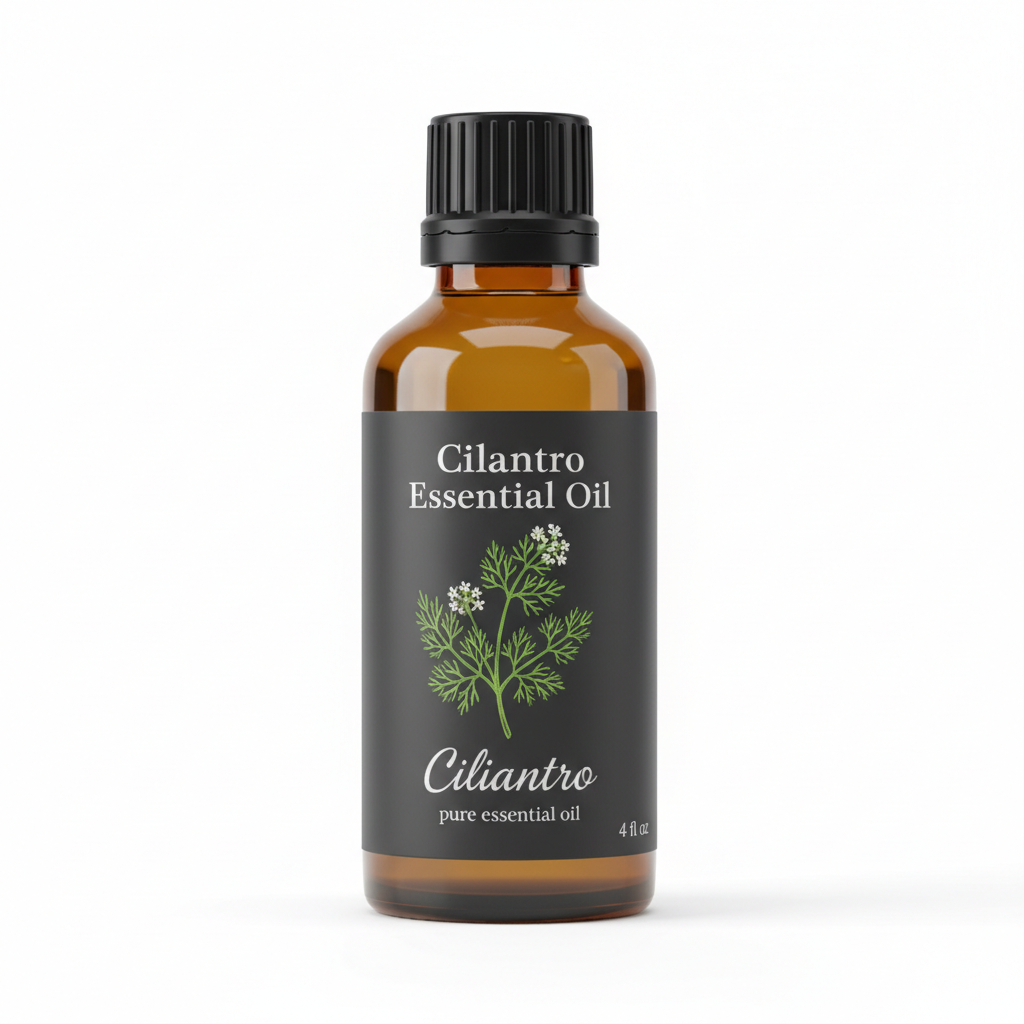
Cilantro Essential Oil
Our own Cilantro Essential Oil, in sizes from 0.5 oz to bulk.
From $13.99
Shop Now →Start here: the symptoms that are not a shopping question
Before any oil, check yourself against the warning signs. The U.S. National Institute of Diabetes and Digestive and Kidney Diseases, on its IBS diagnosis page, lists anemia, bleeding from the rectum, bloody stools or black and tarry stools, and weight loss as signs that may point to another condition instead of irritable bowel syndrome. If you have any of those, or pain that is severe, new or getting worse, or symptoms that persist, the next step is a physician (a gastroenterologist if your doctor refers you), not a bottle of oil and not a diffuser. This is not our judgment to make; we sell a perfumery oil.
Only if you have ordinary, familiar discomfort that a clinician has already looked at is the rest of this page relevant.
What the evidence for "herbal oils and digestion" is
The best large summary I could verify is a 2023 Cochrane review, Báez et al., Cochrane Database of Systematic Reviews, on non-Chinese herbal medicines for functional dyspepsia (chronic upper-abdominal discomfort with no structural cause found). It pooled 41 randomized trials with 4,477 participants that assessed 27 herbal medicines. Its results are a mixed bag, which is the useful part:
- Peppermint and caraway oil together probably improved global symptoms against placebo at four weeks (standardised mean difference -0.87; 2 studies, 210 participants; moderate certainty).
- Aniseed (Pimpinella anisum; 1 study, 107 participants, low certainty) and several other herbs showed improvement, mostly from single small studies.
- Cinnamon oil may make little to no difference against placebo (51 participants, low certainty).
- Mentha longifolia may increase dyspeptic symptoms (88 participants, low certainty).
- Among the findings reported in the abstract, coriander does not appear. I read the abstract, not every trial in the review, so I cannot rule out that a coriander product is inside it; I can say that coriander was not among its headline results.
Two points follow. First, the "oil" results are about named oils at defined doses, used as a medicine in a clinical trial. The review's abstract does not describe the dosage forms, and I am not able to tell you from it how any oil was taken, so reading it as support for any other oil by any other route would be a leap. Second, "essential oils help digestion" is not even a stable statement within this one review: some oils did better than placebo, one did not, and one may have made things worse. Class membership tells you nothing. Each oil has to be tested as itself, and cilantro leaf oil has not been.
What about smelling it or rubbing it on the abdomen?
That is a different route, and the evidence base is older and weaker. In Cooke and Ernst's 2000 systematic review of aromatherapy trials in the British Journal of General Practice, 12 randomized trials were located, six of them with no independent replication. Six concerned relaxation with massage, and the authors concluded that effects beyond a mild, transient relaxing effect were not supported by rigorous trials; they found no digestive indication that held up. The review dates from 2000 and newer trials may exist, so treat it as a calibration point, not a final word. I did not find a trial of any coriander oil applied to the abdomen.
If you enjoy a diluted body oil rubbed on your stomach for the ritual of it, there is no study saying cilantro leaf oil does anything to digestion, and abdominal skin is still skin: the sensitisation reasoning in our skin article applies, and the patch test comes first. Our shop range for skin is 0.5% to 2%, about 3 to 12 drops per ounce of carrier (one ounce is about 29.6 ml, at 20 drops per ml, which is an assumption because drop size varies). Our oil is sold undiluted, so the dilution maths is yours, and I would begin at the low end. We have not tested any abdominal blend.
Why "just a drop in water" is the wrong move
The National Cancer Institute's aromatherapy summary, updated September 2023, states that swallowing large amounts of essential oils is not recommended. That is a general statement about the category, and the same page notes that most oils are labelled GRAS as ingredients in food and fragrance. Do not read that as an invitation. Whether an ingredient is permitted in food flavouring is a regulatory status for a specific material in specific, tiny amounts; it is not a label on a bottle sold for aroma. Our cilantro leaf oil is sold as an essential oil for aroma and diluted skin use. We do not label it as a flavouring or a food, and it is not for internal use. Our full answer on this is in can you ingest cilantro essential oil.
The seed-oil trial on coriander and skin reactivity (Kern et al., Food & Nutrition Research, 2022) is worth naming here because it shows how the swallowing trap works. Women took 200 mg a day of virgin coriander seed oil, a pressed, petroselinic acid-rich fatty oil and not an essential oil, for 28 days, and the company-employed authors reported effects on skin reactivity. A web page that says "coriander oil, taken by mouth, was studied" can send the wrong message for a steam-distilled leaf essential oil, which is a different substance with a different chemistry, so that trial does not tell you anything about swallowing ours.
What our oil is for, in the kitchen sense
The green, bright, herbaceous aroma of cilantro leaf oil with its citrusy edge can be pleasant when diffused, and it can dominate a blend quickly, so a drop or two goes a long way. If the smell of cooking cilantro is something you like at dinner, that is a reason to enjoy the aroma, not a digestive method. Cilantro in the kitchen means the fresh herb or an infused culinary oil from another maker; we do not sell culinary products. Our evidence overview explains how far each type of coriander research reaches.
Who should skip this, and who to ask
- Anyone with the warning signs above, or persistent symptoms: a physician.
- Anyone considering swallowing the oil: do not. If someone has swallowed essential oil, call a poison control centre or a physician promptly.
- Anyone pregnant or nursing, or with a child under care: ask an OB-GYN, midwife or pediatrician before using any essential oil near them. Our safety guide sets out the general cautions.
- Pets: ask a veterinarian before diffusing around them.
The short version of where this leaves us: the honest digestive story for coriander is about the seed and the herb in food, the honest story for our leaf oil is its aroma, and the line between them is the one this page exists to draw.
Cilantro Essential Oil
Cilantro Essential Oil from our own shop, in sizes from 0.5 oz to bulk.
From $13.99
Shop Now →Sources & Further Reading
- Báez G et al., 2023. Non-Chinese herbal medicines for functional dyspepsia. Cochrane Database Syst Rev. pubmed.ncbi.nlm.nih.gov/37323050
- NIDDK. Diagnosis of irritable bowel syndrome. niddk.nih.gov
- Cooke B and Ernst E, 2000. Aromatherapy: a systematic review. Br J Gen Pract. pubmed.ncbi.nlm.nih.gov/10962794
- National Cancer Institute, 2023. Aromatherapy with essential oils (PDQ), patient version. cancer.gov
- Kern C et al., 2022. Virgin coriander seed oil supplementation and reactivity in women with sensitive skin. pubmed.ncbi.nlm.nih.gov/35440935