Cilantro Essential Oil for Skin: Aroma, Not Skincare
Cilantro leaf essential oil is a fragrance ingredient for a diluted body product, and that is the whole honest skin story. No trial I could find tested cilantro leaf essential oil on human skin, and the one real skin risk you can reason about from its chemistry is allergic sensitisation, which is why the dilution and the patch test matter more than any skincare claim.
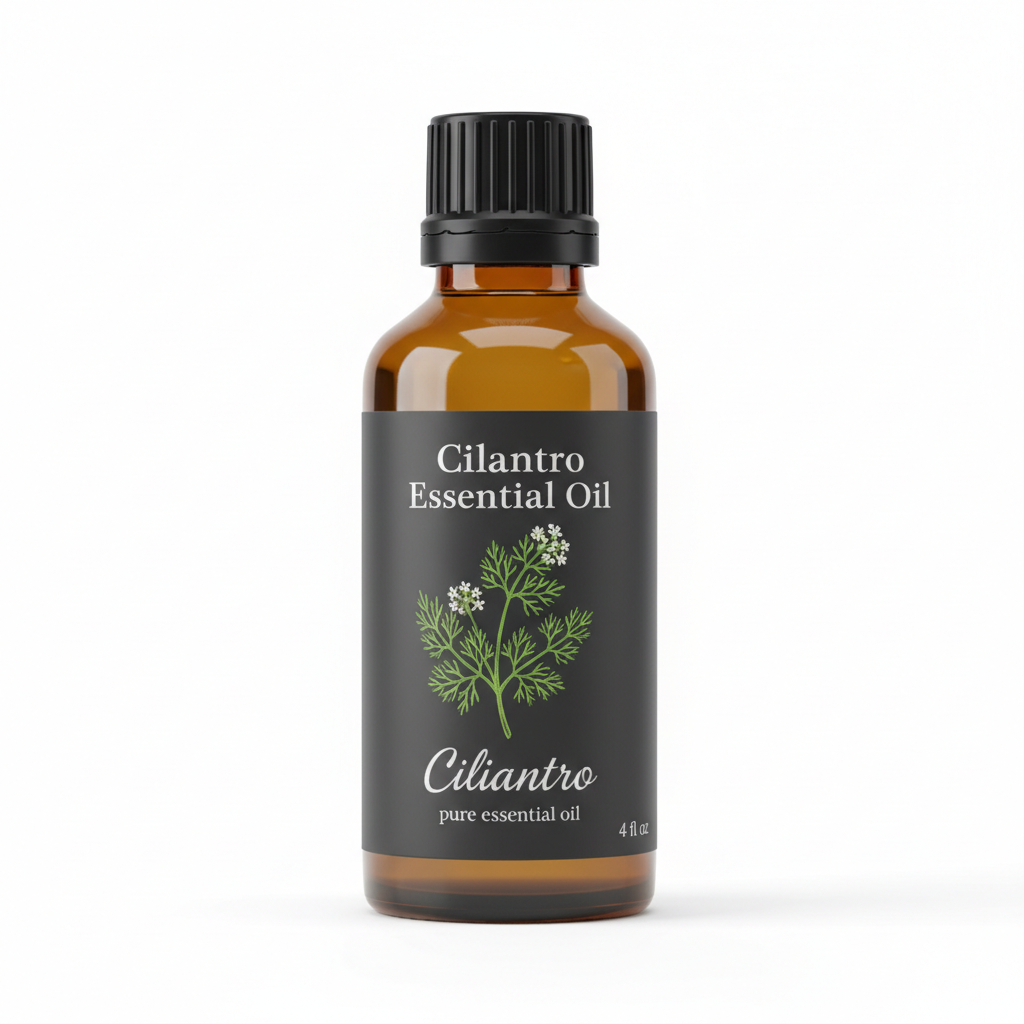
Cilantro Essential Oil
Our own Cilantro Essential Oil, in sizes from 0.5 oz to bulk.
From $13.99
Shop Now →Where the legal line sits, and why we stay on one side of it
In the United States, the FDA decides whether a product is a cosmetic or a drug by its intended use, and the claims made for it help establish that intent. On its cosmetic-or-drug page, the agency gives a massage oil as an example: marketed for lubrication and fragrance it is a cosmetic, while the same oil marketed to relieve muscle pain is a drug. It applies the same logic to essential oils: a fragrance sold for attractiveness is a cosmetic, one sold with aromatherapy claims such as helping you sleep is a drug.
That is why this site does not tell you cilantro oil clears skin, calms anything or fights anything. We sell one oil, undiluted, with no medical claims, and the aroma is the product. If a page or label says otherwise about an essential oil, the claim has moved the product out of the cosmetic category, and you should weigh it accordingly.
What has actually been tested on skin
I looked for human skin data on coriander in PubMed. Here is everything relevant I found, with the preparation named each time because that is where the confusion starts.
- Test-tube work on leaf and seed essential oil. Rezaei et al., West Indian Medical Journal, 2015 measured antimicrobial activity of steam-distilled leaf and seed oil against five bacteria: E. coli, S. aureus, Yersinia enterocolitica, Salmonella enterica and Vibrio cholerae. It reported activity in a range of 2.5 to 320 µg/mL. These are food-borne pathogens, not the bacterium usually discussed in acne, and nothing was applied to a person.
- Mice. Park et al., Journal of Medicinal Food, 2014 applied a coriander preparation at 0.5 to 1% to mouse back skin in a chemically induced dermatitis model and reported fewer lesion-like changes and lower inflammatory markers. The abstract does not describe it as a leaf essential oil, and it was a mouse.
- One human pilot with a skin outcome. Beikert et al., Dermatology, 2013 studied 6% coriander oil in an ointment base against a placebo base on 40 people with athlete's foot, comparing one foot to the other. Clinical signs improved (p < 0.0001) and the authors called tolerability good, but positive fungal cultures only tended to fall (p = 0.0654). The abstract does not name the plant part, and athlete's foot is a medical condition for a pharmacist or physician.
- A swallowed seed oil. Kern et al., Food & Nutrition Research, 2022 gave women with reactive skin 200 mg a day of virgin coriander seed oil, a pressed oil rich in petroselinic acid, for 28 days against placebo and reported lower redness and itch after skin stress tests. It was swallowed, it is not an essential oil, and the authors work for the company that filed patents on it.
So the answer to "does cilantro oil do anything for skin?" is that the question has not been asked of this oil, in this plant part, on people. The 6% figure in the ointment trial is worth turning into arithmetic, because it shows how far the one human study sits from what we advise. One ounce of carrier is about 29.6 ml. At the common assumption of 20 drops per ml (drop size varies, and this is ordinary maths, not a measurement we made), 6% is about 35 drops per ounce. Our shop range of 0.5% to 2% is about 3 to 12 drops per ounce. The trial used roughly three times our ceiling. Reasoning from that gap, you cannot borrow its tolerability finding for a leave-on product at any strength we sell.
The real skin story: sensitisation
Our own batch analysis, as described on our oil page, shows decanal and its relatives dominating. Those are aldehydes. In a 2023 paper on aromatic aldehydes, Böhme, Ulrich and Schüürmann describe the mechanism for the class: aldehydes can form imines (Schiff bases) with amino groups in skin proteins, and that this protein binding can trigger allergic contact dermatitis. Their experiments used 23 aromatic aldehydes in a chemical model, most were weak or non-sensitisers, and they note that aliphatic aldehydes form more stable adducts than aromatic ones. The paper I read does not cover decanal, and I could not find a published sensitisation figure for decanal or for cilantro leaf oil. So this is reasoning from a mechanism, not a measured rate. The practical consequence is to treat a new aldehyde-rich oil as something your skin may meet for the first time, and to start low.
The U.S. National Cancer Institute's aromatherapy summary makes the general point that allergic reactions and skin irritation may occur when essential oils stay in contact with the skin for long periods. A leave-on body oil is exactly that situation. An allergy develops through earlier exposure, so a first application that goes fine is weaker reassurance than it feels. Our skin sensitivity guide goes deeper.
If you still want it in a body product
- Choose the product for the aroma. A diluted body oil or a rinse-off product is a reasonable home for a green, citrusy-edged top note. Our oil dominates a blend quickly, so use less than you expect.
- Do the dilution maths yourself. Our oil is sold undiluted. Start at the 0.5% end: about 3 drops in one ounce of carrier, with the ceiling at 2% (about 12 drops). Our dilution guide shows the working. I have not tested any formulation; these are numbers from our shop range and arithmetic.
- Patch test first, as our patch test guide explains, and keep it away from eyes and broken skin.
- Stop at the first rash, itch or redness and do not retry the same blend.
When this is not the right page, or the right product
Acne is a medical condition with a published, graded guideline. The American Academy of Dermatology's 2024 guideline (Reynolds et al., Journal of the American Academy of Dermatology) made 18 evidence-based recommendations and 5 good practice statements. Its strong recommendations were for benzoyl peroxide, topical retinoids, topical antibiotics and oral doxycycline, with isotretinoin for severe acne or acne causing scarring or psychosocial burden. Essential oils are not in that abstract's list. If you have acne, a spreading rash, a skin infection, or anything that is painful or that is not clearing, see a dermatologist, or a pharmacist for an athlete's foot type problem. Do not use our oil on a baby's skin, and for pregnancy or nursing ask your OB-GYN or midwife first.
For the wider evidence picture, see our evidence map of cilantro and coriander research.
Cilantro Essential Oil
Cilantro Essential Oil from our own shop, in sizes from 0.5 oz to bulk.
From $13.99
Shop Now →Sources & Further Reading
- U.S. FDA. Is it a cosmetic, a drug, or both? (Or is it soap?). fda.gov
- Rezaei M et al., 2015. Antimicrobial activity of the essential oil from the leaves and seeds of Coriandrum sativum toward food-borne pathogens. pubmed.ncbi.nlm.nih.gov/26684163
- Park G et al., 2014. Coriander and contact dermatitis-like skin lesions in mice. pubmed.ncbi.nlm.nih.gov/24963872
- Beikert FC et al., 2013. 6% coriander oil in unguentum leniens for interdigital tinea pedis. pubmed.ncbi.nlm.nih.gov/23466353
- Kern C et al., 2022. Virgin coriander seed oil supplementation and reactivity in women with sensitive skin. pubmed.ncbi.nlm.nih.gov/35440935
- Böhme A, Ulrich N, Schüürmann G, 2023. Amino chemoassay profiling of aromatic aldehydes and skin sensitization potency. Chem Res Toxicol. pmc.ncbi.nlm.nih.gov/PMC10354803
- National Cancer Institute, 2023. Aromatherapy with essential oils (PDQ), patient version. cancer.gov
- Reynolds RV et al., 2024. Guidelines of care for the management of acne vulgaris. J Am Acad Dermatol. pubmed.ncbi.nlm.nih.gov/38300170