Cilantro Detox Claims: Where the Idea Began
The cilantro detox idea is a good story, and it has traveled a long way: a humble herb that supposedly pulls heavy metals out of the body. It is worth knowing where it started, because none of the sources involve an essential oil, and we make no detox claim for ours. Our cilantro leaf oil is an aromatic oil for diffusing, diluted skin products and craft use.
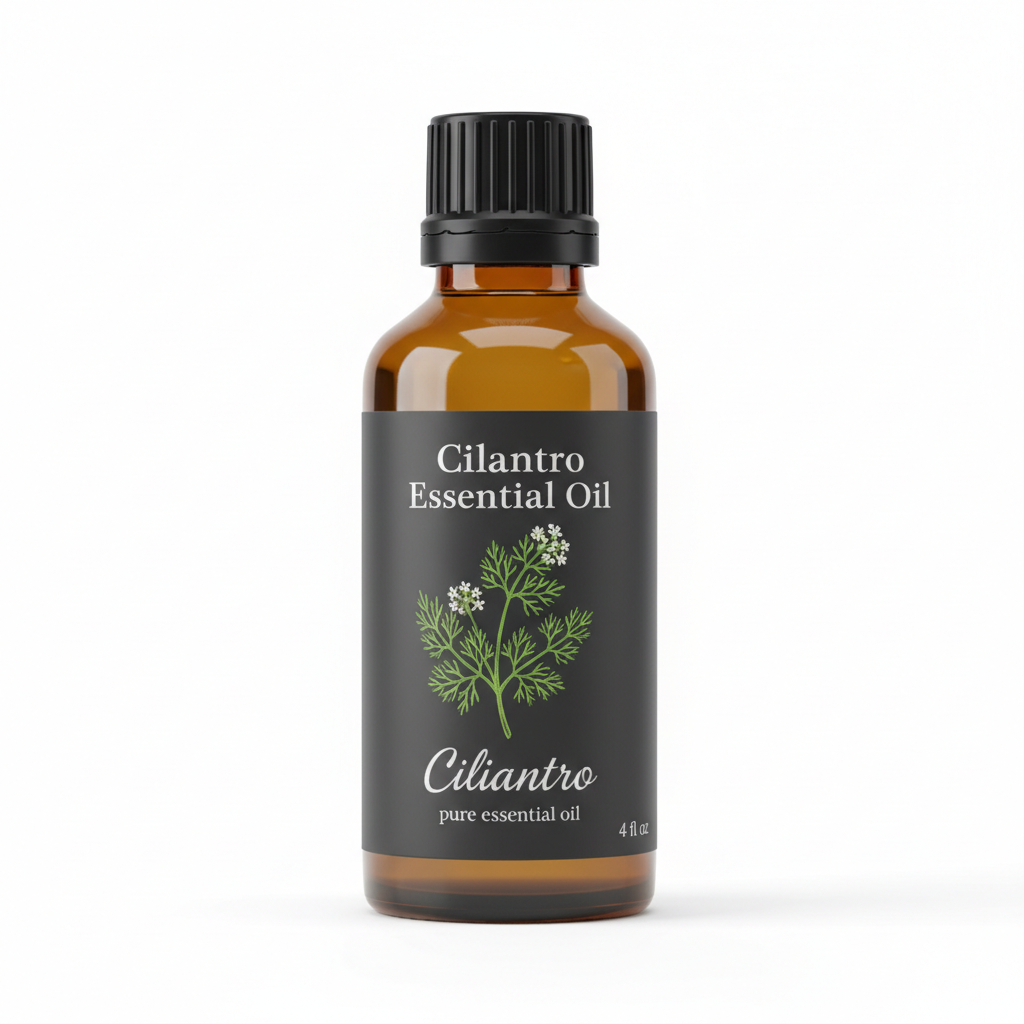
Cilantro Essential Oil
Our own Cilantro Essential Oil, in sizes from 0.5 oz to bulk.
From $13.99
Shop Now →Three sources, one at a time
A 1996 case report. The idea is usually traced to a clinical case report by Yoshiaki Omura and colleagues in Acupuncture & Electro-Therapeutics Research (PubMed 8914687). It follows one person after dental amalgam fillings were removed, and it involves Chinese parsley tablets alongside other methods. One subject with no comparison group can raise a question, but it cannot show that the herb caused anything. And it was the herb, not a distilled oil.
A mouse study. In 2001, Aga and colleagues gave mice lead in their drinking water for 32 days and, from day 7, gave some of them Chinese parsley by gastric tube. Lead in the femur and kidney injury were lower in that group, and the authors suggested the effect probably came from chelation by some substances in the plant. It is an interesting result in mice, looking at preventing deposits during ongoing exposure, which is a different question from clearing metal a person already carries.
A sorbent for water. In 2005, Karunasagar and colleagues made a sorbent from the coriander plant and showed it removed mercury from spiked water, with carboxylic acid groups playing the major role in binding. That is plant material acting like a filter in a beaker.
It is easy to see why the story caught on. Cilantro is a familiar green herb, a handful of it feels wholesome, and a simple answer to a worrying problem is always appealing. We understand the pull of that. But a good story and a tested result are two different things, and it is kind to a reader to keep them apart.
Why an oil is a different material
Steam distillation carries over the volatile part of the plant and leaves the water-loving, solid biomass behind. A 2023 analysis of an essential oil from coriander leaves found its main constituents were octanal, decanal, dec-(2E)-enal and dodecanal (Barbosa et al., 2023), which are aldehydes rather than carboxylic acids. None of the three studies above tested an essential oil. So the findings about plant material give us no particular reason to expect the same of a distillate. That is our reasoning, and to our knowledge nobody has tested it.
What the oil is actually for
When we describe our cilantro leaf oil, we are happy to be plain. It is a green, bright, herbaceous aroma with a citrusy edge, and a top note that appears first and fades first. A drop in a diffuser fills a room with a fresh, waxy green. A few drops in a diluted body oil or a handmade soap give you a scent that nobody else on your street is wearing. That is plenty of reason to own a bottle, and none of it needs a bigger claim.
If a bottle or a website promises to clear something out of your body, treat it with polite skepticism and take the question to a doctor instead.
What regulators say about detox products
The FDA states that it "has never approved any chelation product for OTC use for any health condition," that approved chelation products require a prescription, and that chelation can result in serious side effects such as dehydration, kidney failure and death (FDA questions and answers on unapproved chelation products). That is one more reason we keep detox language away from our oil. In the US, what a seller claims is what decides whether a product is treated as a cosmetic or a drug, a line we explain in our claims article.
It also helps to remember how much of the internet runs on repetition. A claim gets cited, then cited again by someone who never read the source, and after a while it feels like common knowledge. Following one claim back to its first page, as we have done here, is a small act of kindness to yourself.
If you are worried about exposure
A physician is the right person, and for anything serious a medical toxicologist. Testing comes first, and the next step depends on the result and the person. If you suspect a source, such as old paint, a workplace process or a particular product, say so when you ask for the test. Please do not delay a test or stop a prescribed medication because of something you read online, and do not swallow essential oil for this purpose; ours is for external use only. See can you ingest cilantro essential oil for more.
What we are happy to talk about is what the oil is: bright, green and citrus-edged, with a story that begins in a still. For the wider picture of what has and has not been studied, our overview and the safety notes are a good next stop.
We keep a friendly line between the garden, the pharmacy and the workbench. Cilantro is welcome in all three, and each has its own rules.
It is a lovely herb on a plate, and a lovely oil in a diffuser, and each is best enjoyed for what it is.
Cilantro Essential Oil
Cilantro Essential Oil from our own shop, in sizes from 0.5 oz to bulk.
From $13.99
Shop Now →Sources & Further Reading
- Omura Y et al., 1996. Clinical case report on mercury deposits after dental amalgam removal. Acupunct Electrother Res. PubMed 8914687
- Aga M et al., 2001. Preventive effect of Coriandrum sativum (Chinese parsley) on localized lead deposition in ICR mice. J Ethnopharmacol. PubMed 11535365
- Karunasagar D et al., 2005. Removal and preconcentration of inorganic and methyl mercury from aqueous media using a sorbent prepared from the plant Coriandrum sativum. J Hazard Mater. PubMed 15721537
- Barbosa et al., 2023. Coriandrum sativum L. essential oil obtained from organic culture shows antifungal activity against planktonic and multi-biofilm Candida. Braz J Biol. PubMed 36651450
- FDA. Questions and answers on unapproved chelation products. fda.gov