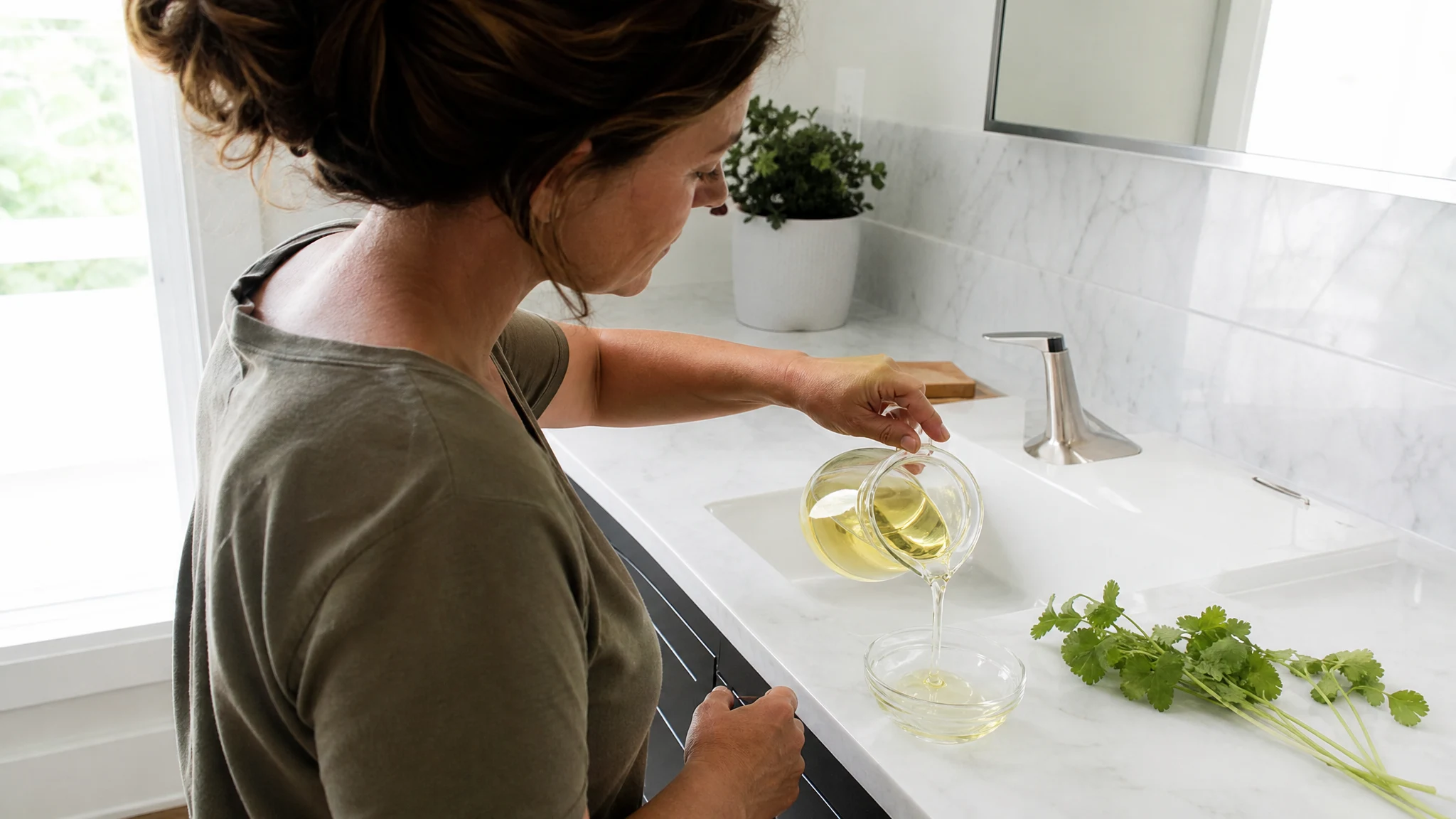
How to Dilute Cilantro Essential Oil: Drops and Percentages
The easiest way to dilute an essential oil is to stop counting drops and start thinking in percentages. Cilantro oil is concentrated and pungent, so a little goes a long way, and a clear sense of what 1% actually looks like in your jar takes most of the mystery out of it.
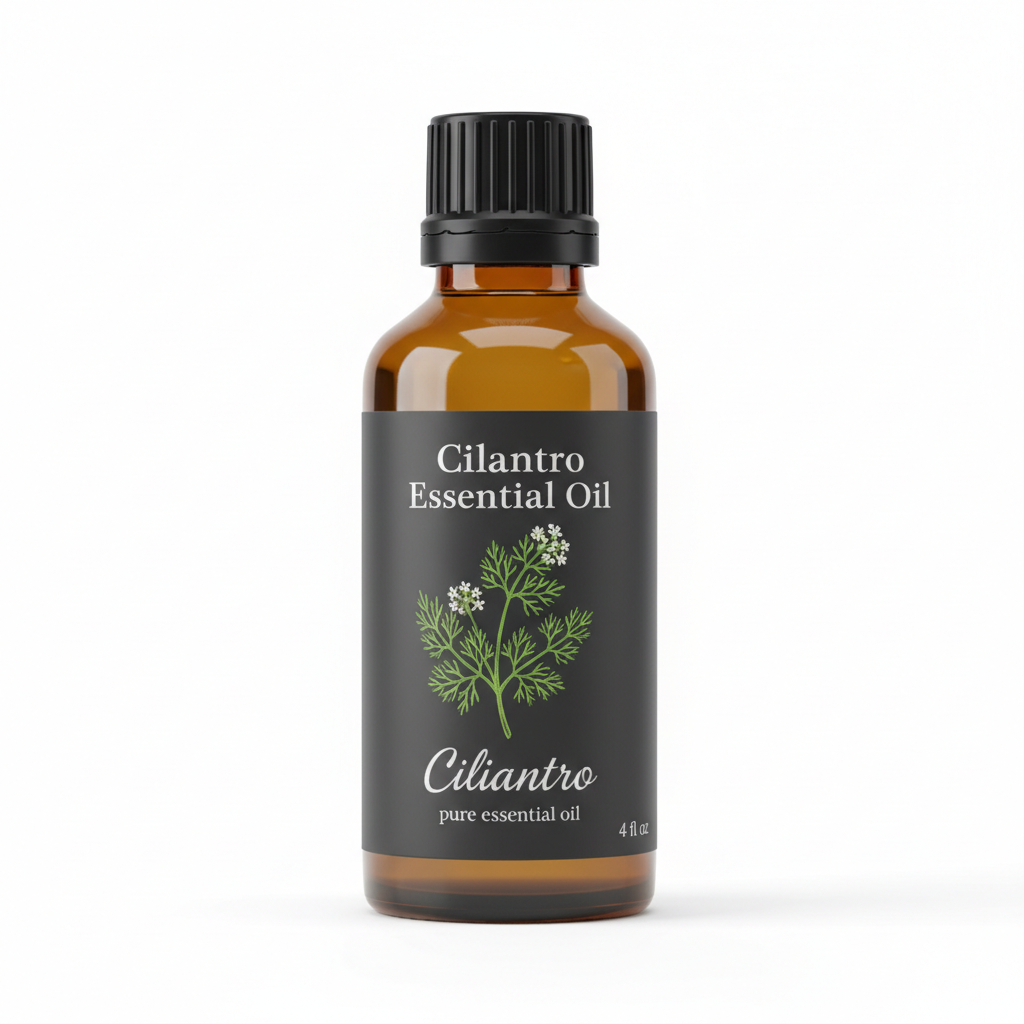
Cilantro Essential Oil
Our own Cilantro Essential Oil, in sizes from 0.5 oz to bulk.
From $13.99
Shop Now →Our line and how it translates
Our dilution guidance for skin is 0.5% to 2% in a carrier oil, with a patch test first, and we sell the oil neat and undiluted, so the mixing is yours to do. That works out to roughly 3 to 12 drops per ounce of carrier. The maths is simple: carrier volume times the percentage gives the volume of essential oil. In 30 ml of carrier, 1% is 0.3 ml, and at the usual rough convention of 20 drops per ml, that is about 6 drops. Drop size varies from bottle to bottle, so treat the drops as a guide.
That is why we like weighing when you can. A 100 g jar of body oil at 1% needs 1 g of essential oil. The batch on the Certificate of Analysis we publish has a relative density of 0.86719, so a gram of that batch is a little over a milliliter, around 23 drops. A small scale that reads to 0.01 g removes the drop-size question completely. Below about 10 ml, the error from a single drop becomes a big share of the dose, so make 30 ml or more and use it over time.
Why we start low
Published analyses of coriander leaf oil find it dominated by long-chain aldehydes. In a study of four coriander leaf cultivars, decanal and (E)-2-decenal were each roughly 14% to 25% of the oil, with two more aldehydes adding about another fifth. Aldehydes are lively, penetrating molecules, and that character is a big part of why the scent is so strong. It also suggests a modest approach on skin, so we would begin at the bottom of our range, at 0.5%, and move up only if you like the scent and your skin is happy.
The Tisserand Institute offers a helpful general framework, describing its ranges as guidelines rather than rules for oils without specific restrictions: 0.2% to 1% for sensitive or impaired skin, 0.5% to 1.2% for facial products and deodorants, 1% to 3% for body oils and massage, and 2% to 4% for bath and wash-off products. Our 0.5% to 2% sits comfortably inside that picture. We have not found a published limit written specifically for cilantro leaf oil, so if you are formulating something for others, check the current IFRA standards for your product type before you settle on a number.
What a percentage looks like in the jar
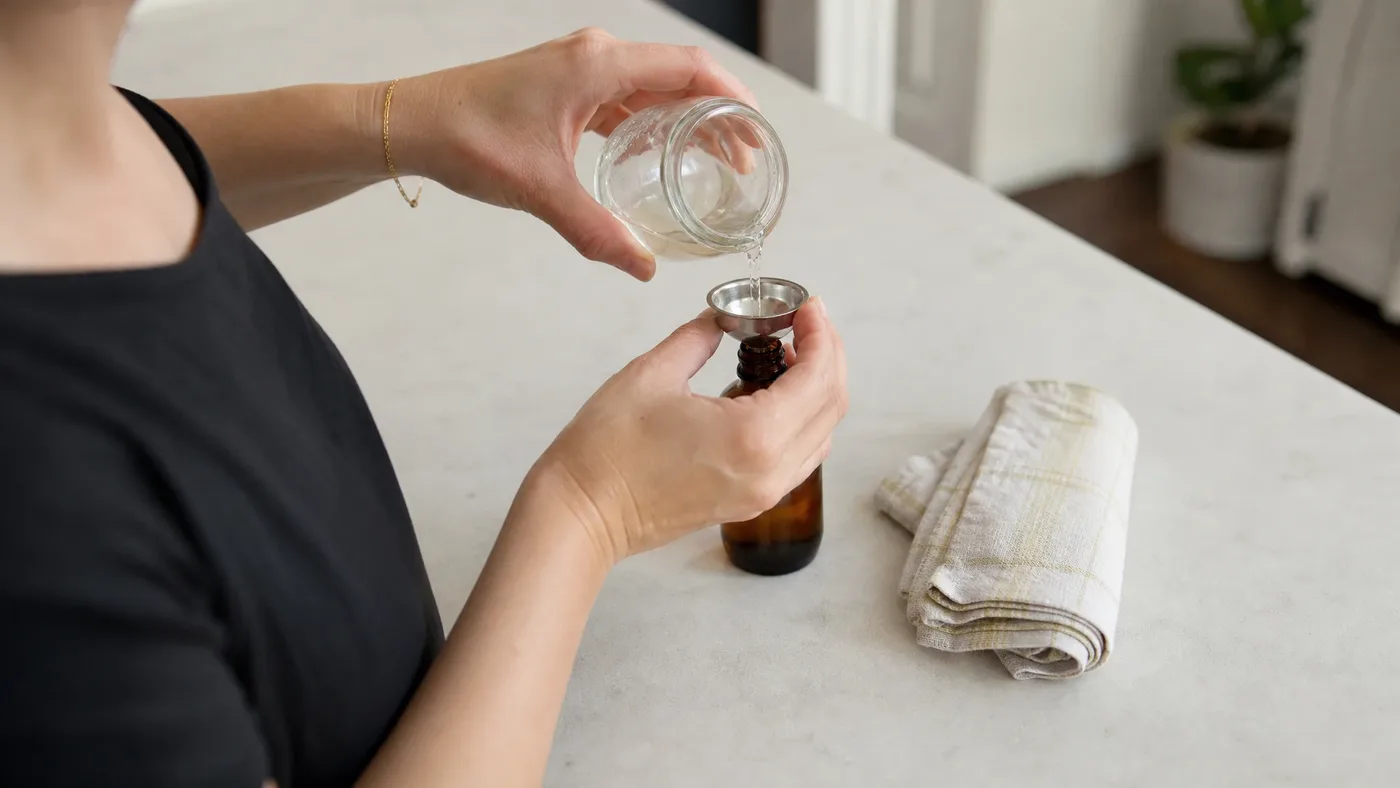
It helps to picture it. Pour your carrier into a small clean jar and add a few drops of cilantro oil, and you will see how little room they take. Our oil is pale yellow to nearly colorless, thin and watery, so it vanishes into the carrier at once and the color of the mix does not change. That means your nose is the only gauge, which is a good reason to keep notes on what you made.
Choosing a carrier
Jojoba and sweet almond are the two we usually suggest. We do not sell carrier oils, so pick them up from a carrier-oil supplier or a well-stocked pharmacy. If anyone using the mix has a tree-nut allergy, jojoba is the easy choice, since it is a liquid wax rather than a nut oil. Whatever you buy, choose an unscented, fresh one, because cilantro oil will already be doing plenty of talking. Keep water out of the jar: water and oil do not mix, and anything containing water needs a proper preservative system, which is a job for a cosmetic chemist's instructions rather than a kitchen-table recipe.
Write it down every time
A little label or a page in a notebook pays for itself. Jot the date, the carrier, the total amount and the percentage you aimed for. If you love the result, you can make it again exactly. If it is too loud, you know which way to move. Change one thing at a time, and nudge the number by small steps rather than big jumps.
A simple routine
- Pour the carrier into a clean amber or glass container first.
- Add the essential oil, by weight if you can, and cap and swirl.
- Label it with the date and the percentage.
- Patch test a small area before wider use; our patch test guide explains how.
- Keep it away from eyes, and out of reach of children and pets.
For a worked example with a specific carrier, see our massage oil post.
When to skip it
If you have reacted to fragrance, cilantro or coriander before, our posts on allergy and irritation versus allergy are the place to start. Children, pregnancy and pets each deserve a careful look, and our posts on kids, pregnancy and pets point to the right professional for each. Skip broken or inflamed skin and the area around the eyes.
One more habit worth having: judge the scent on your skin, not from the neck of the bottle. Cilantro oil is a top note, so what you smell a few minutes after applying is lighter than what rose out of the bottle. Resist the urge to add more drops to chase the bottle's strength. The jar will smell different from the bottle, and that is exactly how it should be.
When in doubt, use the smallest amount that gives you a scent you can detect. With an oil this bold, less is nearly always the better recipe.
Cilantro Essential Oil
Cilantro Essential Oil from our own shop, in sizes from 0.5 oz to bulk.
From $13.99
Shop Now →