5 Citrus and Cilantro Diffuser Blends in Drops
Cilantro leaf oil and citrus oils are both top notes, so a blend of the two has no anchor and the loudest oil wins. Cilantro is usually the loudest. The trick is to treat it as seasoning: one drop does the job, and the citrus does the rest.
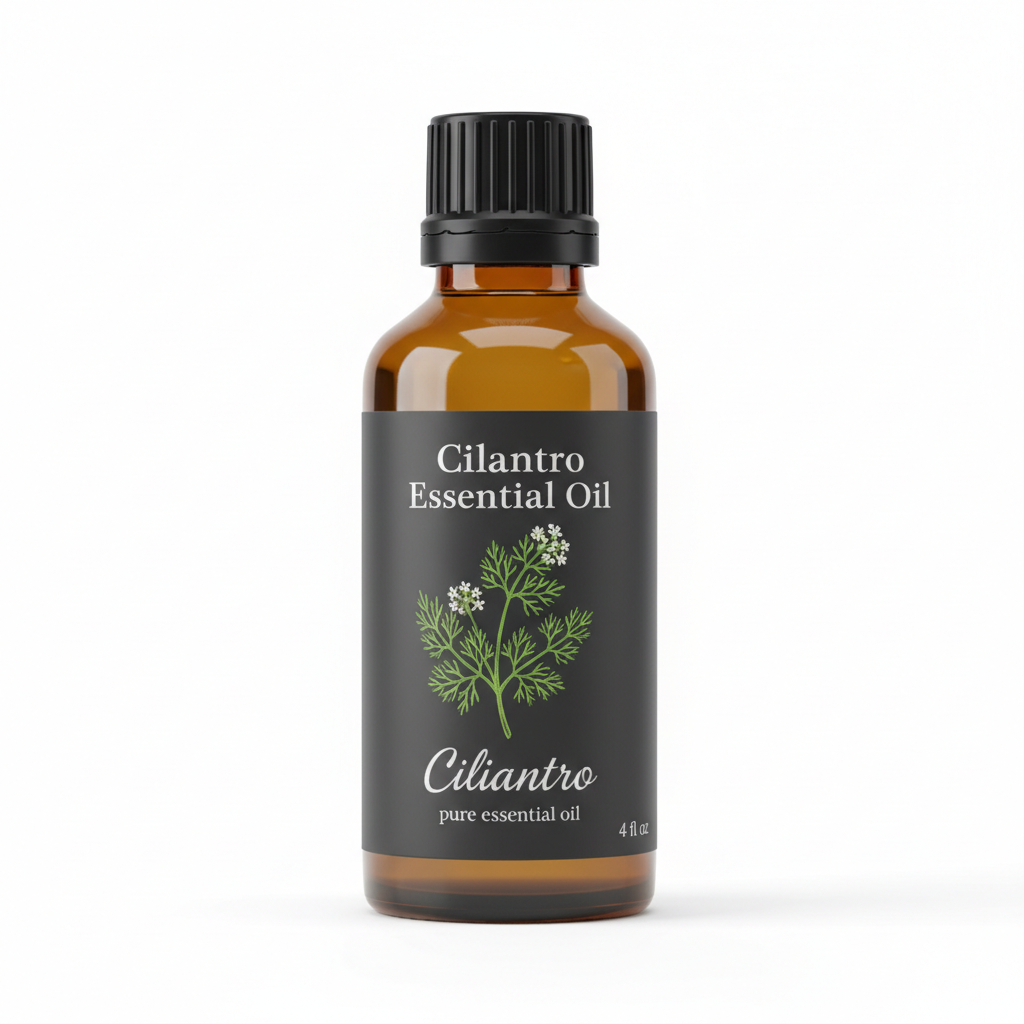
Cilantro Essential Oil
Our own Cilantro Essential Oil, in sizes from 0.5 oz to bulk.
From $13.99
Shop Now →The rule behind every blend
Cilantro oil is pungent in a way that dominates a blend quickly, so we use one drop and never more than a third of the total. That is our position, and it follows from the chemistry: leaf oils in the published analyses are rich in waxy aldehydes and fatty alcohols, such as decanal and 1-decanol (Kumar et al., 2022; Foudah et al., 2021), which carry a long way over a larger amount of simple citrus oil. Our diffuser post covers starting amounts on its own.
What each citrus brings
- Lemon is a moving target. Tunisian lemon peel oils ranged from about 38% to 70% limonene depending on ripeness (Bourgou et al., 2012), so your bottle will not match someone else's.
- Sweet orange is close to one compound. Orange peel oils in that paper were 82% to 86% limonene, and a cold-pressed navel orange oil came in at 85% (Guo et al., 2018). That makes it the rounder, gentler buffer.
- Mandarin is less single-minded, with limonene around 52% to 69% and a good share of gamma-terpinene in the Tunisian samples, which gives a slightly greener citrus that sits closer to cilantro.
- Lemongrass is not a gentle filler. One distilled sample was about three quarters citral (Maksimovic et al., 2025), so a single drop goes a long way.
Ginger and black pepper appear below as warm, dry anchors, a role we assign them from their general use in perfumery.
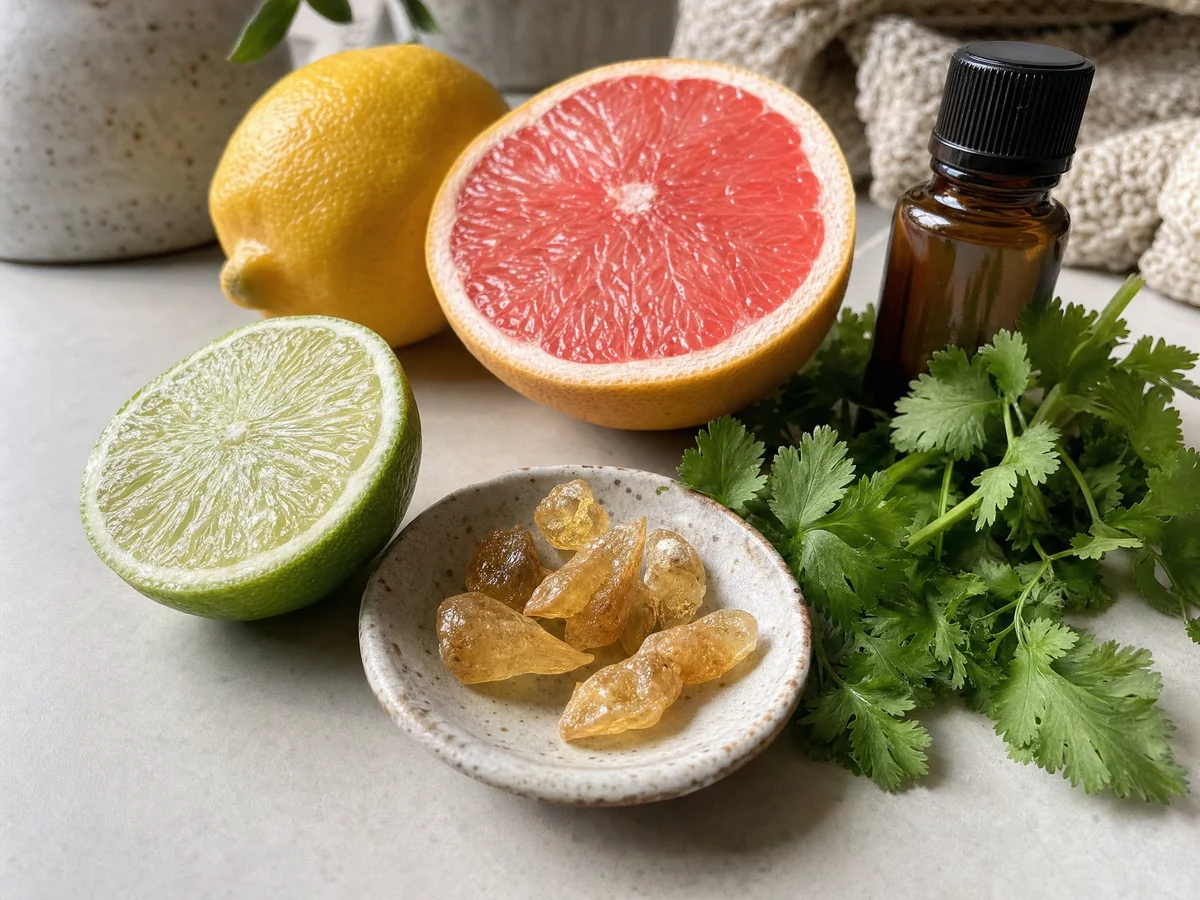
A drop budget
We found no published diffusing limit for cilantro or these citrus oils, so the budget is our own precaution: no more than 5 drops of oil in total per session in a 100 ml tank, a cool ultrasonic or nebulizing unit, and 15 to 30 minutes with a door or window open. At about 20 drops per ml, 5 drops is roughly 0.25 ml. Studies back the caution in general terms: in a chamber test, lemon oil gave off far more particulate than lavender or eucalyptus (Schwartz-Narbonne et al., 2021), and a home simulation found about ten times the terpene levels from a heat diffuser as from an ultrasonic one, for tea tree oil (Zisook et al., 2025). If your diffuser manual gives a lower count, follow the manual. These are room blends only; none of them is meant for skin.
Five blends for a 100 ml tank
| Blend | Drops | Cilantro share | Expected character | Where it fits |
|---|---|---|---|---|
| Lemon and cilantro | 3 lemon, 1 cilantro | 25% | Zesty, with a waxy green edge | Kitchen or entry hall |
| Orange and ginger | 3 sweet orange, 1 cilantro, 1 ginger | 20% | Rounded sweet peel, warm dry finish | Living room |
| Mandarin mist | 2 mandarin, 1 cilantro | 33% | Light, juicy, a faint herb note | Small room, short session |
| Lemongrass and orange | 2 sweet orange, 1 lemongrass, 1 cilantro | 25% | Grassy lemon with a herbal back | Open kitchen |
| Pepper and leaf | 1 lemon, 1 black pepper, 1 cilantro | 33% | Dry, peppery, green with a flash of citrus | Dining room, evening |
Why each one is built this way
Lemon and cilantro stack two bright openings, the limonene sharpness of lemon over the waxy aldehydes of the leaf. Both are fast, so it is a pre-guests blend, not an all-evening one. Orange and ginger is the one to pick if you want a citrus smell that is not sour: orange is the least jagged citrus and buffers the cilantro, while ginger is the one drop meant to linger once the orange has gone. Mandarin mist is the small-budget option; with only three drops, one extra drop of cilantro turns it into a herb blend with a citrus garnish, so count aloud. In lemongrass and orange, each strong oil is held to a single drop with orange supplying the bulk, because a second lemongrass drop would very likely overtake the cilantro. Pepper and leaf flips the usual order, making cilantro the lead, lemon a brief lift and black pepper the dry anchor. It is the least citrusy and most divisive of the five, so strip-test it first (the partner shortlist explains how).
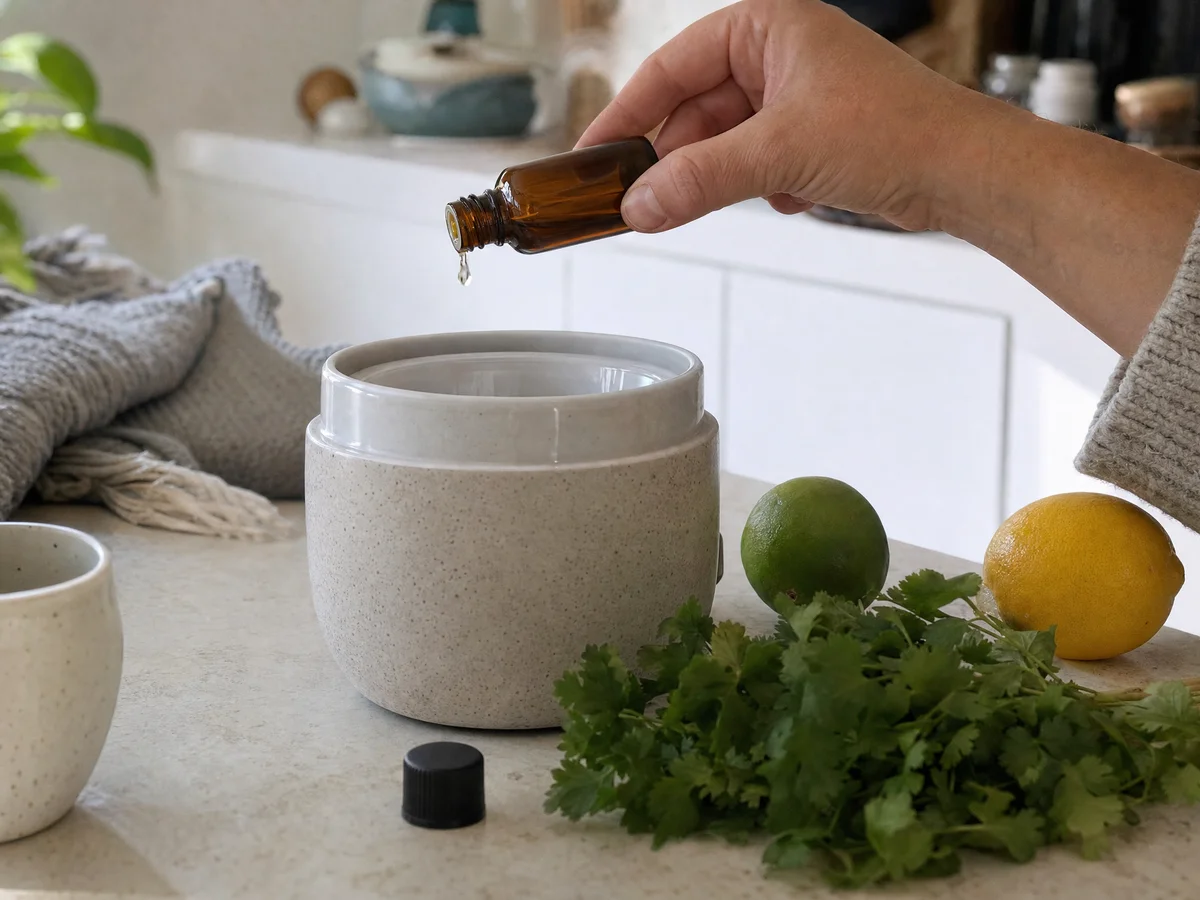
These counts come from the ratio logic above, and your lot, dropper and diffuser will shift the result, so treat the aroma notes as a starting hypothesis for your own nose. If you want the exact aldehyde balance of a lot, ask us in writing through the contact page.
One last tip is to keep a little notebook beside the diffuser. Write the blend, the drops and how the room felt after twenty minutes. If a blend works, you will be glad to have the recipe. If it does not, you will know what to change next time.
Who should sit this out
A blend is only as suitable as its least suitable oil. If there is a cat, bird or small mammal at home, read the pets guide first; the kids and pregnancy posts cover those situations, and a veterinarian, pediatrician or obstetrician is the right person for a specific case. Stop and air the room if anyone coughs, gets watery eyes or a headache. Do not cook with these oils or put them in food or drink; we say not to take cilantro oil internally. For a spray instead of a diffuser, see the room spray post.
Pick the job you want, crisp opener, rounder afternoon, tiny trial, herb market kitchen or dry evening, and the right blend follows.
Cilantro Essential Oil
Cilantro Essential Oil from our own shop, in sizes from 0.5 oz to bulk.
From $13.99
Shop Now →Sources & Further Reading
- Kumar S. et al., 2022. Chemical composition of fresh leaves headspace aroma and essential oils of four coriander cultivars. Front Plant Sci. pubmed.ncbi.nlm.nih.gov/35251089
- Foudah A.I. et al., 2021. Cilantro leaf essential oil composition. Saudi J Biol Sci. pubmed.ncbi.nlm.nih.gov/34121885
- Bourgou S. et al., 2012. Changes of peel essential oil composition of four Tunisian citrus during fruit maturation. ScientificWorldJournal. pubmed.ncbi.nlm.nih.gov/22645427
- Guo Q. et al., 2018. Gannan navel orange peel essential oils. Food Sci Nutr. pubmed.ncbi.nlm.nih.gov/30258585
- Maksimovic T. et al., 2025. Cymbopogon citratus essential oil composition. Plants (Basel). pubmed.ncbi.nlm.nih.gov/40364370
- Schwartz-Narbonne H., Du B., Siegel J.A., 2021. Emissions from an ultrasonic essential oil diffuser. Indoor Air. pubmed.ncbi.nlm.nih.gov/33905580
- Zisook R.E. et al., 2025. Emissions from tea tree oil in essential oil diffusers. pubmed.ncbi.nlm.nih.gov/41004428