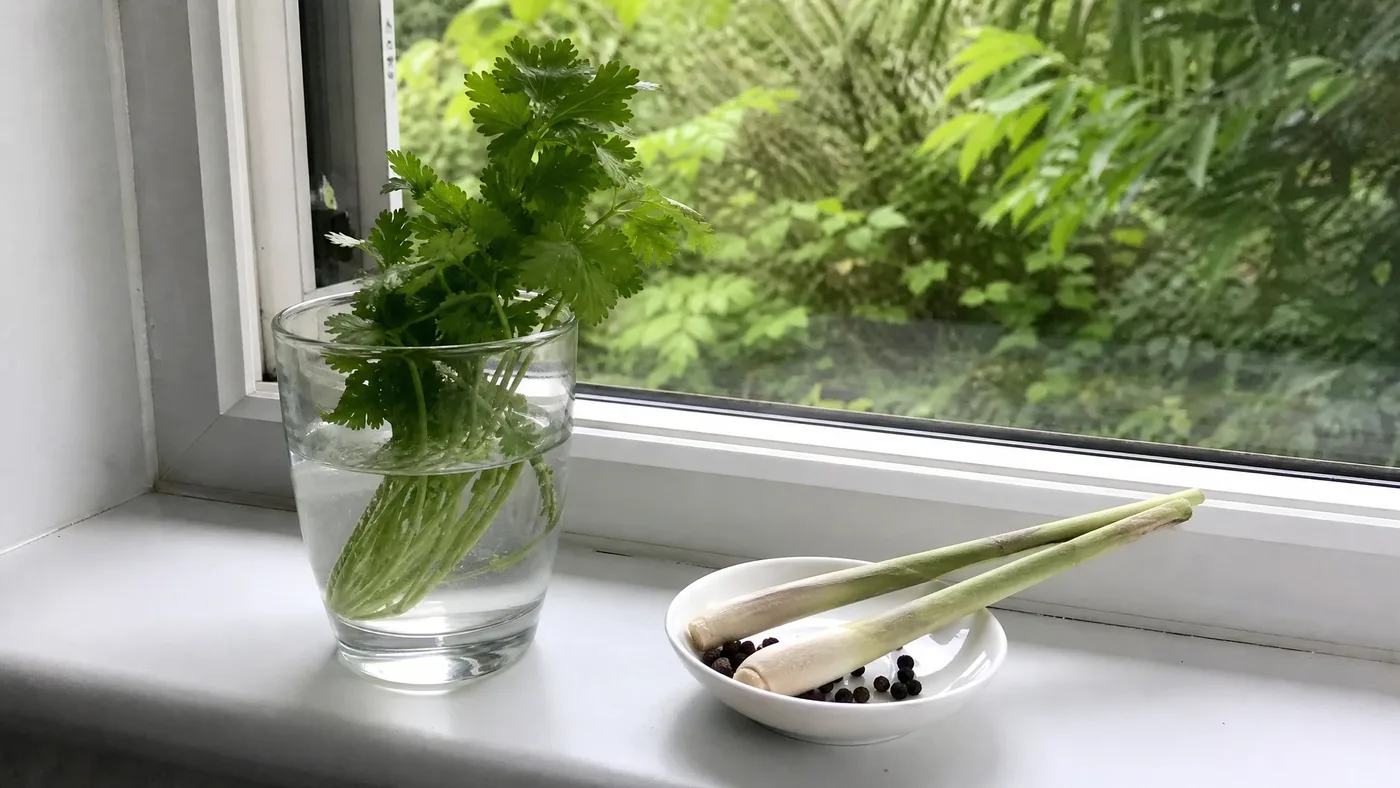
Cilantro Oil Substitutes: What Fills the Gap
Nothing replaces cilantro leaf oil, so the useful question is not "what smells the same?" but "what was the cilantro doing in the first place?" It might be giving a fresh green lift, a waxy citrus-peel edge, or that unmistakable cilantro character that people love or hate. Each of those has a different stand-in. We sell only the cilantro oil, so every suggestion below comes from another supplier.
Cilantro Essential Oil
Our own Cilantro Essential Oil, in sizes from 0.5 oz to bulk.
From $13.99
Shop Now →Name the job first
- The green lift: a fresh-cut top note that opens a blend and fades first.
- The waxy, citrus-peel edge: cilantro leaf oil is led by straight-chain aldehydes such as 2-decenal and decanal, which supplies this (Kumar et al., 2022).
- The cilantro identity: the specific character that divides people, which we dig into in the soap-smell post.
No single oil does all three, so substitute for the job, not for the scent.
The candidates
These come from published composition papers, each about one specific sample, and the ratings are our reasoning from chemistry.
| Candidate | What a paper reports | What it shares | What it does not |
|---|---|---|---|
| Coriander seed oil | Linalool 60 to 73% in three fruit oils (Machado 2023) | The plant | The aldehyde lead |
| Culantro (Eryngium foetidum) leaf oil | A Nigerian leaf oil led by (E)-2-dodecenal 28.43% and 13-tetradecenal 27.45% (Thomas 2017) | An aldehyde-led make-up | A different plant with longer-chain aldehydes |
| Lemongrass | Dermal maximum of 0.7% (Tisserand Institute) | A lemony, citrus-leaning lift | The waxy aldehyde edge |
| Distilled lime | A brighter, sharper top note | The citrusy opening | The aldehyde lead |
Coriander seed oil: same plant, different job
The overlapping names invite this swap, and it is the weakest match for a leaf-oil recipe. Linalool leads the fruit oils, while the aldehydes lead the aerial-part oils from the same species. Use seed oil if you want a different oil, and do not expect it to behave like ours. Our leaf versus seed article has the comparison.
Culantro: the closest in spirit
If it is the aldehyde edge you want, culantro leaf oil shares the chemical family. The Nigerian sample above came from one place and one harvest, so it is a single data point, and other culantro oils will differ. Because its aldehydes run longer, we would expect it to read differently from cilantro, so treat it as a relative rather than a twin.
Lemongrass: check the limit before you swap
Lemongrass has a skin maximum of 0.7%, well inside the 0.5% to 2% we recommend for our cilantro oil. In practice, one ounce of carrier is about 29.57 ml, so 0.7% is about 0.2 ml, or roughly 4 drops at the usual rough 20 drops to the millilitre. A recipe written for 12 drops of cilantro per ounce would give about three times that limit if lemongrass went in one for one. Scale to the substitute's own limit.
Lime: ask whether it is distilled or expressed
The Tisserand Institute notes that distilled lime is fine on skin before going out in the sun, while expressed lime is phototoxic and should be diluted heavily or avoided if sun exposure is expected (Tisserand Institute, supplier guide). "Cold pressed" on a listing can hide which one you are getting, so ask and check the botanical name.
If the job is "green"
The same four-cultivar paper collected the air around freshly chopped leaves and found (Z)-3-hexenyl acetate at 66 to 77% and (Z)-3-hexenol at 6 to 13%, then reported those green leaf volatiles as largely absent from the steam-distilled oils. So even cilantro oil does not hold the classic fresh-cut molecules, and if that exact note is the goal, you want a different ingredient. Green notes explained unpacks the vocabulary.
Trying a swap without wasting a bottle
Before you commit to a full bottle of anything new, try the substitute on a paper strip next to a drop of ours, if you have it. Smell them at the start and again after ten minutes. Note which part of the cilantro you miss. Then make the smallest possible test blend, a couple of drops in a spare dish or on a tissue, rather than a full batch. Most disappointments with substitutes come from judging a scent in a rush.
It also helps to remember that cilantro's charm is its oddness. If your blend does not need that quirk, you may find a softer green or citrus more comfortable to live with. If it does need it, wait for the original and make something else in the meantime.
A quick decision walk-through
- Want the waxy aldehyde edge? Try culantro leaf oil and buy the smallest size.
- Want a bright top note and nothing more? Distilled lime.
- Want a citrus-leaning aldehyde? Lemongrass, scaled to its own 0.7%.
- Want the same oil as the recipe? Nothing substitutes.
Whatever you choose, patch test a diluted sample first and see a dermatologist or allergist if you react. Other relatives are covered in cilantro versus parsley and fragrance oil versus essential oil, and if cilantro is the lead and you only need supporting oils, the blending post is the one to read. Essential oils are not food flavourings, and ours is not for internal use.
Pick the stand-in for the job, and accept that sometimes the honest answer is that only the original will do.
Cilantro Essential Oil
Cilantro Essential Oil from our own shop, in sizes from 0.5 oz to bulk.
From $13.99
Shop Now →Sources & Further Reading
- Kumar S. et al., 2022, Front Plant Sci 13:820644. PMC8891447
- Machado A.M. et al., 2023, Plants 12(14):2749. PMC10384636
- Thomas P.S. et al., 2017, Eryngium foetidum essential oils, Medicines 4(2):24. PMC5590060
- Tisserand Institute, dermal maximums. tisserandinstitute.org/learn-more/safety-maximum-dermal
- Tisserand Institute, supplier guide. tisserandinstitute.org/essential-oil-suppliers