Cilantro Fragrance Oil vs Essential Oil: Which to Pick?
A bottle marked "cilantro fragrance oil" does not have to contain a single cilantro leaf. A bottle marked "cilantro essential oil" is, by the usual understanding, a distillate of the plant. Both can smell wonderfully green, and both have a place, but they are different kinds of product and it helps to know which one you are holding.
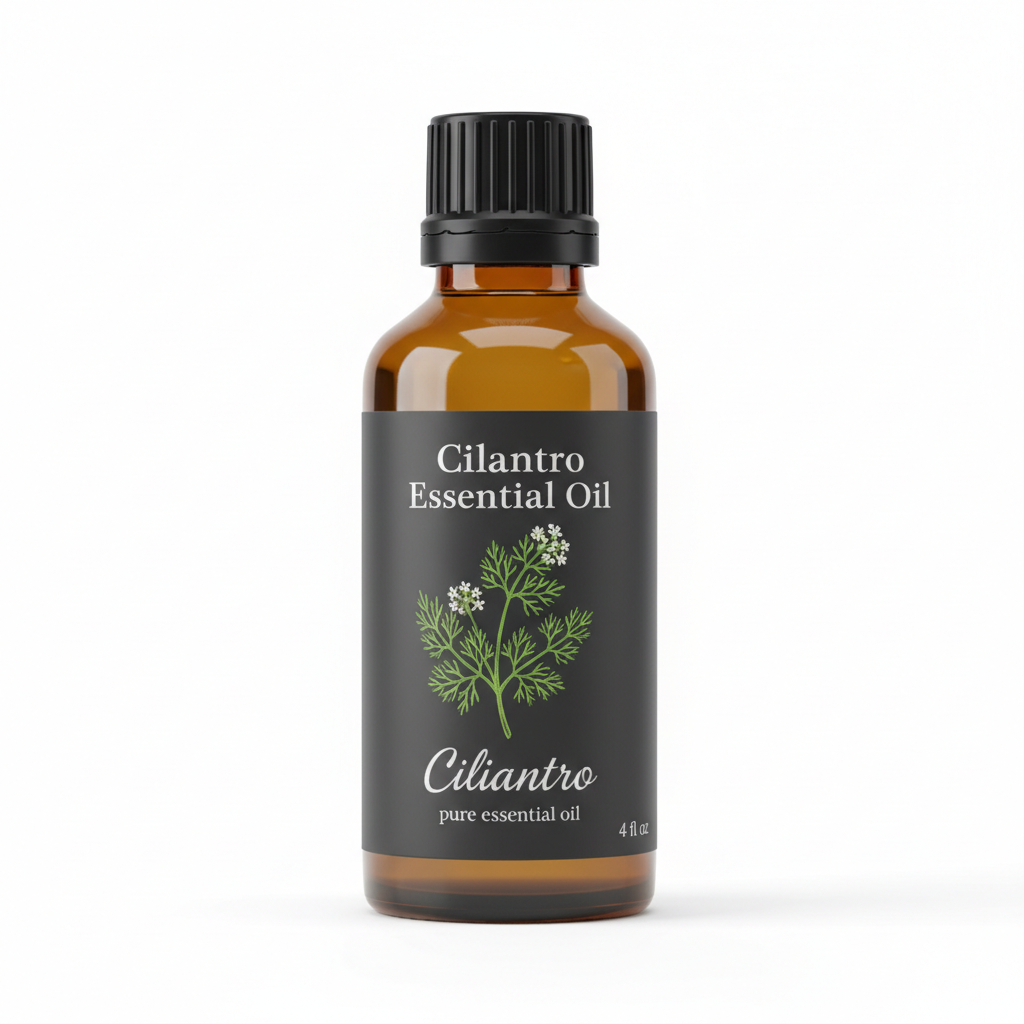
Cilantro Essential Oil
Our own Cilantro Essential Oil, in sizes from 0.5 oz to bulk.
From $13.99
Shop Now →Our verdict, in one paragraph
Reach for an essential oil when you want the real plant and are happy to let the scent shift a little from one lot to the next. Reach for a fragrance oil when you need the same scent every time and do not mind that the formula belongs to the maker. Neither is better in the abstract. What we would steer you away from is letting the word "cilantro" on the label suggest the two are interchangeable.
What the regulator does and does not say
The US Food and Drug Administration points out that there is no regulatory definition of "essential oil". It also explains that fragrance and flavor ingredients can be listed on a cosmetic label simply as "Fragrance" or "Flavor", and that these formulas are complex mixtures of natural and synthetic chemicals (FDA, Fragrances in Cosmetics). Reading that page plainly, three things follow.
- "Essential oil" is a description rather than a checked standard, so the botanical name, plant part and method of extraction are where the real information lives.
- A fragrance oil can be fully synthetic, partly natural or a blend, and a cilantro-like scent can be built from aldehydes and green notes without distilling any plant.
- A fragrance oil's label may reveal very little. The safety data sheet and any allergen disclosure from the supplier are what to ask for.
Why an essential oil never smells exactly the same twice
This is the part of natural materials that surprises people. Even within one species, cilantro leaf oil is not one fixed thing. One recent study steam-distilled 48 coriander accessions from 19 countries, all grown at the same site, and found oils that were mostly led by the aldehyde (E)-2-decenal but with a few led by linalool instead. Across the group, linalool ran from none to over 61% (Kim and Kim, Molecules, 2026). Other methods can produce still another picture. A hydrodistilled leaf oil from Bangladesh was led by acids, with 2-decenoic acid at about 31% (Bhuiyan et al., 2009).
The takeaway is that natural variation is part of the character. A fragrance oil is engineered to flatten it out.
Picking for the job
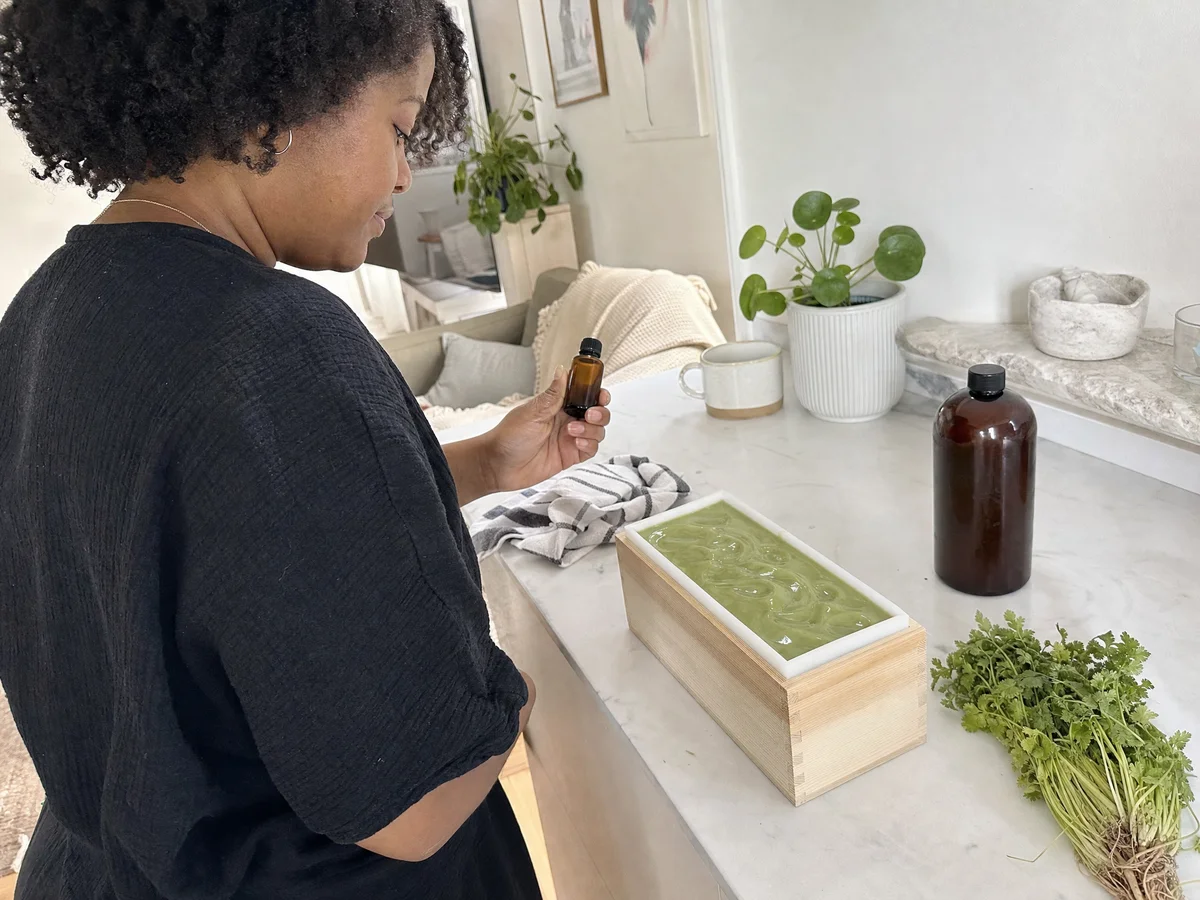
Candles and soap you plan to sell. A fragrance oil usually arrives with a maker-stated usage rate and a statement about which processes it suits. An essential oil from us does not come with those, so you would work out loading in your own base from your supplier's data. Our candle and soap buyer's guide and our piece on cilantro oil in soap take you through the arithmetic.
Skin products. You need a dilution ceiling you can point to. For our oil we recommend 0.5% to 2% in a carrier with a patch test first. For a fragrance oil use the maker's stated limit and ask for the allergen declaration. If fragrance in general bothers your skin, a dermatologist is the right person to ask.
A diffuser at home. Either works. If you want a green, citrus-edged aroma from the plant itself, the essential oil is the one. If you want the exact smell of a freshly chopped bunch from your memory, read the fragrance oil's description closely, because the real oil leans sharper and waxier. Our scent profile describes it.
Anything edible. Neither one. Our oil is not for internal use, and a physician is the right call for any question about swallowing an oil.
Thinking about a repeatable product
Imagine a small soap maker who needs batch 12 to smell like batch 1. With an essential oil, that depends on the lot, so the maker would buy enough of one lot to cover a run or accept a shift between runs. With a fragrance oil, the maker can request the same reference formula and the supplier's allergen disclosure again. Reasoning from that, repeatability is a real strength of fragrance oil, while a named botanical and the story of a distilled plant are the real strengths of the essential oil. If you sell a finished product, check labeling rules for your market, since the FDA page above speaks to US cosmetic labeling only in general terms.
If you can, smell both side by side. The essential oil tends to open sharp and waxy and then wander, while a fragrance oil is usually built to stay on one note from start to finish. Neither impression is wrong, and which one you prefer is a very personal call.
Questions worth sending any supplier
- Is it all distilled plant material, or does it contain solvents, carriers or synthetics?
- For an essential oil, what are the botanical name, plant part, extraction method and lot analysis?
- For a fragrance oil, what do the safety data sheet, recommended maximum usage rate and allergen disclosure say?
- For either, what are the lot number and date?
For ours, the answers are Coriandrum sativum, steam-distilled from fresh leafy tops, with a lot reference on the bottle. The Certificate of Analysis we publish covers one batch and lists density, refractive index and optical rotation. If you need the composition for your lot, ask us in writing through the contact page before ordering. We sell only the one oil, so if you want a fragrance oil you would find it at a candle or soap supplier. For the leaf oil next to its seed cousin, see the leaf and seed comparison.
If a real plant scent with some natural personality sounds right for your project, a small first bottle is an easy way to find out.
Cilantro Essential Oil
Cilantro Essential Oil from our own shop, in sizes from 0.5 oz to bulk.
From $13.99
Shop Now →Sources & Further Reading
- US Food and Drug Administration. Fragrances in Cosmetics. fda.gov/cosmetics/fragrances-cosmetics
- Kim M, Kim S, 2026. Climate Zone of Geographical Origin Associations with Essential Oil Composition, Yield, and Chemotype Distribution in Coriandrum sativum L. pmc.ncbi.nlm.nih.gov/articles/PMC13257553
- Bhuiyan MNI, Begum J, Sultana M, 2009. Chemical composition of leaf and seed essential oil of Coriandrum sativum L. from Bangladesh. banglajol.info/BJP/2800