Cilantro Oil in Perfumery: A Sharp Green Top Note
Perfumers talk about "green" as if it were one smell, but it is a whole family, and cilantro oil is an unusual member. Knowing which kind of green it is tells you exactly what job it can do in a scent.
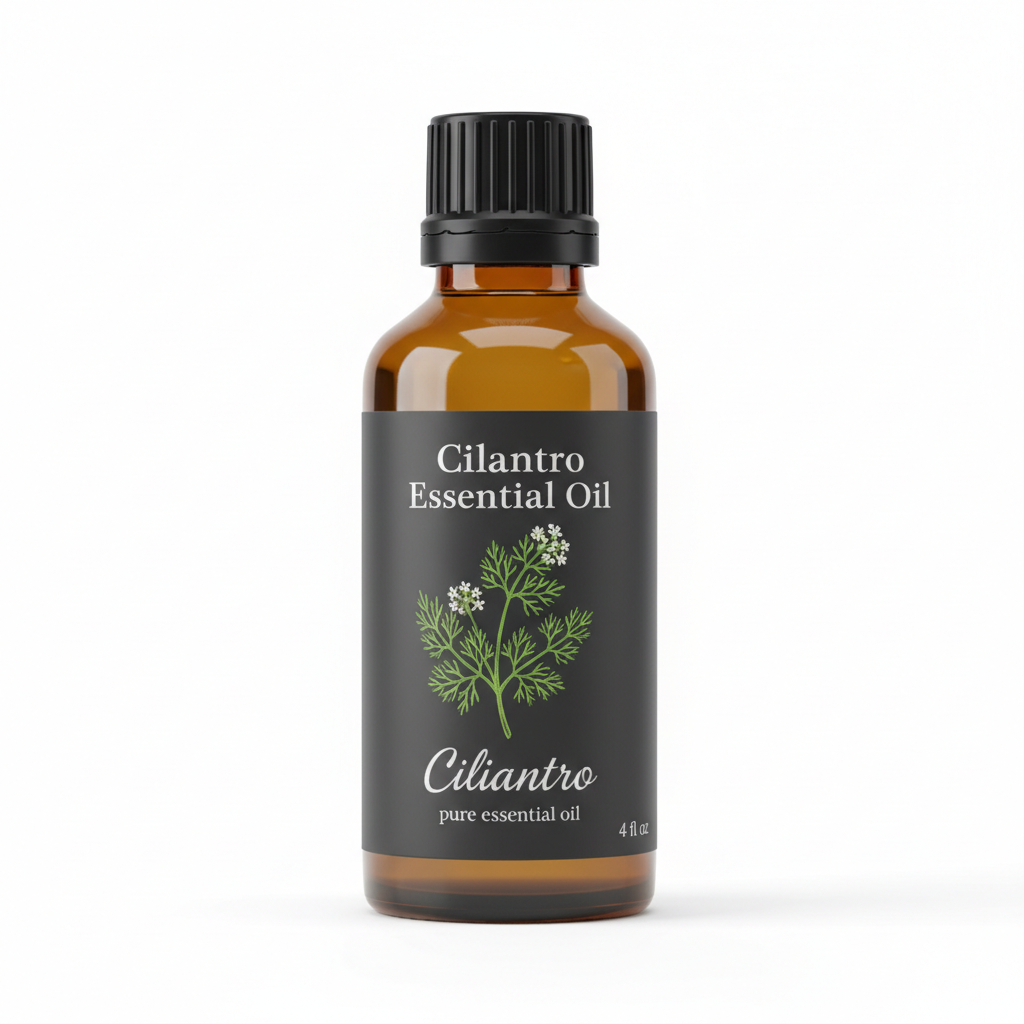
Cilantro Essential Oil
Our own Cilantro Essential Oil, in sizes from 0.5 oz to bulk.
From $13.99
Shop Now →Green is a family, not a note
A 2022 review of fragrance chemistry describes the green odor family as reminiscent of leaves and grasses, and notes it also takes in minty, camphorous and resinous materials. It singles out (Z)-hex-3-en-1-ol, the leaf alcohol that smells of cut grass, as an intense green material often used with geranium, galbanum, oakmoss, lavender and mint (Kleoff, Kiler and Heretsch, Beilstein J Org Chem, 2022). The review says nothing about cilantro, so we use it only as a map of the territory.
If you want to train your nose, make green a little game. Smell a torn basil leaf, a cut stem, a lemon peel and a drop of cilantro oil on separate strips, one after the other. Between each, sniff the crook of your elbow to reset. You will notice the oil has the citrus lift of the peel and the leafiness of the stem, but with a waxy twist neither has.
Where cilantro leaf oil sits
Cilantro oil is not the crushed-stem green of leaf alcohol. Chopped coriander leaf in one 2022 study was 66% to 77% (Z)-3-hexenyl acetate, a classic leaf-green ester. The steam-distilled oil was led instead by four long-chain aldehydes, about 59% to 66% combined. Reasoning from that, the oil is an aldehydic, waxy, citrus-leaning green: less "just mowed lawn", more bite and sparkle. We call it a top note with a citrusy edge.
That gives it a clear job. If you want the freshly cut impression, you need a leaf-alcohol material, and we do not sell one. If you want a sharp herbal-citrus lift at the front of a scent, cilantro oil does that very well. Green notes explained goes further into the aldehyde versus leaf-alcohol split.
Three decisions before you start
Room or skin? For rooms, the partners we recommend are lime, lemongrass, black pepper, ginger, petitgrain and bergamot, and the diffuser post covers dosing. For skin we recommend diluting to 0.5% to 2% in a carrier with a patch test, and the perfume maths post shows the workings. If you plan to sell a product, check the limit for your product type against current IFRA standards.
How much? A top note is a small fraction of the whole, and cilantro oil is pungent enough to take over, so start with far less than you expect.
Who will smell it? Some people perceive cilantro as soapy, and receptor research links that to how we detect medium-chain aldehydes (Wang et al., Cell, 2026). Our guess is that an aldehyde-rich oil makes that more likely than the herb does, so try it on a few other noses before committing. Our post on why cilantro smells like soap explains more.
A good habit is to keep a short scent diary. Write a few words about what you smell at one minute, ten minutes and an hour. Top notes like this one change quickly, and your notes will show you what is really left after the opening bursts.
A worked example in one drop
Take a 10 ml roll-on at our 2% upper line. That is 0.2 ml of total essential oil, about 4 drops at the rough convention of 20 drops per ml. If cilantro is the top note and not the star, giving it a quarter of those drops means one drop in 10 ml, or about 0.5%. The remaining drops go to a partner such as lime or bergamot. The 20-drops figure varies with the dropper, so weigh it if you want precision; the batch on our published Certificate of Analysis had a relative density of 0.86719, so 1 ml weighs about 0.867 g.
If numbers are not your thing, a simpler way to work is by proportion. Think of the oil as a pinch of salt in a pot: you want to notice that something is there, but you never want to taste the salt itself. Start with a pinch, smell, and add only if it seems flat.
Whichever way you go, give a blend time. Smell it right after mixing, again after a day, and again after a few days. Fast top notes like this one settle into the mix, and many blends smell more rounded once they have had a rest.
Not quite right for the job?
For a plain citrus or herbal lift, lime or bergamot may suit you better and is less divisive. We do not sell either, and our substitutes guide compares options by job. For a leave-on product you plan to sell, a cosmetic chemist is the right person to ask about the aldehydes.
A note earns its place when it does something nothing else in your formula can, and for cilantro oil that something is a sharp, citrus-edged green.
Cilantro Essential Oil
Cilantro Essential Oil from our own shop, in sizes from 0.5 oz to bulk.
From $13.99
Shop Now →Sources & Further Reading
- Kleoff M, Kiler P, Heretsch P, 2022. Synthesis of odorants in flow and their applications in perfumery. Beilstein J Org Chem 18:754-768. beilstein-journals.org/bjoc/articles/18/76
- Kumar S et al., 2022. Chemical composition of fresh leaves headspace aroma and essential oils of four coriander cultivars. Front Plant Sci. pubmed.ncbi.nlm.nih.gov/35251089
- Wang T et al., 2026. Structural decoding of reversible covalent linkage of odorants in human olfactory receptor OR6A2. Cell 189(5). pubmed.ncbi.nlm.nih.gov/41570822