
Cilantro Oil: The Complete Guide to Coriander Leaf Essential Oil
Key Takeaways
- Cilantro essential oil is distilled from fresh Coriandrum sativum leaves, making it distinctly different from coriander seed oil in both scent and chemistry.
- Its aroma is bright, green, and unmistakably herbaceous, with a slightly citrus-edged finish that many people describe as "freshly chopped herb in a bottle."
- Cilantro oil is gaining traction in natural perfumery, cosmetic formulation, and home diffusing, though it remains one of the rarer items in the essential oil market.
- Quality varies significantly between suppliers. Knowing what to look for on a label, in a GC/MS report, and in the bottle itself will protect your purchase.
- Proper dilution (typically 0.5% to 1% in leave-on cosmetics) and a patch test are non-negotiable before using any essential oil on skin.
- Always consult a qualified healthcare provider before incorporating essential oils into any health-related routine.
1. What Is Cilantro Oil, Exactly?
The name "cilantro oil" sounds straightforward until you start shopping for it. You will quickly notice that the plant Coriandrum sativum produces two entirely different essential oils, and confusing them is one of the most common mistakes new buyers make.
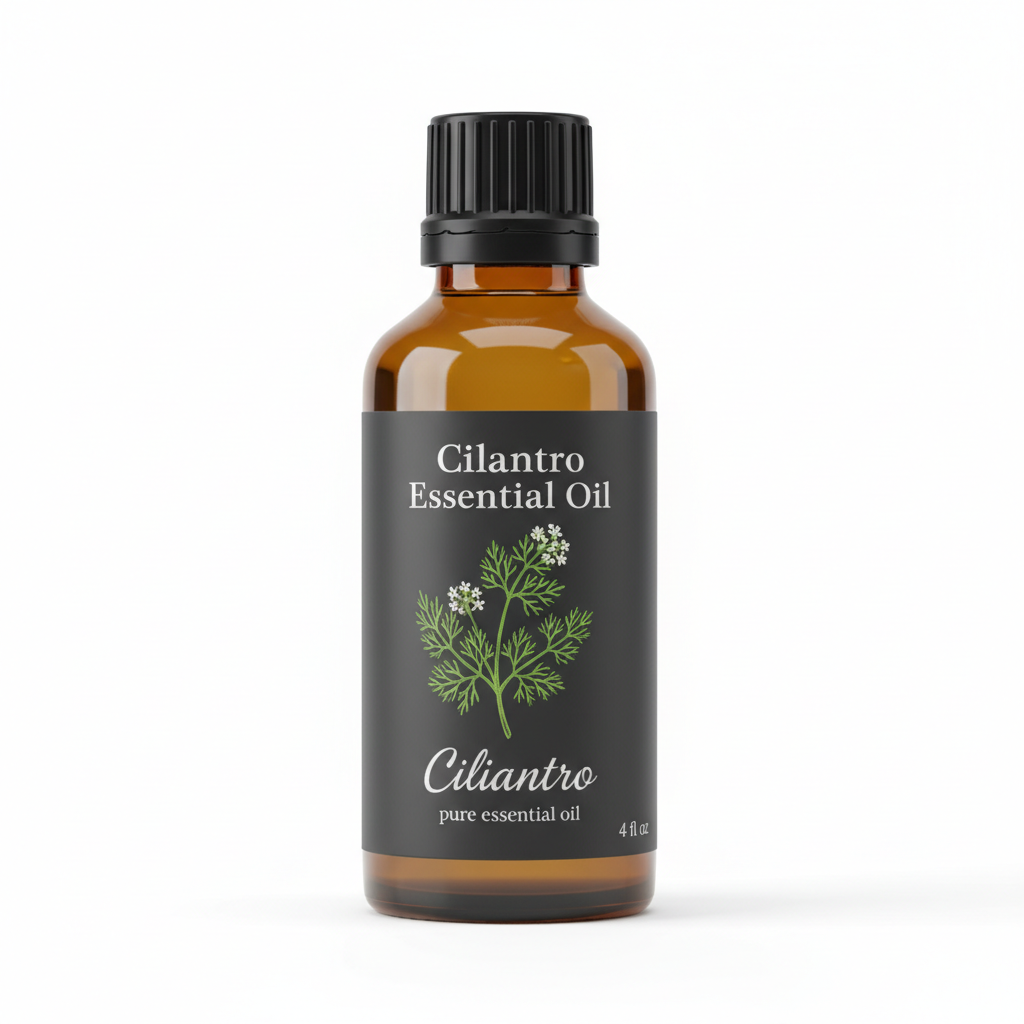
Cilantro Essential Oil
Our own Cilantro Essential Oil, in sizes from 0.5 oz to bulk.
From $13.99
Shop Now →Coriander seed oil is distilled from the dried, ripe seeds of the plant. It has a warm, spicy, slightly floral character and has been used in perfumery and food flavoring for centuries. Cilantro leaf oil, sometimes listed as coriander leaf essential oil or oil of cilantro, is distilled from the fresh green leaves and stems. It smells unmistakably like the herb itself: vivid, green, and polarizing in the best way.
This guide is specifically about the leaf oil. The two products share a botanical parent but diverge sharply in chemistry, aroma, and application. Keep that distinction in mind whenever you read a product label or a supplier description.
Botanical Background
Coriandrum sativum belongs to the Apiaceae family, the same plant family that includes parsley, dill, fennel, and carrot. It is an annual herb that grows widely across South and Southeast Asia, Latin America, the Mediterranean, and parts of Africa. The plant has been cultivated for thousands of years. Seed residues have been found in Egyptian tombs, and references to the herb appear in Sanskrit texts and the Old Testament.
Today, major producing regions for the leaf oil include India, Mexico, China, and parts of Eastern Europe. The growing conditions, harvest timing, and post-harvest handling all influence the final oil's aroma and constituent profile, which is why the same botanical species can smell noticeably different from one supplier to the next.
How "Oil of Cilantro" Appears on Labels
If you are scanning ingredient lists on cosmetic products or reading supplier catalogs, you may encounter several interchangeable names for the same leaf oil:
- Cilantro essential oil
- Coriander leaf essential oil
- Oil of cilantro
- Coriandrum sativum herb oil (the INCI name used in cosmetics)
- Coriander herb oil
The INCI designation on a cosmetics label is your most reliable confirmation that you are looking at the leaf-derived product. When the label says "coriander seed oil" or lists the INCI as Coriandrum sativum fruit oil, you are looking at something different.
2. How Cilantro Essential Oil Is Made
Steam distillation is the standard production method for cilantro leaf oil, and the process has a direct impact on the quality of what ends up in your bottle. For a detailed walkthrough of the distillation process, see our dedicated article on how cilantro essential oil is made through steam distillation. Here is the overview.
Steam Distillation: The Basics
Fresh cilantro leaves and stems are loaded into a still. Steam is passed through the plant material, causing the aromatic molecules within the plant's oil glands to vaporize. That vapor travels through a condensing coil, cools back into liquid, and separates into two layers: the essential oil (which floats) and the hydrosol, or floral water (which sinks). The essential oil is drawn off, filtered, and bottled.
The entire process is deceptively simple in concept but demanding in practice. Cilantro leaves are delicate. They contain a high percentage of water relative to their oil content, and that oil begins to degrade almost as soon as the plant is harvested. This is why the timing between harvest and distillation matters enormously for leaf oil quality.
Why Harvest Timing Is Critical
Cilantro is harvested before the plant bolts to seed. Once flowering begins, the leaf's aromatic profile shifts, and the essential oil yield drops. Skilled producers harvest early in the morning when the plant's volatile compounds are at their highest concentration, and they move the material to the still within hours rather than days.
Slow processing introduces two quality risks. First, the leaves begin to ferment slightly, which can push the oil toward off-notes that experienced noses describe as "soapy" or "musty." Second, some of the more volatile top-note compounds evaporate before distillation even begins, leaving behind a less complex, flatter oil.
Yield and Why the Oil Is Relatively Rare
Cilantro leaf oil has a low yield compared to many other essential oils. It typically takes somewhere between 150 and 300 kilograms of fresh plant material to produce one kilogram of essential oil, depending on the cultivar, growing region, and conditions that season. That low yield, combined with the logistical demands of rapid post-harvest processing, explains why genuine cilantro essential oil commands a higher price than many common oils and remains difficult to source reliably.
Cold Pressing: An Alternative Worth Knowing
A small number of producers offer cold-pressed cilantro leaf extracts, using mechanical pressure rather than heat. Cold pressing tends to preserve a broader range of delicate aromatic compounds that steam distillation can partially denature. The resulting product is not a true essential oil in the distilled sense, but it is highly valued in natural perfumery for its fresher, more nuanced character. If you encounter a cold-pressed cilantro leaf product, read the label carefully: it will often be labeled as an absolute or a CO2 extract rather than an essential oil.
3. The Scent Profile: What to Expect in the Bottle
If you have ever pulled a bunch of fresh cilantro from a grocery store and brought it to your nose, you already have a reasonable sense of what this oil smells like. But there is more nuance in the bottle than in the herb.
For a deeper sensory exploration, read our full article on what cilantro essential oil smells like. The summary below will orient you.
The Primary Aroma Character
Cilantro essential oil opens with a sharp, intensely green note. There is something almost aldehydic about it, a clean, waxy brightness that recalls freshly cut stems rather than dried herb. Underneath that opening lies a faintly citrus edge, often described as somewhere between lemon and lime but softer than either. As the oil dries down, a mild earthy, slightly woody undertone emerges, anchoring what would otherwise be a very top-heavy fragrance.
In perfumery language, cilantro leaf oil is classified as a top-to-heart note. It does not have the longevity of a base note, but it adds remarkable lift and green freshness to a blend, and it lingers longer than many other green herbaceous oils.
Why Some People Smell "Soap" (And What That Means)
The "soapy" perception that some people associate with cilantro is not imaginary, and it is not simply a preference. Research has identified a genetic variant that affects how certain aldehydic compounds in the herb are perceived. For people with this variant, those same molecules that smell bright and herbal to most noses register as soapy or metallic.
This genetic perception difference applies primarily to eating the fresh herb, but it can carry over to the essential oil experience as well. If you have always disliked fresh cilantro for this reason, approach the essential oil with a small sample first rather than committing to a full bottle.
Scent Comparison: Cilantro Leaf vs. Coriander Seed
| Attribute | Cilantro Leaf Oil | Coriander Seed Oil |
|---|---|---|
| Primary character | Green, herbaceous, fresh | Spicy, floral, slightly woody |
| Citrus note | Mild, leafy-citrus | Warm, subtle |
| Perfumery classification | Top to heart note | Heart to base note |
| Longevity on skin | Moderate (2 to 4 hours) | Good (4 to 6 hours) |
| Most common use | Diffusing, green perfumery, cosmetics | Perfumery, flavoring, body care |
4. Inside the Bottle: Chemistry and Key Constituents
Understanding the chemical profile of cilantro essential oil helps explain its aroma behavior, its cosmetic properties, and the quality standards that a good supplier should be able to document. This section is not a chemistry lecture. It is practical context.
The Aldehyde-Dominant Profile
Cilantro leaf oil is dominated by aliphatic aldehydes, particularly a series of straight-chain compounds including (E)-2-decenal, decanal, and dodecanal. These aldehydes are largely responsible for the oil's characteristic green, soapy-citrus scent. Aliphatic aldehydes are potent aroma compounds: a small amount has a large olfactory impact, which is one reason cilantro oil should be used sparingly in blends.
Linalool, the same terpene alcohol that gives lavender and coriander seed much of their character, appears in cilantro leaf oil as well, though typically at lower percentages than in the seed oil. Its presence adds a gentle floral softness to what would otherwise be a sharply green profile.
Terpenes and Supporting Compounds
Beyond the aldehydes and linalool, a well-characterized cilantro leaf oil will contain smaller amounts of:
- Alpha-pinene and beta-pinene (fresh, piney top notes)
- Gamma-terpinene (a warm, woody supporting note)
- Camphor (in minor quantities, contributing a cool, slightly medicinal edge)
- Geraniol (a rosy, soft floral undertone)
The precise ratios of these compounds vary by origin. Indian-grown cilantro leaf oil, for example, tends to have a higher aldehyde content and a sharper, more assertive green character than oils from some Eastern European sources, which can lean more toward the linalool-forward profile.
Why a GC/MS Report Matters
Gas chromatography/mass spectrometry (GC/MS) testing is the industry standard method for identifying and quantifying the chemical constituents in an essential oil. A reputable supplier will provide a GC/MS report, either on request or published openly on their website.
For cilantro leaf oil specifically, the GC/MS report can confirm that you are buying true leaf oil and not a blend of seed oil with added synthetic aldehydes, a substitution that does occur in the market. Look for that characteristic aldehyde cluster. If the report shows a dominant linalool peak with low or absent aldehydes, you likely have a seed oil or a mislabeled product.
5. Cilantro Oil Uses: Cosmetic, Aromatic, and Around the Home
Cilantro oil uses span a wider range than most people expect from such a niche ingredient. Its bright, green character makes it genuinely useful in several categories. For a full list of creative applications, see our article on 15 fresh ideas for cilantro oil uses in the kitchen and home.
Aromatic Uses: Diffusing and Home Fragrance
Diffusing cilantro essential oil is perhaps the most immediate way to experience what the oil does well. In a diffuser, it fills a room with a clean, green freshness that feels distinctly different from the more common floral or woodsy aromatics. Many people find the scent invigorating during the morning or mid-afternoon, when a bright, green atmosphere supports a focused, alert mood.
For detailed diffuser blends and guidance on ratios, visit our dedicated resource on cilantro essential oil in the diffuser. The quick version: start with 2 drops of cilantro oil in a standard ultrasonic diffuser, paired with a citrus or conifer oil. The scent is potent. A light hand produces a better result than a heavy one.
Simple Morning Diffuser Blend
2 drops cilantro essential oil
3 drops sweet orange essential oil
2 drops Douglas fir or Siberian fir essential oil
Run for 30 to 60 minutes with windows slightly open for the best effect.
Natural Perfumery
In natural perfumery, cilantro leaf oil is valued as a green, herbal top note that adds lift and distinctiveness to blends. It works particularly well in chypre-style compositions, in fresh aquatic accords, and as a counterpoint to heavier resinous or animalic base notes. Perfumers often use it at low concentrations: 1% to 3% of the overall formula is typically sufficient to make its presence felt without overwhelming other materials.
The oil's aldehyde-forward profile means it behaves somewhat like a natural aldehyde in a composition, brightening and amplifying the top of a fragrance in a way that synthetic aldehydes (as in classic Chanel No. 5 type accords) are known for, but with a distinctly botanical greenness instead of a waxy-soapy character.
Skin and Body Care Formulation
Cilantro essential oil appears in facial oils, serums, body lotions, and hair care products, though at very low use levels. Cosmetic formulators are drawn to its aroma profile as a natural fragrance option and to its compatibility with carrier oils that share the green, fresh aesthetic, such as hemp seed oil, rosehip oil, and certain plant-based squalane formulations.
Some formulators note that cilantro leaf oil blends particularly well into products designed for oily or combination skin types, where its fresh, non-floral scent fits the overall sensory experience of lightweight, mattifying formulas. These are cosmetic formulation choices, not claims about skin outcomes.
Keep use levels conservative. In leave-on products like facial oils or lotions, 0.5% to 1% essential oil (total, not just cilantro) is a widely used guideline. In rinse-off products like shampoos or body washes, up to 2% may be used, since the formula contacts skin briefly before washing off. Always follow your formulation guidelines and consult a cosmetic chemist when developing new products.
Hair Care
A small amount of cilantro oil in a scalp oil or hair serum adds a fresh herbal scent that some people find preferable to the more common lavender or rosemary profiles. It blends well in jojoba or argan carrier bases. At 0.5% to 1% total essential oil, it contributes meaningfully to the product's aromatic character without being overwhelming.
Anecdotal reports from natural hair care communities suggest that a cilantro-scented scalp oil makes the weekly oil-treatment ritual feel more invigorating and less heavy, purely in terms of the sensory experience. No claims about scalp outcomes are made here.
Home Cleaning and Freshening
Cilantro essential oil performs well in DIY home-freshening sprays, where its clean, green scent replaces synthetic room sprays. A simple formulation uses distilled water, a small amount of witch hazel or grain alcohol as a solubilizer, and a blend of cilantro with lemon and eucalyptus oils. Shake before each use, since essential oils and water do not form a stable emulsion without a proper emulsifier.
Basic Room-Freshening Spray (Makes approximately 100 ml)
- 80 ml distilled water
- 20 ml witch hazel (at least 14% alcohol content to help disperse oils)
- 5 drops cilantro essential oil
- 8 drops lemon essential oil
- 4 drops eucalyptus globulus essential oil
Combine in a dark glass spray bottle. Shake well before each use. Spray into the air, not directly onto surfaces. Test on an inconspicuous area before spraying on soft furnishings.
6. Blending Cilantro Essential Oil: Pairings and Ratios
Cilantro oil is a strong blender. It does not fade into the background of a formula: it asserts its character. That quality is both its greatest asset and its primary challenge. Knowing which oils it harmonizes with, and which it clashes with, saves time and materials.
Oils That Harmonize with Cilantro
| Essential Oil | Why It Works | Suggested Ratio (Cilantro to Partner) |
|---|---|---|
| Sweet Orange | The citrus sweetness softens cilantro's sharp edges | 1 : 2 |
| Bergamot | Adds floral depth without competing with the green note | 1 : 2 |
| Grapefruit | Amplifies the citrus-green facet; crisp and clean result | 1 : 3 |
| Frankincense | The resinous base anchors cilantro's volatility beautifully | 1 : 4 |
| Cedarwood (Atlas or Virginia) | Woody dryness creates contrast with the fresh green top | 1 : 3 |
| Lime (steam-distilled) | Intensifies the fresh, green-citrus character | 1 : 2 |
| Black Pepper | Adds warmth and complexity to the herbal profile | 1 : 1 |
| Geranium | The rosy floral note creates an unexpected, sophisticated accord | 1 : 2 |
Oils to Use Cautiously Alongside Cilantro
Strong camphoraceous oils (eucalyptus at high ratios, rosemary) tend to flatten cilantro's green character rather than complement it. Very heavy musks or labdanum at high ratios can make the blend smell medicinal in an unpleasant way. Clove and cinnamon bark oils, while beautiful in other contexts, tend to overpower cilantro entirely unless cilantro is used purely as a trace accent.
A Practical Blending Sequence
When working with cilantro essential oil in a new blend for the first time, follow this sequence:
- Start with your base and middle notes on a fragrance strip. Let them dry for 30 seconds.
- Add a single drop of cilantro oil to a separate strip and smell it independently.
- Wave both strips together at arm's length before bringing them closer. This gives you a rough preview of how the accord will behave.
- Begin blending in a small test batch, starting with cilantro at no more than 5% of your total essential oil portion.
- Allow the blend to rest for 24 to 48 hours before making further adjustments. Cilantro's top notes evolve as the blend matures.
7. Safety, Dilution, and Who Should Use Caution
Essential oil safety is not optional, and cilantro oil is no exception. This section covers the practical safety information every user should know before opening the bottle.
Dilution Guidelines
Cilantro essential oil should always be diluted in a carrier oil or appropriate base before skin contact. Applying undiluted essential oils directly to skin is not recommended practice. The following are widely used starting-point guidelines, based on recommendations from aromatherapy safety references:
- Leave-on facial products (serums, facial oils, spot applications): 0.5% to 1% total essential oil
- Leave-on body products (lotions, massage oils, body serums): 1% to 2% total essential oil
- Rinse-off products (shampoos, body washes): up to 2% to 3% total essential oil
- Diffuser blends: 2 to 4 drops per 100 ml water capacity, with 30 to 60 minute sessions and ventilation
To calculate a 1% dilution: add 6 drops of essential oil per 30 ml (one fluid ounce) of carrier oil. For a 0.5% dilution, use 3 drops per 30 ml.
Patch Testing
A patch test should always precede first use on skin. Apply a small amount of your diluted blend (not the undiluted oil) to the inside of the forearm or the crook of the elbow. Cover lightly and leave for 24 hours. If you notice redness, itching, or any skin change, wash the area thoroughly with mild soap and water. Do not use that oil or blend on skin.
Phototoxicity Note
Cilantro leaf oil does not carry the same phototoxicity concerns associated with cold-pressed citrus peel oils such as bergamot or lemon peel. However, as with any essential oil used in a leave-on product, avoiding prolonged direct sunlight on freshly applied areas is a sensible general precaution.
Populations Who Should Exercise Extra Care
- Pregnant and nursing individuals: Many essential oils are not recommended during pregnancy or while nursing without direct guidance from a qualified healthcare provider. Consult yours before using cilantro oil or any essential oil during this period.
- Young children: Essential oil dilution guidelines for children are significantly lower than for adults. Products formulated for children require specialist guidance. Do not use adult formulation ratios on children.
- Individuals with known plant sensitivities: People with documented sensitivities to the Apiaceae (carrot/parsley) family should approach cilantro essential oil with extra caution and consult a healthcare provider.
- Pets: Many essential oils are potentially harmful to cats, dogs, and other animals. Keep cilantro oil and all essential oils stored securely away from pets. Consult a veterinarian before diffusing in any space shared with animals.
Storage
Store cilantro essential oil in a dark glass bottle, away from heat and direct sunlight. The refrigerator or a cool, dark cabinet both work well. Aldehyde-rich oils can oxidize more rapidly than some other essential oil types, which can produce off-notes and increase the potential for skin sensitization. For best quality, use within 1 to 2 years of opening. Note the date on your bottle when you first open it.
A Note on Medical Advice: This guide covers cosmetic and aromatic uses of cilantro essential oil. Nothing here constitutes medical advice. Please consult a qualified healthcare provider for any health-related questions or before changing any aspect of your health routine.
8. How to Buy Cilantro Oil: A Quality-First Checklist
Buying cilantro essential oil with confidence requires knowing what to look for and what to avoid. Because this oil is relatively rare and commands a higher price, it attracts more substitution and adulteration than common essential oils. The good news: a systematic checklist makes the process straightforward.
For a comprehensive buyer's guide with additional sourcing details, see our full articles on how to buy cilantro essential oil: quality checks for a rare oil and where to buy cilantro oil online: an ordering checklist.
What the Label Should Tell You
A quality label on a genuine cilantro essential oil bottle will include:
- The full botanical name: Coriandrum sativum
- The plant part: leaf (or herb), not seed or fruit
- The extraction method: steam distillation (or CO2 extraction, if applicable)
- The country of origin
- A batch or lot number (for traceability)
- Net volume
- A best-before or fill date
If a label says only "coriander oil" or "cilantro oil" without specifying the plant part, that is a gap worth querying before purchasing. It may indicate the seed oil rather than the leaf oil, or it may suggest the supplier has not invested in clear specification documentation.
GC/MS Reports: Your Best Verification Tool
Reputable essential oil suppliers publish GC/MS reports for each batch they sell, either on the product page, accessible via a QR code, or available on request. For cilantro leaf oil, the report should show a recognizable aldehyde cluster (particularly decenal and dodecanal compounds) alongside linalool and supporting terpenes. A report that shows linalool at 60% or higher with minimal aldehydes is likely a coriander seed oil, not a leaf oil.
If a supplier cannot or will not provide a GC/MS report, consider that a meaningful quality signal and source elsewhere.
Price as a Quality Indicator
Genuine cilantro leaf essential oil is not cheap. Given the low yield from fresh plant material and the demands of rapid post-harvest processing, a very low price per bottle deserves scrutiny. Here is a rough guide to what pricing signals might mean:
| Price Signal | What It May Suggest |
|---|---|
| Very low (comparable to common oils) | Possible mislabeling, adulteration, or seed oil sold as leaf oil |
| Mid-range with full documentation | Likely genuine; verify with GC/MS |
| Premium with batch-specific documentation | Strong indicator of genuine, well-sourced oil |
| Very high without documentation | Price alone is not quality proof; ask for documentation |
Bottle and Packaging
Cilantro essential oil should be packaged in a dark glass bottle, either amber or cobalt blue. Clear glass or plastic packaging is a red flag: essential oils, and aldehyde-rich oils in particular, degrade faster when exposed to light, and certain plastics can leach into or react with essential oils over time.
A properly fitting orifice reducer (the insert that allows you to dispense drops) is standard in quality packaging. It prevents over-pouring and slows oxidation between uses.
Organic Certification: Worth It?
Certified organic cilantro leaf oil is available from some suppliers, and the certification (USDA Organic, ECOCERT, or equivalent) provides a documented assurance that the plant material was grown without certain synthetic pesticides and fertilizers. For cosmetic formulators creating products marketed as natural or organic, sourcing certified organic essential oils may align with your formulation goals and your label claims. For personal aromatic use, organic certification is a quality signal but not an absolute requirement. Prioritize documentation, traceability, and GC/MS testing regardless of organic status.
Sampling Before Committing
Because cilantro leaf oil is divisive in terms of scent perception and because genuine oil is not inexpensive, ordering a sample before committing to a larger quantity is a sensible approach. Many quality essential oil suppliers offer 1 ml, 2 ml, or 5 ml samples. Smell the sample on a dry fragrance strip and on your skin (diluted in a carrier, with a patch test first) before placing a larger order.
When the sample arrives, assess it against these markers of quality:
- The scent should be vivid, green, and recognizable as cilantro. Not flat, musty, or predominantly soapy.
- The color should be pale yellow to nearly colorless. Dark coloration can suggest degradation or adulteration.
- The oil should be fluid, not viscous. Cilantro leaf oil has low viscosity at room temperature.
- The aroma on the strip should evolve over 15 to 30 minutes, showing some development from the initial sharp top note to a softer, slightly earthy dry-down.
Red Flags When Buying Online
- No botanical name on the listing
- No country of origin disclosed
- Descriptions that make medical claims (these violate regulations and suggest the seller is not operating carefully)
- "Therapeutic grade" or "certified pure" without reference to a specific certifying body (these are marketing terms with no industry standard definition)
- No visible customer reviews or a product that has been listed for years with zero reviews
- Significantly lower price than comparable products from established suppliers
Recommended Supplier Types
For sourcing reliable cilantro essential oil, consider these supplier categories:
- Specialist aromatherapy companies with transparent sourcing pages and published GC/MS testing
- Natural perfumery suppliers who cater to professional formulators and publish full technical documentation
- Direct-from-farm distillers in major producing regions, if you are buying in larger quantities and want supply chain traceability
General retail marketplaces can work, but they require more due diligence. Check the seller's own website independently before purchasing through a third-party platform. Look for an "about our sourcing" page, published GC/MS reports, and clear contact information for questions.
Bringing It All Together
Cilantro essential oil occupies a genuinely distinctive place in the world of botanical aromatics. It is not the easiest oil to source, it requires a thoughtful approach to blending, and its intensity demands respect. But for those who appreciate its vivid green character, it opens up creative possibilities in diffuser blending, natural perfumery, and cosmetic formulation that few other oils can match.
Start with a quality sample, verify the documentation, and give yourself time to explore what cilantro oil does in a variety of contexts before settling on your favorite applications. The oil rewards patience and curiosity in equal measure.
As you deepen your knowledge of this ingredient, revisit our linked resources for detailed guidance on specific applications: the diffuser blending guide, the 15 creative uses article, and the full buyer's quality checklist are all natural next stops on your cilantro oil journey.