Cilantro Essential Oil in the Diffuser: Fresh Green Blends
Cilantro essential oil is one of those scents that stops people mid-sentence. It smells exactly like the fresh herb: bright, green, faintly citrusy, with a clean edge that feels almost aquatic on the back end. In a diffuser, it does something no synthetic fragrance can replicate. It fills a room with the unmistakable presence of a just-picked bunch from the garden.
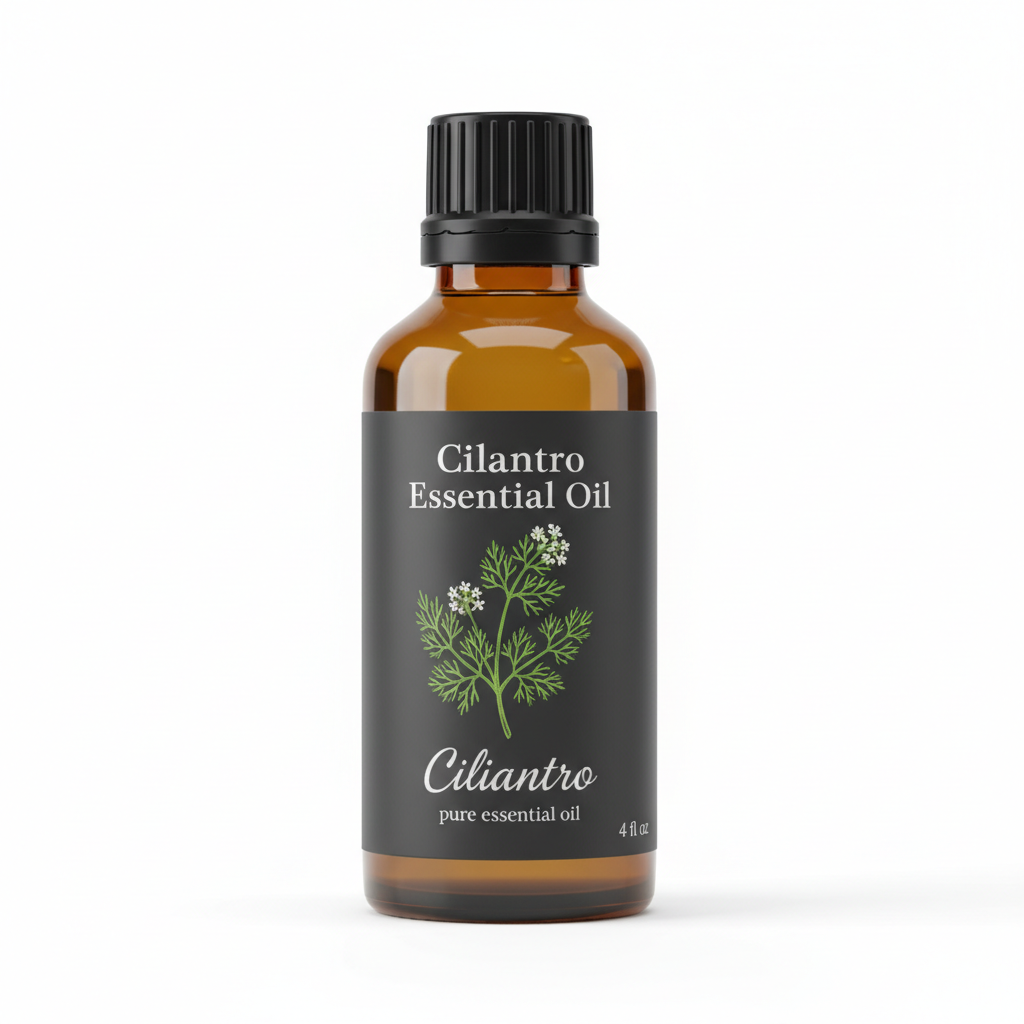
Cilantro Essential Oil
Our own Cilantro Essential Oil, in sizes from 0.5 oz to bulk.
From $13.99
Shop Now →If you are new to working with this oil, the complete guide to coriander leaf essential oil is a good place to start before diving into blending. For those ready to get into the diffuser right now, this guide walks through one signature blend built around a specific frankincense variety, plus three variations you can adapt for any room in the house.
Why Boswellia Serrata? The Case for Indian Frankincense in a Fresh Herbal Diffuser Oil
Several frankincense species are popular in aromatics. Carterii from East Africa brings a sharp, almost medicinal woodsiness. Sacra from Oman is resinous and sweet. Frereana has a bright, almost lemony dryness. Each has its place.
Boswellia serrata is different. Sourced from the dry forests of India, this variety carries a warm, rounded woodiness that sits lower in the scent profile than its East African relatives. It opens with a light resinous note, softens into something almost creamy, and finishes with a gentle earthiness that reads as grounded rather than heavy. There is very little of the sharp incense-smoke quality that can sometimes push frankincense into overpowering territory.
That softness is exactly what makes Boswellia serrata essential oil the right partner for cilantro. Cilantro is volatile and lively. It needs a base note that will hold it in place without competing with its brightness. Serrata does precisely that. It provides a quiet, stable foundation, letting the fresh herbal diffuser oil quality of the cilantro stay front and center while adding just enough depth to make the blend feel complete rather than one-dimensional.
Serrata also blends exceptionally well with citrus. Since many of the best citrus cilantro diffuser oil combinations call for a drop or two of lemon or bergamot, choosing serrata means the frankincense note will integrate smoothly rather than clash.
The Signature Blend: Green Garden Morning
This blend is designed for a 100 ml ultrasonic diffuser running in a medium-sized room (roughly 150 to 250 square feet). The ratio leans toward fresh and bright, with the serrata adding a warm resonance underneath.
Ingredients
| Oil | Drops | Approximate Volume (ml) | Role in Blend |
|---|---|---|---|
| Cilantro essential oil (fresh leaf) | 4 drops | 0.20 ml | Top note: bright, green, citrus-herb |
| Bergamot essential oil (furanocoumarin-free) | 3 drops | 0.15 ml | Top-middle note: floral citrus lift |
| Boswellia serrata essential oil | 2 drops | 0.10 ml | Base note: warm, rounded wood anchor |
| Lime essential oil (steam distilled) | 2 drops | 0.10 ml | Top note: sharp citrus brightness |
| Cedarwood (Atlas) essential oil | 1 drop | 0.05 ml | Base note: dry woody smoothing agent |
Total blend volume: 12 drops (approximately 0.60 ml of essential oil concentrate)
Step-by-Step Instructions
- Prepare a small glass mixing vessel. A 2 ml amber sample vial or a clean ceramic dish works well. Avoid plastic, which can absorb oil and skew future blends.
- Add the oils in order from heaviest to lightest. Start with cedarwood, then serrata frankincense, then bergamot, then lime, and add the cilantro last. This order helps the heavier base notes disperse evenly before the volatile top notes are introduced.
- Swirl gently for about 20 seconds. Do not shake vigorously. A slow, circular motion is enough to combine the blend without agitating it.
- Rest the blend for 5 to 10 minutes. This short resting period allows the molecules to begin interacting. You may notice the scent shifts slightly as the oils settle together. This is normal and desirable.
- Fill your diffuser to its water line (typically 80 to 100 ml for a standard ultrasonic unit) and add the 12-drop blend directly to the water.
- Run the diffuser in 30-minute intervals with 30-minute breaks. Continuous diffusion in an enclosed space can become overwhelming, even with a pleasant scent.
Dilution Context and Safety Notes
For diffusion, the oils go directly into water rather than onto skin, so traditional dilution ratios (such as the 1 to 2 percent guideline for topical use) do not apply in the same way. However, the total essential oil load relative to water volume still matters for comfort and safety.
- At 12 drops in 100 ml of water, this blend sits at roughly 0.6 percent oil by volume. This is within the generally accepted comfort range for home diffusion.
- Keep the room ventilated. A cracked window or door allows fresh air to circulate and prevents the scent from becoming saturated.
- Cilantro essential oil is considered safe for most adults at standard diffusion levels. Some individuals may find concentrated herbal top notes irritating. If anyone in the household reports discomfort, reduce the cilantro drops to 2 and increase the diffuser-run intervals.
- Do not diffuse around infants under 2 years old, young children, or pets without first consulting a qualified healthcare provider.
- If you plan to use any oil in this blend topically (such as in a loofah, a bath, or a body oil), always dilute in a carrier oil at 1 to 2 percent and perform a patch test on a small area of inner forearm skin for 24 hours before broader use.
- Bergamot, even in furanocoumarin-free form, can occasionally cause sensitivity in some individuals. The lime in this recipe is steam distilled (not cold pressed), which significantly reduces its photosensitizing potential. If substituting cold-pressed lime, avoid skin contact before sun exposure.
Variations on the Green Garden Morning Blend
Once you are comfortable with the signature blend, these three variations give you different directions to explore. Each one keeps the citrus cilantro diffuser oil core intact while shifting the character of the overall blend.
Variation 1: Coastal Green (Lighter, More Aquatic)
This version emphasizes the clean, almost watery quality that fresh cilantro leaf oil can carry when it is not weighted by too much wood.
- Cilantro essential oil: 5 drops
- Bergamot (FCF): 3 drops
- Eucalyptus globulus: 2 drops
- Boswellia serrata: 1 drop
- Spearmint: 1 drop
The eucalyptus adds a cool, open quality that pairs surprisingly well with cilantro's herbal freshness. Serrata stays in the blend but drops to a single drop, making it nearly invisible as a discrete note while still providing structural depth. Use this variation in a kitchen or entryway where you want something crisp and immediately welcoming.
Variation 2: Warm Herbal Evening (Deeper, More Grounded)
For later in the day, when a slightly richer atmosphere suits the hour, this variation leans into the serrata more fully and adds vetiver for an earthy, root-like grounding note.
- Cilantro essential oil: 3 drops
- Boswellia serrata: 3 drops
- Sandalwood (Australian): 2 drops
- Vetiver: 1 drop
- Bergamot (FCF): 2 drops
- Lime (steam distilled): 1 drop
The cilantro note recedes slightly here, threading through the richer base rather than leading it. This is the variation to reach for during a quiet evening wind-down, when the atmosphere of a room should feel settled and warm rather than energizing.
Variation 3: Citrus-Forward Garden Party (Bright, Celebratory)
This variation amplifies everything in the citrus cilantro diffuser oil direction and is perfect for a social gathering where you want a room to feel vibrant and lively. For more ideas in this direction, the guide to citrus and cilantro blending for a lively home covers the broader landscape.
- Cilantro essential oil: 4 drops
- Grapefruit: 4 drops
- Lemon: 2 drops
- Boswellia serrata: 1 drop
- Ginger (steam distilled): 1 drop
Grapefruit leads here, pushing the blend into unambiguously sunny territory. Ginger adds a faint spice that prevents it from tipping into pure sweetness. Serrata, at one drop, serves as a barely perceptible warmth underneath. Run this one in an open-plan living space or kitchen during a gathering.
Storage and Shelf Life
Cilantro essential oil is a top note, which means it contains a higher proportion of smaller, more volatile aromatic molecules. These are also the molecules most prone to oxidation over time.
- Store any pre-made blend concentrate in a dark amber or cobalt glass bottle with a tight-fitting dropper cap. Keep it away from direct light, heat, and humidity.
- A well-stored cilantro essential oil has a shelf life of approximately 1 to 2 years from opening. Serrata frankincense is more stable and can last 3 years or more under proper conditions.
- A pre-blended concentrate stored correctly will remain at its best for roughly 6 to 12 months, after which the top notes may begin to fade first.
- Write the blend date on the bottle with a label. It takes 10 seconds and removes any guesswork later.
- If the blend begins to smell flat, sharp, or noticeably different from when you first made it, it is time to mix a fresh batch.
Sourcing Notes: What to Look for in a Cilantro Diffuser Oil
The quality of a fresh herbal diffuser oil blend depends entirely on the quality of the individual oils you put into it. Cilantro leaf essential oil (distinct from coriander seed oil, which has a very different character) should smell unmistakably like the fresh herb. If it smells musty, flat, or vaguely like coriander seed, it may be mislabeled or past its prime.
For Boswellia serrata specifically, look for suppliers who can provide a gas chromatography mass spectrometry (GC-MS) report. Serrata is sometimes adulterated with lower-cost resins or diluted with carrier oils. A transparent supplier will share testing data without hesitation. The buyer's shortlist for oils that blend with cilantro covers what to look for across the full range of partner oils, including sourcing red flags to watch out for.
A Note on Scent and Space
Diffuser blends are enormously dependent on context. Room size, airflow, ceiling height, the ambient humidity, and even the season all affect how a blend opens and how long it lingers. The measurements in this guide are starting points, not fixed formulas. Trust your nose. If the serrata feels too quiet, add another drop. If the cilantro feels sharp for your space, pull it back by one.
The point of a fresh herbal diffuser oil blend is not precision for its own sake. It is finding the version of this combination that makes you pause when you walk into the room and makes the space feel like yours.