
How Cilantro Essential Oil Is Made: Steam Distilling the Fresh Leaf
Cilantro is one of those plants that divides people sharply at the dinner table. But as a source material for essential oil distillation, it earns near-universal respect among perfumers, formulators, and botanical enthusiasts. The oil that emerges from fresh Coriandrum sativum leaves is genuinely unlike anything else in the aromatic palette: bright, green, faintly citrusy, and almost impossible to replicate synthetically. Understanding how cilantro essential oil is made helps explain why the finished product is so distinctive, and why quality varies so dramatically from one supplier to the next.
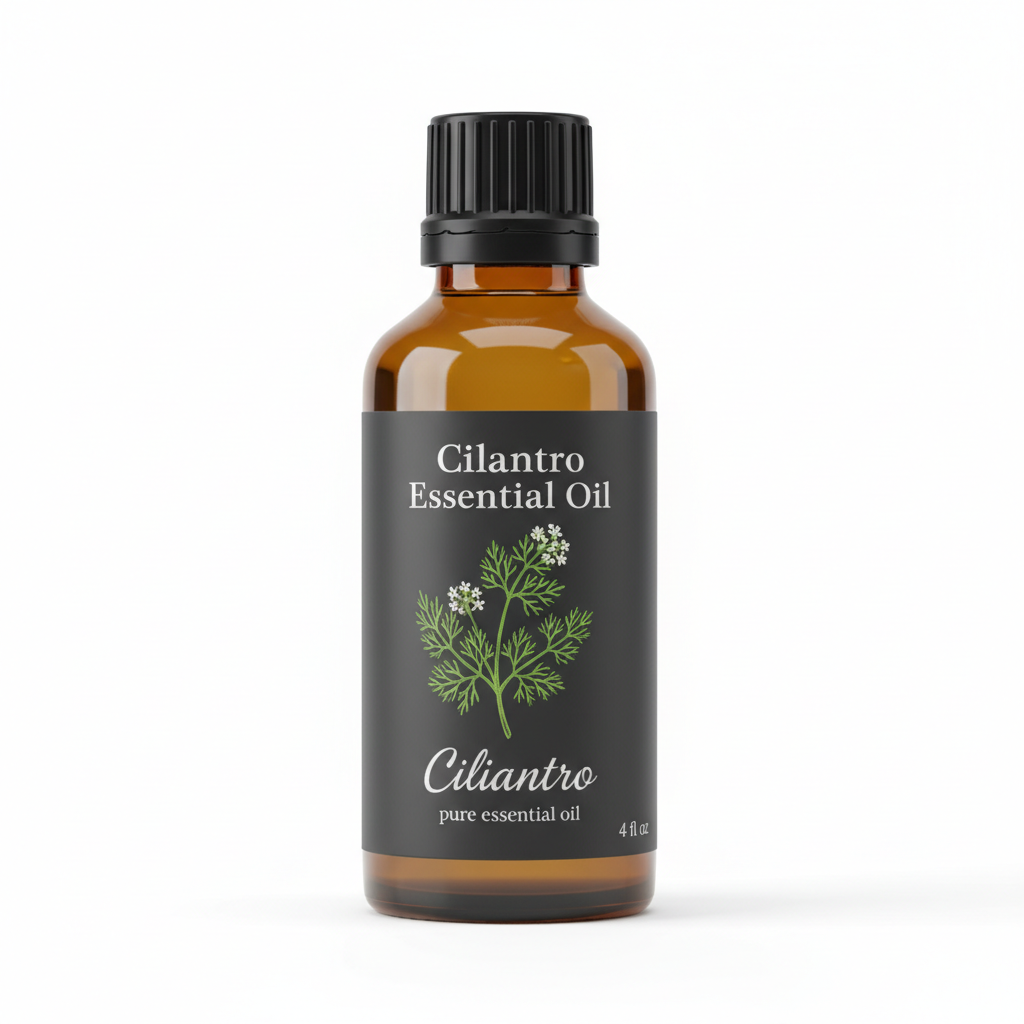
Cilantro Essential Oil
Our own Cilantro Essential Oil, in sizes from 0.5 oz to bulk.
From $13.99
Shop Now →This article walks through the distillation process from harvest to bottle, then examines the chemistry, the available research, and what to look for when evaluating sourcing and purity.
From Field to Still: How Cilantro Oil Is Made
Cilantro essential oil is produced almost exclusively by steam distillation of the fresh aerial parts of the plant, primarily the leaves and tender stems. This is worth emphasizing because Coriandrum sativum yields two entirely different oils depending on which part of the plant is processed. The seeds produce coriander seed oil, a warmer, woodier, slightly spicy oil dominated by linalool. The leaves produce something far greener and more volatile. If you want to understand the full contrast between these two, our comparison of coriander seed oil vs. cilantro leaf oil covers the differences in depth.
Harvest Timing and Leaf Condition
Timing is everything in coriander leaf distillation. Cilantro is a fast-bolting annual, meaning it moves quickly from vegetative growth to flowering and seed production. The aromatic profile of the leaf changes significantly across this window. Leaves harvested during the vegetative phase, before the plant sends up a flower stalk, tend to carry the highest concentrations of the aldehydes responsible for cilantro's signature green-citrus character.
Once the plant begins to flower, the leaf chemistry shifts. Some of the lighter, more volatile compounds diminish, and the overall yield from distillation can drop. Most distillers working with fresh leaf material aim to harvest in the early morning, when essential oil content in the glands is highest and the plant has not yet experienced heat stress from the midday sun. The fresher the leaf going into the still, the more accurately the finished oil reflects that living green aroma.
The Steam Distillation Process
Steam distillation works on a simple physical principle: when steam passes through plant material, it carries volatile aromatic compounds along with it. That steam-and-oil vapor then travels through a condenser, where it cools back into liquid. Because essential oil and water do not mix, they separate naturally in a receiving vessel called a Florentine flask or separator. The essential oil floats to the top and is drawn off; the water layer beneath it (called hydrosol or floral water) is collected separately and has its own aromatic uses.
For cilantro leaf specifically, distillation times are kept relatively short. The most volatile green compounds, particularly the short-chain aldehydes, can be driven off quickly and may degrade or transform under prolonged heat exposure. A skilled distiller monitors the process closely and stops distillation at the point that best preserves the fresh, leafy top notes that define quality cilantro oil.
The yield from cilantro leaf is notably low. Fresh leaf material typically produces somewhere between 0.1% and 0.4% essential oil by weight, depending on variety, growing region, and harvest timing. To produce a single kilogram of cilantro essential oil, a distiller may need 250 to 1,000 kilograms of fresh plant material. That yield differential goes a long way toward explaining the oil's price point relative to more generous botanical sources.
Chemical Composition: What's Actually in the Oil
The chemistry of cilantro essential oil is dominated by a group of compounds that set it apart from almost every other leaf oil on the market. Gas chromatography and mass spectrometry (GC-MS) analyses of fresh-leaf distillates consistently identify the following compound classes as the primary constituents.
Aliphatic Aldehydes
This is where the story really begins. Cilantro leaf oil is unusually rich in short-chain aliphatic aldehydes, particularly (E)-2-decenal, (E)-2-dodecenal, decanal, and dodecanal. These compounds are responsible for the sharp, soapy, green, and almost metallic character that makes cilantro so polarizing as a food ingredient. In the essential oil, they contribute the bright, piercing top-note quality that distinguishes fresh leaf oil from every other plant in the Apiaceae family.
Research suggests that the aldehydic fraction is both the most aromatically distinctive and the most chemically unstable component of the oil. Aldehydes are reactive molecules. They can oxidize over time, particularly when exposed to air, light, or heat, which is one reason proper storage conditions matter so much for cilantro leaf oil.
Terpene Alcohols
Linalool is present in cilantro leaf oil, though typically at lower concentrations than in coriander seed oil. Other terpene alcohols, including geraniol and terpinen-4-ol, appear in smaller amounts depending on chemotype and growing region. These compounds contribute softer, slightly floral or green-herbaceous facets that round out the sharper aldehyde notes.
Monoterpenes
Gamma-terpinene, p-cymene, and alpha-pinene have been identified in various cilantro leaf distillates. These compounds add a lighter, more atmospheric backdrop to the oil's aromatic structure. Their concentrations vary more than the aldehydes do, making them useful marker compounds for distinguishing distillates from different geographic origins.
Chemotype Variation
It is worth noting that Coriandrum sativum exhibits chemotype variation, meaning plants grown in different regions or selected from different seed stocks can produce oils with meaningfully different chemical profiles. Research observations from studies comparing cilantro leaf oils from India, Morocco, and Eastern Europe suggest that aldehyde ratios, in particular, shift depending on soil composition, climate, and variety. This variation has real aromatic consequences. An oil high in (E)-2-dodecenal will smell sharper and more intensely green than one where that aldehyde is less prominent.
What Research Observations Suggest
A modest but growing body of laboratory research has examined the chemical behavior of cilantro leaf oil and its constituent compounds. These are observations from controlled studies, not clinical conclusions, and they should be understood as such.
Some research suggests that the aliphatic aldehydes present in cilantro leaf oil show interesting activity in laboratory models examining cellular interactions. These findings are preliminary, and no conclusions about efficacy in human applications should be drawn from them. The research is best understood as early-stage chemistry investigation.
Separately, some studies examining the aromatic compounds in cilantro leaf have looked at their behavior in food preservation contexts. Again, these are laboratory observations, not clinical recommendations.
For a broader look at how this oil fits into cosmetic and aromatic formulation, see our complete guide to cilantro essential oil, which covers practical application alongside the science.
Safety Profile and Contraindications
Cilantro essential oil is potent, and it requires the same care in handling that any concentrated aromatic extract demands. The following points reflect current general guidance and are not a substitute for advice from a qualified healthcare provider. Always consult a professional before incorporating any new essential oil into your routine, particularly if you have existing health considerations or are in a vulnerable population group.
Skin Dilution
Cilantro leaf oil should always be diluted before any skin application. The aldehydes that make it aromatically distinctive are also among the more sensitizing compound classes in aromatics. Standard guidance from established aromatic safety references suggests dilution rates of 0.4% to 1% for leave-on skin products, meaning roughly 4 to 10 drops per 100 ml of carrier oil or lotion base. Higher concentrations increase the risk of skin sensitization, particularly with repeated use.
Patch testing before broader application is always recommended. Apply a small amount of the diluted preparation to the inner forearm, wait 24 to 48 hours, and assess for any reaction before use on larger areas.
Oxidation Risk
Because the aldehyde fraction is chemically reactive, cilantro leaf oil can oxidize relatively quickly compared to more stable oils. Oxidized essential oils carry a higher sensitization risk than fresh oil. This makes storage conditions critical: keep cilantro oil in a tightly sealed dark glass bottle, refrigerated or at least stored away from heat and light, and use it within 12 to 18 months of opening.
Pregnancy, Nursing, and Children
As a general precaution observed across reputable aromatic safety frameworks, cilantro essential oil is typically not recommended for use during pregnancy, while nursing, or on young children without specific guidance from a qualified healthcare provider.
Sensitization Risk with Repeated Use
Aldehyde-rich oils can cause sensitization over time even when properly diluted. This means that someone who uses cilantro oil without issue initially may develop a reaction after repeated exposure. Rotating essential oils in personal care formulations, rather than using any single oil continuously, is a practice many formulators recommend for this reason.
Sourcing and Quality Indicators
Because cilantro leaf oil is produced in relatively small quantities and commands a respectable price, adulteration and mislabeling are genuine concerns in the market. Here is what to look for when evaluating a supplier.
Botanical Clarity
A reputable supplier will specify the full Latin name (Coriandrum sativum), the plant part used (leaf or aerial parts), and the country of origin. Vague labeling is a warning sign. The distinction between leaf oil and seed oil matters enormously for both chemistry and scent, as explored in detail in our piece on coriander seed oil vs. cilantro leaf oil.
GC-MS Testing
Any supplier serious about quality should be able to provide a GC-MS report for each batch. For cilantro leaf oil, look for a profile dominated by aliphatic aldehydes, with (E)-2-decenal and (E)-2-dodecenal typically listed as major constituents. If a report shows an unusually high linalool percentage as the dominant compound, you may be looking at a seed oil, a blended product, or a mislabeled oil.
Freshness and Packaging
Cilantro leaf oil should arrive in dark glass, ideally amber or cobalt blue, with a tight seal. Any sign of a rancid, sharp metallic, or stale-smelling character beyond the expected green-soapy sharpness may indicate oxidation. Fresh, high-quality cilantro oil has an immediately recognizable brightness that is difficult to mistake once you know it. For a thorough walkthrough of the aromatic experience, our guide on what cilantro essential oil smells like is a useful reference point.
Harvest and Distillation Transparency
The best suppliers can tell you where and when the plant material was harvested, whether it was fresh or partially dried before distillation, and what distillation method was used. This level of traceability is particularly important for an oil where timing and plant condition have such a direct impact on the finished aromatic profile.
A Note on Complexity
Cilantro leaf distillation sits at an interesting crossroads in botanical extraction. The plant is common and inexpensive as a culinary herb, yet producing a high-quality essential oil from it requires precise timing, careful handling, and experienced distillation technique. The low yield amplifies the cost of any mistake. An oil harvested a week too late, or distilled too long, or stored improperly, is a noticeably diminished product.
That gap between a mediocre cilantro oil and a genuinely excellent one is wide enough to notice immediately on first opening the bottle. Understanding the process behind coriander leaf distillation makes it much easier to recognize quality when you encounter it, and to ask the right questions of the suppliers you choose to trust.