Organic Cilantro Oil: What the Label Does and Doesn't Say
"Organic" is one of the most persuasive words on an essential oil label, and one of the least understood. It describes how the plants were farmed. It says nothing about how the oil smells, how strong it is, or what is in the bottle once it has been distilled, and for a cilantro leaf oil the more useful question is whether a seller can show you a certificate and a report that belongs to your lot.
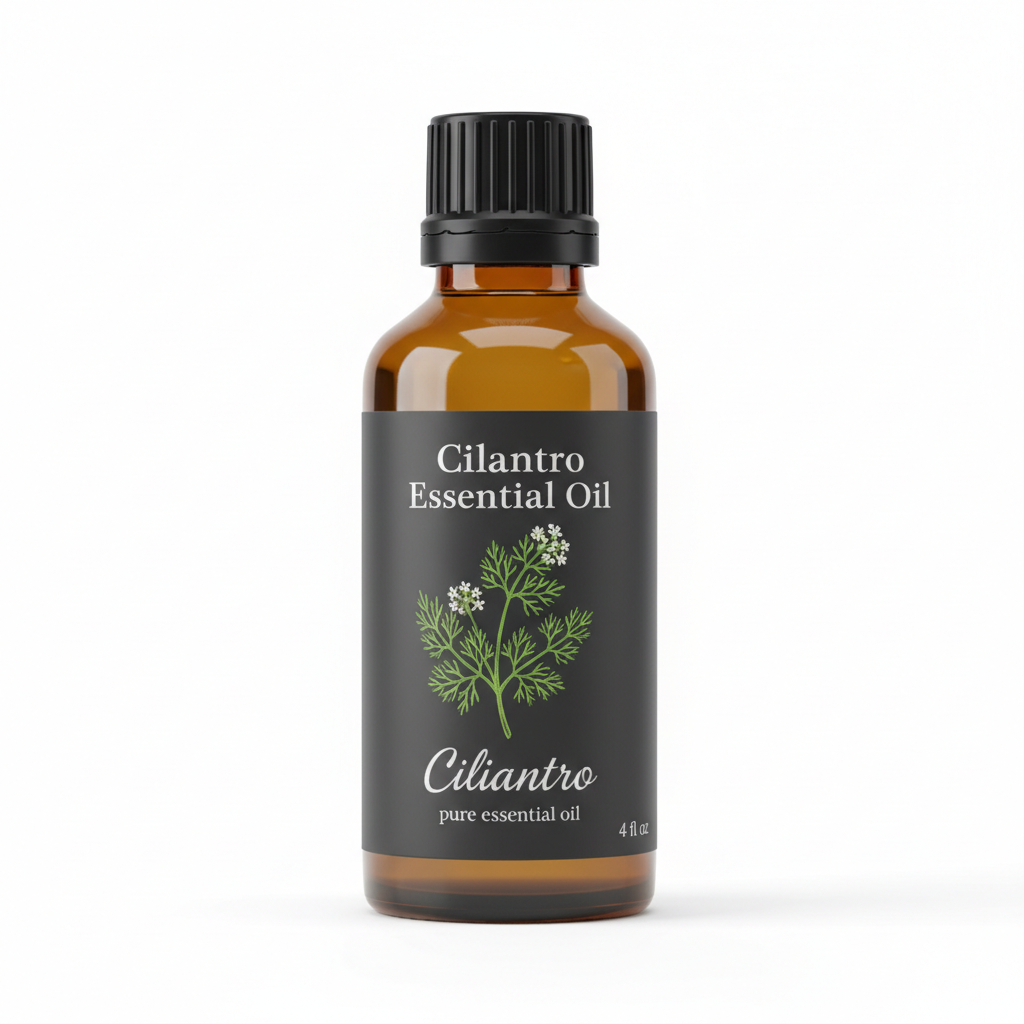
Cilantro Essential Oil
Our own Cilantro Essential Oil, in sizes from 0.5 oz to bulk.
From $13.99
Shop Now →What the rules actually require of the land
In the US, the National Organic Program sets the meaning of the word for agricultural products, and the FDA says plainly that it has no definition of "organic" of its own for cosmetics. Cosmetics labelled organic have to satisfy both agencies' rules (FDA, "Organic" Cosmetics).
On the farm side, the land requirement is specific: no prohibited substances applied for the three years immediately before harvest (7 CFR 205.202). That is a rule about inputs and land history. It is not a purity specification for a distilled oil, and it sets no minimum for any compound in it.
What it does not change
Safety. The FDA puts it neatly: "An ingredient's source does not determine its safety." Cilantro leaf oil is rich in aldehydes, and any skin sensitivity comes from the oil's own chemistry, whichever way the plants were grown. Dilution and a patch test are the controls, which is why we recommend 0.5% to 2% in a carrier oil with a patch test first. Our safety guide has more.
Aroma. Leaf oil composition moves with cultivar, growth stage and region, as a 2023 review (Al-Khayri et al.) of coriander oil notes. In the two studies we compare in our GC/MS reading guide, 2-decenal ranged from 15.7 to 25.1% in four steam-distilled cultivars and from 37 to 63% in Portuguese aerial-part oils. Neither study compared organic with conventional farming, so neither says organic leaf oil smells different.
Residues. If pesticide residue is the real worry behind the word, the direct answer is a residue screen on the batch. Farming rules shape what is likely to be in the field. A screen tells you what is in the bottle. A composition report such as GC/MS is a different test and does not show residues, so ask for the right document.
Why people reach for the word
Mostly it comes down to trust. People want to know the plants grew somewhere looked after, and that is a fair instinct. Wanting to know how a thing was grown is a good habit. The only catch is that a word on a label is where the conversation starts, and a certificate is how you finish it.
How to check an organic claim
- Ask for the certificate, not the word. It should name the operation, the certifier and what is covered.
- Look the operation up in the USDA's Organic Integrity Database and make sure the two agree.
- Check scope. A certified farm does not by itself tell you about the handler who distilled the oil, so ask about both.
- If residue is your concern, ask for a residue screen for the lot.
- Ask for the composition report and match its lot number to your bottle.
Keeping it in proportion
For most people using a cilantro oil, the bigger wins are simple: start with a small bottle, dilute properly, patch test, cap it after every use and use it while it is fresh. Those habits shape your result more than any single label word. Spend your attention where it changes what you actually smell and use.
Who should insist on certification
Choose a certified oil if you need to label your own product organic, if a retailer or marketplace requires the certificate, or if you simply want the farming restrictions behind your supply. Those are good reasons. We sell our cilantro oil without an organic label, so if certification is a requirement, get the certificate from whichever seller you choose before you buy.
For a candle, soap or room spray made for your own use, the dilution maths and a lot report will change your result more than the word on the label ever will. The same logic applies to other label words, and our post on what the word therapeutic means on a label makes the point again. If you are weighing where to buy at all, this checklist helps.
A word on a label is a description, and a certificate is the proof, so ask for the second.
Cilantro Essential Oil
Cilantro Essential Oil from our own shop, in sizes from 0.5 oz to bulk.
From $13.99
Shop Now →Sources & Further Reading
- US FDA, "Organic" Cosmetics. fda.gov/cosmetics/cosmetics-labeling-claims/organic-cosmetics
- eCFR, 7 CFR 205.202, Land requirements. ecfr.gov, 7 CFR 205.202
- Al-Khayri J.M. et al., 2023, coriander oil composition review. pubmed.ncbi.nlm.nih.gov/36677754
- USDA AMS, Organic Integrity Database. organic.ams.usda.gov/integrity