
Cilantro vs Coriander Oil: The Ultimate Guide to One Plant, Two Scents
Key Takeaways
- Cilantro leaf oil and coriander seed oil both come from Coriandrum sativum, yet they smell almost nothing alike.
- The leaf oil is green, sharp, and intensely herbaceous. The seed oil is warm, rounded, and subtly woody-sweet.
- Their chemical profiles differ significantly: leaf oil is dominated by aldehydes, while seed oil is rich in linalool.
- Seed oil is far more widely available and less expensive. Leaf oil is rarer and more volatile in both scent and price.
- Each oil serves different purposes in cosmetic formulation, diffuser blending, and fragrance work.
- Proper dilution (typically 1-3% in a carrier) and a patch test are essential before any skin application.
Same Plant, Different Worlds
Pick up a bottle of cilantro essential oil and a bottle of coriander essential oil. Unscrew both caps. You will likely wonder if someone has made a labeling error. The scents are so different that it is genuinely hard to believe they originate from the same botanical species. Yet they do. Both oils are pressed or distilled from Coriandrum sativum, an annual herb in the Apiaceae family that has been cultivated for thousands of years across regions stretching from southern Europe to South Asia.
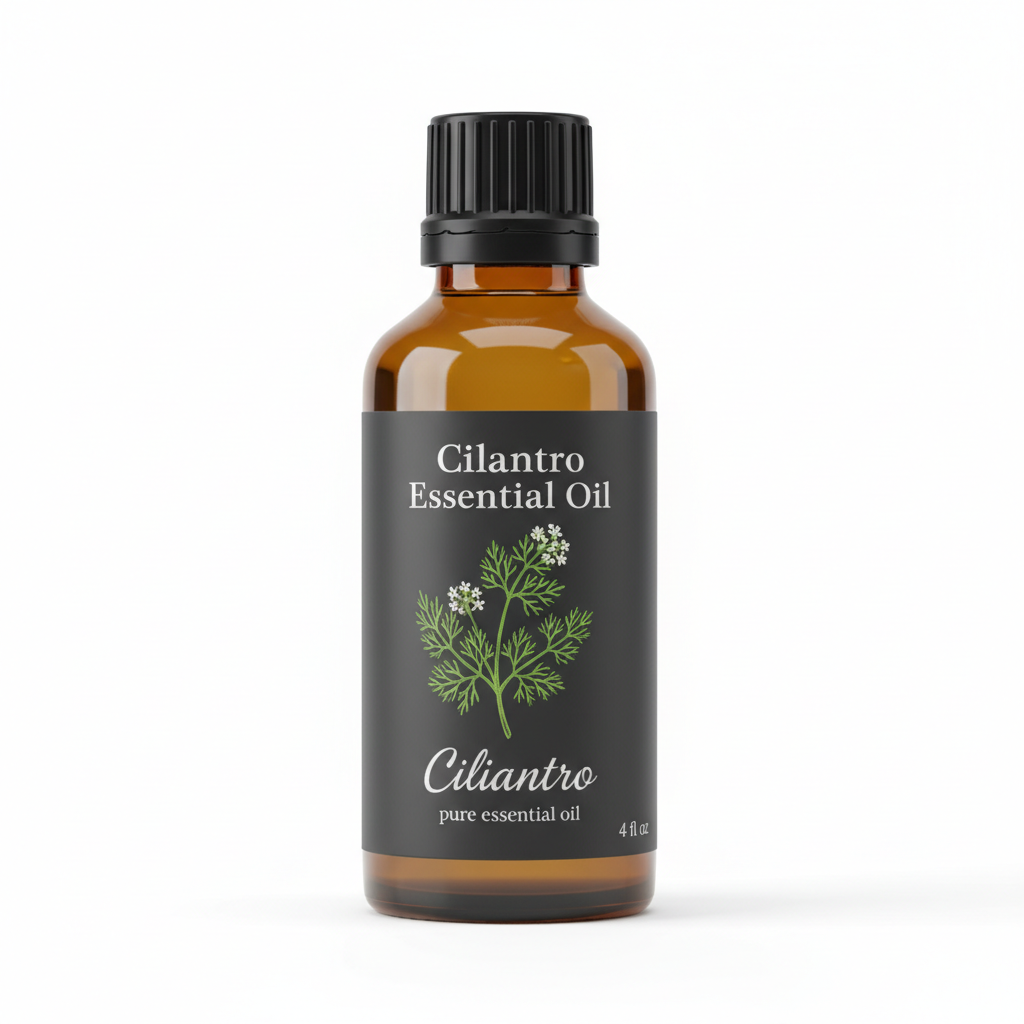
Cilantro Essential Oil
Our own Cilantro Essential Oil, in sizes from 0.5 oz to bulk.
From $13.99
Shop Now →The difference comes down to a single factor: which part of the plant you start with. The leaf yields one oil. The seed yields another. Same genetic material, wildly divergent chemistry.
This guide is for people who want to understand that divergence fully, not just at a surface level. We will move through how each oil is produced, what they smell like and why, what the chemistry actually reveals, and how to use each one responsibly in cosmetic and aromatic contexts. If you have ever stood in front of a supplier's catalog wondering which oil to choose, or if you have bought one expecting the other, this is the reference you needed from the start.
It is worth noting that the naming conventions around this plant cause significant confusion even among experienced formulators. If you want the deeper etymology, the linguistic history, and the regional naming traditions that created the cilantro/coriander split, the article cilantro vs coriander: why one plant has two names covers that ground thoroughly. Here, we will stay focused on the oils themselves.
How Each Oil Is Made
Distilling the Leaf: A Race Against Volatility
Cilantro leaf oil is produced by steam distillation of the fresh or partially dried aerial parts of the plant, primarily the leaves and tender stems. The process is straightforward in principle and genuinely tricky in practice. Fresh cilantro leaves contain a high proportion of volatile aromatic compounds that begin degrading almost immediately after harvest. The window between cutting and distilling is narrow.
Most quality producers distill within hours of harvest, not days. Some facilities are positioned directly adjacent to growing fields specifically to minimize transit time. The yield is also quite low. You need a substantial quantity of fresh leaf material to produce even a small volume of essential oil, which contributes directly to the higher price point you will encounter with cilantro leaf oil.
For a detailed look at the equipment and process involved, how cilantro essential oil is made by steam distilling walks through each stage of production. Understanding the process helps explain why quality varies so much between suppliers.
Distilling the Seed: A More Forgiving Process
Coriander seed oil follows a different production path. The seeds (technically fruits) are harvested when fully mature, then dried. Dried coriander seeds are stable. They can be stored, transported, and processed on a more flexible schedule than fresh leaf material. This stability makes large-scale, consistent production far more practical.
The seeds are typically crushed or lightly milled before steam distillation to increase surface area and improve extraction efficiency. Yield is considerably higher than leaf distillation, and the resulting oil is more consistent batch to batch when sourced from reputable producers.
Major producing countries for coriander seed oil include Russia, India, Morocco, and Romania. Each origin brings subtle regional variation in chemical composition, influenced by soil, climate, and the specific cultivar grown. Indian coriander seed oil, for instance, often carries a slightly more pronounced woody character compared to Russian-origin oils, which tend to emphasize the sweeter, more floral aspects of linalool.
A Note on CO2 Extraction
Some specialty suppliers offer CO2-extracted versions of both oils. CO2 extraction operates at lower temperatures than steam distillation and can capture a broader range of aromatic compounds, including some that degrade under heat. CO2-extracted cilantro leaf oil, in particular, often presents a more vivid, true-to-fresh-herb scent profile. It is a premium product at a premium price, and it is worth seeking out if you are working on fine fragrance formulations where authenticity of the green note matters.
The Scent Profiles: What You Actually Smell
Cilantro Leaf Oil: Green, Sharp, Polarizing
If you have encountered fresh cilantro in cooking, you have some preparation for the leaf oil. But the distilled oil amplifies and concentrates those aromatic qualities to an intensity that fresh herb does not fully prepare you for. The scent is aggressively green. There is a sharp, almost metallic edge underneath the herbaceous top notes. Some people detect something watery or cucumber-adjacent. Others notice a faint floral wisp beneath the green intensity.
And then there is the soap perception. A meaningful percentage of people find cilantro leaf oil distinctly soapy, an experience that has a documented biochemical explanation rooted in aldehyde sensitivity. If you want to understand that phenomenon, why does cilantro smell like soap to some people breaks down the current scientific thinking. For formulators, this is not a flaw in the oil. It is a characteristic to work with intentionally.
Cilantro leaf oil is a top note. It has limited tenacity. In a blend, it will announce itself prominently, then fade relatively quickly, leaving space for middle and base notes to develop.
Coriander Seed Oil: Warm, Woody, Surprisingly Soft
Coriander seed oil is a genuinely approachable scent, even for people who strongly dislike fresh cilantro. The dominant impression is warm and slightly sweet. There is a woody-spicy element that some people compare loosely to orris or to a gentled version of cardamom. The floral quality from linalool comes through clearly, adding a softness that makes it blend easily with a wide range of other oils.
It does not smell like a spice rack, exactly, though it carries a mild spice association. It does not smell medicinal. It is not sharp or piercing. The overall character is rounded, which is part of why perfumers have used coriander seed oil as a modifier and blender for centuries.
In terms of volatility class, coriander seed oil sits at the border between top and middle notes. It has noticeably more lasting power than cilantro leaf oil, which makes it more practical for leave-on cosmetic formulations.
Side by Side
| Characteristic | Cilantro Leaf Oil | Coriander Seed Oil |
|---|---|---|
| First impression | Sharp, green, herbaceous | Warm, soft, slightly sweet |
| Complexity | Intense, linear | Layered, evolving |
| Volatility class | Top note | Top-to-middle note |
| Tenacity | Low to moderate | Moderate |
| Polarizing factor | High (soap perception common) | Low (broadly appealing) |
| Fragrance family | Green, herbal | Spicy, floral, woody |
The Chemistry Behind the Difference
Scent follows chemistry. To understand why these two oils smell so different, you have to look at what molecules are actually present in each one.
What Drives Cilantro Leaf Oil's Scent
The aromatic signature of cilantro leaf oil comes primarily from a group of compounds called aliphatic aldehydes. The dominant ones in most analyses are decanal, (E)-2-decenal, dodecanal, and (E)-2-tridecenal. These are the same class of compounds that give fresh cilantro its characteristic green, waxy, slightly fatty edge.
Aldehydes are potent aroma compounds. They register at very low concentrations, which is part of why cilantro leaf oil can seem overwhelming on first encounter. Some phenolic and terpene compounds are also present in smaller quantities, contributing secondary layers to the overall scent, but the aldehydes are doing most of the aromatic heavy lifting.
The soap perception noted by some individuals relates specifically to these aldehydes. Certain aldehydes are actually used in the fragrance industry as components of soapy-clean scents, which is why the association is so consistent across people who have the relevant sensitivity. It is not imaginary and it is not a quality defect. It is a straightforward chemical overlap between the compounds in cilantro and the compounds that define a certain fragrance category.
What Drives Coriander Seed Oil's Scent
Coriander seed oil tells a completely different chemical story. The dominant compound, typically comprising 60-80% of the oil depending on origin and cultivar, is linalool. Linalool is a terpene alcohol with a soft, floral-woody character. It is also found in lavender and bergamot, which helps explain the approachable, rounded quality of coriander seed oil.
Beyond linalool, you find smaller quantities of compounds including camphor, geraniol, borneol, cymene, and terpinene. These supporting molecules add the subtle spice and woody qualities that distinguish coriander seed oil from, say, a lavender-dominant oil. The overall composition is considerably more complex and, for most people, considerably more pleasant than the aldehyde-forward profile of the leaf oil.
The high linalool content is also one reason why coriander seed oil has attracted research attention in recent years. Linalool has been studied in a variety of contexts. As with all essential oil research, findings are preliminary and should be understood as observations, not definitive conclusions about efficacy.
A Quick Chemistry Comparison
| Chemical Class | Cilantro Leaf Oil | Coriander Seed Oil |
|---|---|---|
| Dominant compounds | Aliphatic aldehydes (decanal, decenal) | Linalool (60-80%) |
| Secondary compounds | Terpenes, phenolics (minor) | Camphor, geraniol, borneol |
| Primary chemical family | Aliphatic aldehydes | Monoterpene alcohols |
| Scent impact per drop | Very high | Moderate |
| Oxidation sensitivity | High | Moderate |
Cosmetic and Aromatic Uses for Each Oil
Cilantro Leaf Oil in Formulation
Because of its intensity and quick fade, cilantro leaf oil is best used in formulations where you want a bright, green opening note that does not linger too long. Rinse-off products such as cleansers, shampoos, and body washes are natural fits. The oil performs well as a top note in solid and liquid soaps, where its green sharpness reads as fresh and clean rather than overwhelming.
In leave-on products such as body lotions or serums, the leaf oil requires more careful handling. The high aldehyde content means it can cause sensitization if used at excessive concentrations. A usage rate of 0.5% or lower in leave-on formulations is a prudent starting point, and adherence to current IFRA guidelines for the specific product category is essential.
In diffuser blending, cilantro leaf oil can serve as a lively, unexpected twist in blends built around other green or citrus notes. A single drop in a blend of bergamot, lime, and vetiver can add genuine freshness and complexity. More than that, and it tends to dominate unpleasantly.
Room sprays and linen mists are another area where cilantro leaf oil shines briefly. Its rapid dispersion means it delivers an immediate burst of botanical freshness, which clears quickly without leaving an overpowering residue. If you grow your own cilantro and want to understand how the plant moves from garden to distillate, the guide on growing cilantro for flavor and fragrance from seed to snip provides useful context.
Coriander Seed Oil in Formulation
Coriander seed oil is more versatile across product categories, partly because of its broader appeal and partly because of its better tenacity. It is a legitimate workhorse in natural perfumery, used as a modifier that softens sharper notes and adds warmth without weight.
In skin-focused products, coriander seed oil is often found in face serums, body oils, and moisturizers. The linalool content is associated in some preliminary research with a calming sensory experience, though it is important to note that these are observations from early studies, not established cosmetic claims. What is clearer is that the scent is pleasant for most users and does not overpower the base formulation.
Hair care is another productive category for coriander seed oil. It blends well with carrier oils such as argan, jojoba, and rosehip, contributing fragrance complexity without the sharp edge that leaf oil brings. Pre-shampoo scalp oils and leave-in conditioning treatments are both reasonable applications, subject to appropriate dilution.
For diffuser use, coriander seed oil is remarkably easy to blend. It plays well with citrus oils (especially bergamot, lemon, and grapefruit), with floral notes (rose, geranium, ylang ylang), and with deeper base notes (sandalwood, cedarwood, frankincense). Its ability to bridge scent families makes it a useful connector in complex diffuser formulas.
Uses at a Glance
| Application | Cilantro Leaf Oil | Coriander Seed Oil |
|---|---|---|
| Diffuser blending | Yes, use sparingly (1 drop) | Yes, very versatile |
| Rinse-off body products | Good fit | Good fit |
| Leave-on face products | Use with caution, low % | Well suited |
| Natural perfumery | Green/herbal top notes | Modifier, bridge note |
| Hair care | Rinse-off only, diluted | Versatile, rinse and leave-in |
| Room and linen sprays | Excellent for immediacy | Good, more lasting |
Sourcing, Quality, and What to Look For
The Availability Gap
One practical reality every buyer encounters quickly: cilantro leaf oil is considerably harder to find than coriander seed oil, and considerably more expensive when you do find it. The production challenges outlined earlier (low yield, narrow harvest window, volatility of the raw material) translate directly into price and scarcity at the retail level. Many suppliers who appear to offer cilantro leaf oil are actually selling coriander seed oil under a misleading label, whether intentionally or through a naming error in their supply chain.
The price comparison is detailed usefully in the article coriander seed oil vs cilantro leaf oil: price and scent, which is worth reading before you make a purchase. For now, a simple rule applies: if a product is labeled cilantro leaf oil but priced similarly to coriander seed oil, be skeptical. Request a GC/MS report.
What a Good GC/MS Report Shows
Gas chromatography/mass spectrometry (GC/MS) analysis is the gold standard for verifying essential oil identity and purity. A reputable supplier will provide batch-specific GC/MS reports on request or make them available on their website. Here is what to look for:
For cilantro leaf oil: The aldehydes should dominate, particularly decanal and (E)-2-decenal. Linalool should be minimal. If you see linalool as a major component, the oil is almost certainly coriander seed oil or a blend.
For coriander seed oil: Linalool should appear in the range of 60-80%. Camphor typically appears as a secondary peak. If aldehydes dominate instead, something is wrong with the sourcing or labeling.
Storage and Shelf Life
Cilantro leaf oil has a shorter practical shelf life than coriander seed oil. The aliphatic aldehydes that give it character are also prone to oxidation over time. An oxidized cilantro leaf oil smells flat, fatty, and stale. It is also more likely to cause skin sensitization in its oxidized state. Store cilantro leaf oil in a dark glass bottle, away from heat and light, and plan to use it within 12-18 months of opening. Refrigeration can extend that window.
Coriander seed oil is more stable. Stored properly, it can remain in good condition for 2-3 years. The same dark glass, cool and dark storage principles apply. Any oil that smells noticeably different from when you opened it should be used only in rinse-off products or retired from skin application entirely.
Organic and Wildcrafted Considerations
Organic certification matters more for cilantro leaf oil than for coriander seed oil, in the view of many experienced formulators. Leaves absorb and concentrate soil amendments and foliar sprays more directly than seeds, which have a protective outer layer. If skin application is your intention, sourcing certified organic cilantro leaf oil is a reasonable priority. For coriander seed oil, organic certification is still a positive indicator of sourcing standards, but the protective seed structure somewhat reduces the urgency.
Blending Guide: Pairing Both Oils Effectively
Blending with Cilantro Leaf Oil
Because cilantro leaf oil is so assertive, blending philosophy here is largely about restraint and counterbalance. The goal is usually to incorporate its distinctive green note as an accent, not a foundation. Think of it the way a chef might use a pungent finishing ingredient: a little creates complexity and life, a lot overwhelms everything else.
Complementary pairing options for cilantro leaf oil include:
- Citrus oils: Bergamot, lemon, yuzu, and lime all share top-note volatility with cilantro leaf oil, and their brightness picks up the green quality rather than fighting it. A 3:1 ratio of bergamot to cilantro leaf makes a compelling opener for a fresh green fragrance.
- Woody base notes: Cedarwood, sandalwood, and vetiver provide the staying power that cilantro leaf oil lacks. They also offer a grounding contrast to the sharp green top, preventing the blend from reading as one-dimensional.
- Earthy middle notes: Geranium, violet leaf absolute, and galbanum can all work as bridges between the bright top and the deeper base, while harmonizing with rather than fighting the herbaceous quality of cilantro leaf.
- Aquatic accents: In diffuser blends, a touch of cucumber seed oil or violet leaf can reinforce the watery, clean dimension of cilantro leaf oil beautifully.
A simple starting formula for a green herbal diffuser blend might look like this:
Fresh Garden Diffuser Blend
- Bergamot: 4 drops
- Cedarwood (Virginian): 3 drops
- Geranium: 2 drops
- Cilantro leaf: 1 drop
Total: 10 drops. Add to diffuser with water per manufacturer's instructions.
Blending with Coriander Seed Oil
Coriander seed oil is a more forgiving blending partner. Its linalool backbone gives it natural affinity with many essential oil families, and its moderate volatility means it bridges top and heart notes well.
Productive pairings for coriander seed oil include:
- Floral middle notes: Rose otto, geranium, palmarosa, and ylang ylang all combine naturally with coriander seed oil's linalool richness. Coriander adds a spiced depth that prevents floral blends from reading as purely sweet.
- Citrus top notes: Bergamot and coriander seed is a classic pairing used in many commercial and niche fragrances. The combination is clean, warm, and genuinely elegant.
- Resinous and balsamic bases: Frankincense, benzoin, labdanum, and myrrh all marry well with the slightly woody quality of coriander seed. These combinations work particularly well in body oil formulations designed for evening use.
- Spice companions: Cardamom, black pepper, and ginger share aromatic kinship with coriander seed oil without any redundancy. They amplify the spice aspect while the coriander provides softness and roundness.
Evening Warmth Body Oil Blend
Designed for a 30ml carrier oil (such as jojoba or sweet almond) at approximately 2% total essential oil concentration.
- Coriander seed: 6 drops
- Bergamot (bergapten-free): 4 drops
- Frankincense: 3 drops
- Geranium: 2 drops
- Ylang ylang: 1 drop
Total: 16 drops in 30ml carrier. Always patch test before full application. See safety section below.
Using Both Together
It is entirely possible to use both oils in the same formulation. The contrast between the sharp green leaf note and the warm rounded seed note can create a surprisingly complete aromatic portrait of the full plant. The key is proportion. Coriander seed should anchor the blend, with cilantro leaf serving as the bright accent. A ratio in the neighborhood of 4:1 or 5:1 (seed to leaf) tends to produce a coherent result.
Safety, Dilution, and Sensible Precautions
Essential oils are concentrated botanical extracts. Both cilantro leaf oil and coriander seed oil require dilution before any skin contact. This is not an optional precaution. It is a fundamental practice for safe use.
Dilution Guidelines
The appropriate dilution range depends on the product type and the individual using it. As general starting points drawn from industry standards:
| Product Category | Suggested Maximum Dilution |
|---|---|
| Face serums and leave-on facial products | 0.5-1% |
| Body lotions and leave-on body products | 1-3% |
| Rinse-off body washes and shampoos | Up to 4% |
| Body oils and massage oils | 2-3% |
| Diffuser use | Per manufacturer recommendation (typically 5-10 drops total per session) |
For cilantro leaf oil specifically, current IFRA guidelines set limits for different product categories. Because these guidelines are updated periodically, always check the most recent IFRA standards for your specific application before finalizing a formula.
Patch Testing
Always conduct a patch test before using any new essential oil blend on a larger skin area. Apply a small amount of the diluted product to the inner forearm, cover loosely, and wait 24 hours. If any redness, itching, or discomfort develops, do not proceed with that formulation. Rinse with a carrier oil (not water) to remove the product, and consult a healthcare professional if any reaction persists.
Populations Requiring Extra Caution
Certain groups should consult a qualified healthcare provider before using essential oils topically or aromatically. These include people who are pregnant or nursing, young children, individuals with reactive or compromised skin, and anyone currently managing a health condition under medical supervision. Essential oils should not replace professional medical guidance under any circumstances. A qualified healthcare provider is the appropriate resource for any health questions.
Keep Away from Eyes and Mucous Membranes
Neither oil should ever be applied near the eyes, inside the nose, or on mucous membranes. In the event of accidental eye contact, flush thoroughly with a plain carrier oil or whole milk (fats help disperse the essential oil), then rinse with water and seek medical attention.
Storage Safety
Keep both oils out of reach of children and pets. Store in tightly sealed, dark glass bottles at room temperature or slightly below. Label bottles clearly with the oil name, origin, batch number if available, and date of opening. Never leave oils in a warm car or in direct sunlight.
Bringing It All Together: Which Oil Do You Actually Need?
After covering chemistry, scent, production, sourcing, blending, and safety, the practical question remains: which oil should you reach for?
The honest answer is that they serve genuinely different purposes, and the right choice depends entirely on what you are trying to create. Cilantro leaf oil belongs in your toolkit if you are building fresh, green aromatic experiences, if you want to capture something close to the living herb in a diffuser or rinse-off product, and if you are comfortable working with a potent, characterful ingredient that rewards restraint. It is not easy to use well, but when used well, it is distinctive and memorable.
Coriander seed oil belongs in your toolkit if you want a warm, approachable, genuinely versatile oil that works across product categories and blends without drama. It is the more forgiving partner, the more stable ingredient, and the one with centuries of established use in professional fragrance formulation behind it. For most people starting out with Coriandrum sativum oils, it is also the smarter first purchase.
Many experienced formulators keep both on hand. The cilantro leaf oil comes out for specific projects that call for its particular energy. The coriander seed oil earns regular use across a broad range of work. Together, they represent the full aromatic story of one remarkable plant.
If you are considering growing your own cilantro to better understand the source material before distilling or purchasing, the practical guide to growing cilantro for flavor and fragrance from seed to snip is a useful companion read. And if the naming conventions still feel unclear after everything covered here, the etymology piece on cilantro vs coriander: why one plant has two names will settle that once and for all.
One plant. Two scents. Endless possibility.