Cilantro Massage Oil: Choosing a Dilution and Carrier
Cilantro leaf oil is an odd choice for massage, and we would rather say so before you buy a carrier oil. Massage means a large area of skin, a lot of oil, and a scent you breathe for the length of a session, and our oils page says the aroma of this oil is divisive and that it dominates a blend quickly. If you still want to try it, the useful decisions are the percentage, the carrier and the quantity, in that order, and each is worked out below. We have not made or tested a massage oil with it.
Cilantro Essential Oil
Our own Cilantro Essential Oil, in sizes from 0.5 oz to bulk.
From $13.99
Shop Now →Step one: does the scent survive the test that matters?
Before any maths, open the smallest bottle and smell it on a tissue for a few minutes, not a few seconds. We sell the leaf oil only, and the shop and our oils page both suggest the smallest size first for this reason. The oil is pale yellow to nearly colourless and thin and watery, with a green, bright, herbaceous aroma and a citrus edge. If it reads as soapy to you or to the person you plan to massage, stop here: that reaction is common enough to have its own explainer. A massage oil is the worst place to discover it, because the smell is on your hands and the other person's body at once.
Step two: the percentage, and where two sources differ
The Tisserand Institute dilution article (Robert Tisserand, no publication date shown) gives 1% to 3% for body oils and lotions including massage, and says aromatherapists have used that range for over 50 years for body massage. It gives 0.2% to 1% for sensitive or impaired skin and 0.5% to 1.2% for facial products. Our shop copy gives 0.5% to 2% for skin. The overlap is 1% to 2%, and the sensible place inside it for a leaf oil you have never used is the bottom.
Reasoning from those sources, not from any trial on cilantro oil: the Tisserand range is a general guideline across oils, our range is the one we put on our own product, and neither says anything about how cilantro leaf oil behaves on a particular person's skin. Our leaf oil's laboratory analysis is on the shop page as a Certificate of Analysis; we do not quote numbers from it here, and we did not find a primary study of how the aldehydes in leaf oil (our aldehyde explainer covers what they are) behave on skin. With that gap, we suggest 0.5% for a first batch and 1% as the ceiling until you have a record of your own skin tolerating it.
Step three: the quantity changes the dose, not just the drops
Our oil is sold undiluted, so the dilution maths is yours. At the convention of 20 drops per millilitre (approximate, as Tisserand notes), the drops are:
| Batch | 0.5% | 1% | 2% |
|---|---|---|---|
| 30 ml (about 1 oz) | 3 drops | 6 drops | 12 drops |
| 100 ml | 10 drops | 20 drops | 40 drops |
| 250 ml | 25 drops | 50 drops | 100 drops |
The first row matches our shop's 3 to 12 drops per ounce. The part that is easy to miss is the amount of oil that actually goes on the body. Suppose, as an assumption of ours rather than a measured figure, a session uses 15 ml of massage oil. At 1% that is 0.15 ml of essential oil on the skin in one go, more than the 0.1 ml in an entire 10 ml roller bottle at 1% (see the roller article). The percentage is the same, the exposure is not. That is a reason to stay at the low end for massage even though the Tisserand range runs higher, and a reason to make small batches: a 100 ml bottle at 1% holds 1 ml of cilantro oil, and the 15 ml session uses up 15% of it.
Two practical consequences follow from the arithmetic. Count drops into a clean, dry bottle before adding carrier, and write the total on the label, so a second person pouring does not guess. And do not top up an existing bottle with more oil: you cannot tell what percentage you end up with.
Step four: the carrier, and what we could and could not verify
We do not sell carrier oils, so choose from any reputable supplier, and ask the supplier for the allergen statement. Here is what we can source. Jojoba is mainly liquid wax esters rather than triglycerides, and Tsuchimoto et al., BPB Reports, 2022 found crude jojoba more stable to heating (60 degrees C for 60 days) than olive oil and squalene, with stability varying between producers and years. Stability on a shelf is the claim; how it feels under a massage therapist's hands is not something we found a source for, so we make no statement about slip, absorption or viscosity. A very thin essential oil in a heavier carrier is a different texture problem from the dilution one, and a licensed massage therapist is the person to ask about technique and which oil a given session needs. We have none on staff.
Nut allergy deserves a paragraph, since many massage oils are nut-derived. A 2026 narrative review by Laura et al. in Nutrients found clinically confirmed almond allergy appears uncommon despite frequent sensitisation, with positive oral food challenges in 4% to 33% of sensitised people and severe reactions in 0.5% to 12.2% of those challenged. That is about eating almonds, not skin contact, so applying it to an almond massage oil is an inference. For a person with a known tree nut allergy, it is a question for an allergist; the simplest approach is to choose a carrier that is not a nut. Separately, Paris et al., Allergy, 2016 reported three cases of occupational asthma to argan powder among nine factory workers, with in vitro cross-reaction to hazelnut allergens; that was inhaled powder, not oil.
A separate allergy point: a 2025 narrative review by Berghea et al. lists coriander among spices implicated in allergic reactions in children, with cross-reactivity to birch and mugwort pollen common. It covers eating, so it does not tell you about skin, but if you react to coriander or celery-family foods, speak to an allergist first.
Who should skip this
- Anyone with broken, inflamed or very sensitive skin: Tisserand's own lower band is 0.2% to 1%, and a dermatologist is the person to ask.
- Faces and eyes: keep it away; for the face see the beard oil article, which uses a lower range.
- Babies, children, pregnancy and pets: not our call. See a pediatrician, an OB-GYN or midwife, or a veterinarian.
- Pain, injury or a medical condition: a physician or licensed massage therapist, not a recipe. Our shop makes no medical claims.
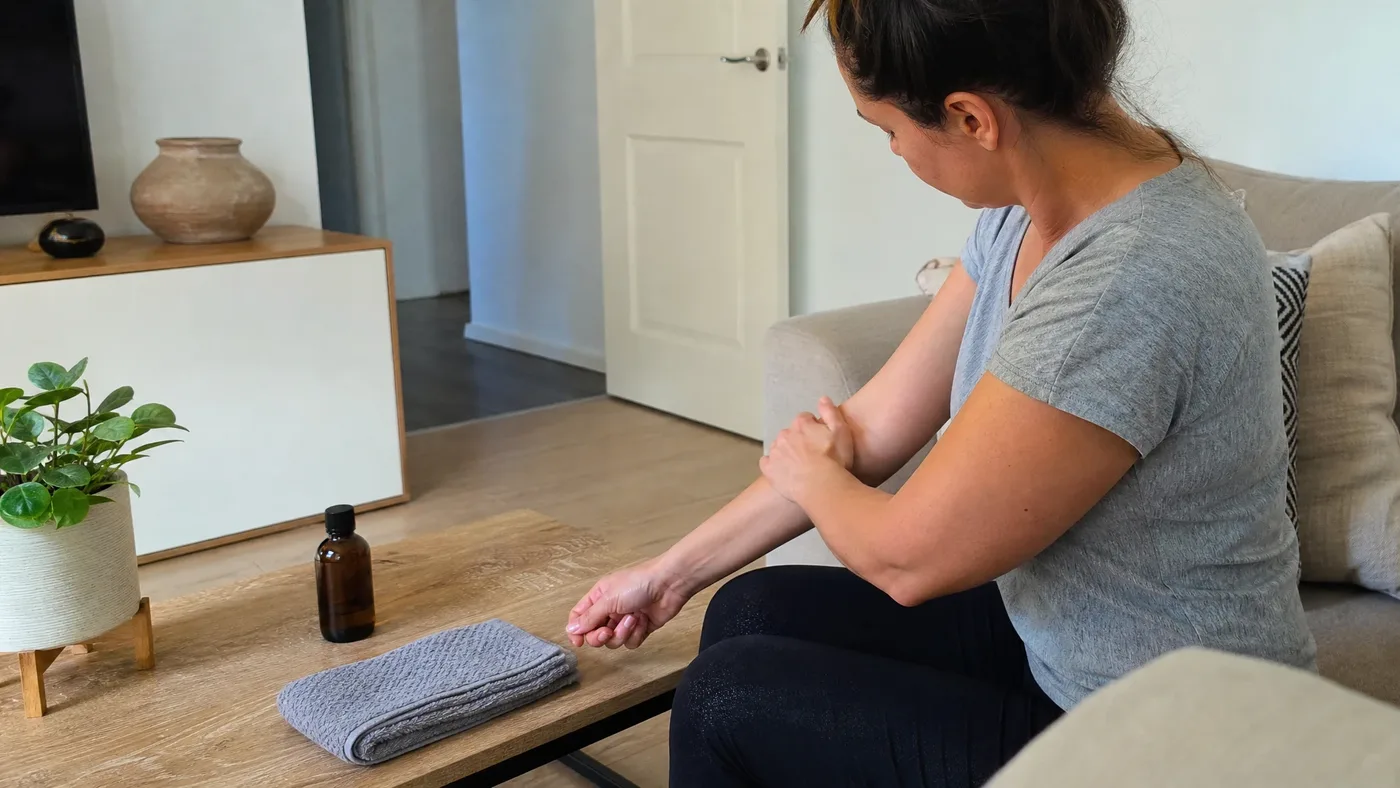
Do a patch test with the finished mixture, following our patch test guide, and read the safety overview. Oil also marks towels and sheets, so lay down fabric you do not mind losing, and keep the bottle capped and away from heat and light: the Tisserand Institute names oxygen, light and heat as the causes of oxidation in essential oils.
If you try it, start with 0.5% in a 30 ml bottle, which is three drops, and decide from there.
Cilantro Essential Oil
Cilantro Essential Oil from our own shop, in sizes from 0.5 oz to bulk.
From $13.99
Shop Now →Sources & Further Reading
- Tisserand R., Tisserand Institute, undated page. Dilution ranges by use. tisserandinstitute.org/safety/dilution
- Tisserand Institute. Oxidation and the Shelf Life of Essential Oils. tisserandinstitute.org/oxidation-shelf-life-essential-oils
- Tsuchimoto S., Sakai H., Fukui K., 2022. Oxidative Stability and Antioxidant Activity of Crude Jojoba Oil. BPB Reports 5(6):121-124. jstage.jst.go.jp/bpbreports/5/6/5_121
- Laura T. et al., 2026. Almond Allergy in Children and Adults: A Narrative Review. Nutrients 18(5):831. PubMed 41830001
- Paris C. et al., 2016. First evidence of occupational asthma to argan powder in a cosmetic factory. Allergy 71(4):550-555. PubMed 26606505
- Berghea E.C. et al., 2025. Spices, herbs and allergic reactions in children: myth or reality. Front Allergy. PubMed 41306764