Cilantro Roller Blend Recipes: The 10 ml Drop Maths
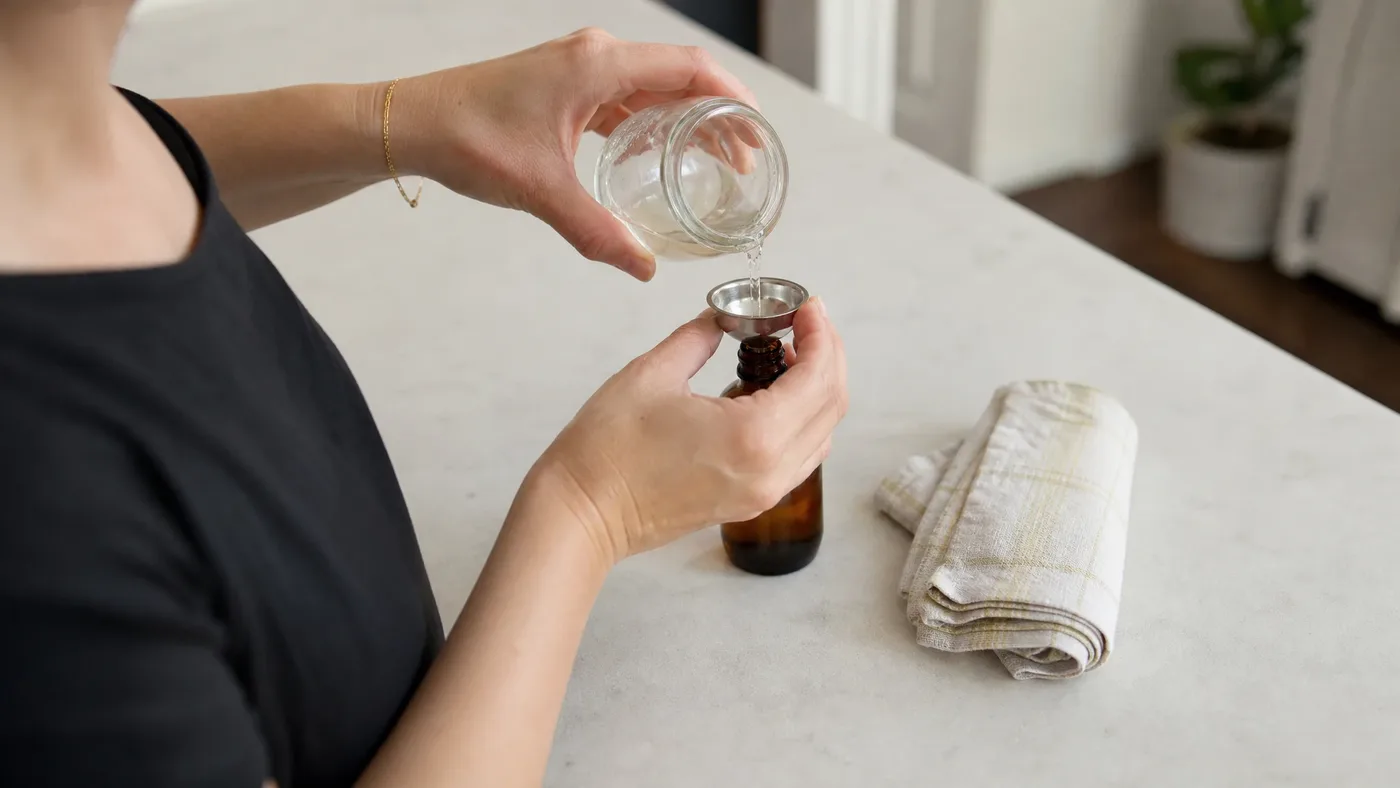
A 10 ml roller bottle at 1% holds 0.1 ml of essential oil, which is two drops if you count 20 drops to the millilitre. That is the whole problem with roller recipes: the batch is so small that one drop is a 50% change in strength. Every recipe below is arithmetic from cited guidance, not something we have made or tested, because we sell one oil (cilantro leaf essential oil, undiluted) and have not run a blend bench.
Cilantro Essential Oil
Our own Cilantro Essential Oil, in sizes from 0.5 oz to bulk.
From $13.99
Shop Now →The maths, once, with the error bars
Drops = percentage x millilitres x drops per millilitre. The 20 drops per millilitre figure is a convention, not a constant: the Tisserand Institute dilution article (Robert Tisserand; the page carries no publication date) says drop conversions are always approximate because no two drops are identical, and that you must not mix weight and volume in one calculation. Our own shop copy gives 0.5% to 2% in a carrier, roughly 3 to 12 drops per ounce, and the same convention reproduces it: an ounce is about 29.6 ml, so 0.5% is 0.148 ml (about 3 drops) and 2% is 0.59 ml (about 12 drops). For the full chart see our dilution article; here we only need the roller sizes.
| Total essential oil in 10 ml | Drops at 20 per ml | If your dropper really gives 15 or 30 per ml |
|---|---|---|
| 0.5% | 1 | 0.75 to 1.5 drops |
| 1% | 2 | 1.5 to 3 drops |
| 1.5% | 3 | 2.25 to 4.5 drops |
| 2% | 4 | 3 to 6 drops |
The right-hand column is our own arithmetic, with 15 and 30 drops per ml chosen as illustrative bounds, not measured values. Reasoning from it, the practical consequence is that a 10 ml roller cannot hold a recipe more precise than about half a percent unless you meter the oil in millilitres with a graduated pipette or syringe. If you want 1% reliably, make 30 ml (6 drops) in a larger bottle and decant into rollers.
Which percentage belongs in a roller
Here two sources disagree, and the disagreement is worth knowing. Tisserand lists "pain and feel good rollerballs" at 3% to 10%, on the argument that a roller covers a small area, and lists facial cosmetics and deodorants at 0.5% to 1.2% and sensitive or impaired skin at 0.2% to 1%. Our shop range tops out at 2%. We follow our own range, and for a first batch we would sit at its bottom, for two reasons from the same sources. First, nothing in the Tisserand article is specific to cilantro leaf oil. Second, a roller bottle is used on the same spot, such as a wrist, repeatedly, so a small area does not mean a small cumulative dose. That second point is reasoning, not a finding.
The percentage is the total of every essential oil in the bottle, not the figure for each oil. A 1% roller that has two drops in it is cilantro plus everything else combined. Adding a second oil means giving up some cilantro drops.
Four formulations, worked out
All four are 10 ml, 1% total (two drops at 20 per ml), roller filled with carrier. We have not made them. The oil list comes from the blends named on our shop page (lime, lemongrass, black pepper, ginger, petitgrain, bergamot); we sell none of those, so any reputable supplier will do. Because cilantro leaf oil takes over a blend quickly (our oils page says to start with less than you expect), the cilantro share is deliberately the smaller one wherever you want the partner oil to be noticed.
- Cilantro on its own: 1 drop in 10 ml (0.5%) with nothing else. Plain, but it is the cleanest first test of whether you like the smell on skin at all.
- Cilantro and distilled lime: 1 drop each (0.5% each). Use steam-distilled lime. See the phototoxicity section for why.
- Cilantro and black pepper or ginger: 1 drop cilantro plus 1 drop partner. We cite no sensitisation data for either, so this one rides on the patch test.
- Cilantro, petitgrain, lemongrass: one drop of each, which is 3 drops or 1.5% total in 10 ml, inside our 0.5% to 2% range. Lemongrass and petitgrain are distilled, but we have not fetched a source on their skin data, so patch test the finished bottle, not the parts.
For which oils make scent sense next to cilantro, our blending shortlist and the citrus pairing piece cover scent. This article is only about the dose.
The citrus trap: bergamot and lime
The Tisserand Institute phototoxicity article says cold-pressed (expressed) citrus oils contain furanocoumarins and can be phototoxic, while distilled citrus oils contain very little; it cites distilled lemon oil as having 12 to 930 times fewer than expressed lemon. For bergamot it gives an IFRA guideline of 0.4% in leave-on products on sun-exposed skin (bergapten limit 15 ppm), and it advises keeping treated skin out of UV for at least 12 hours. It gives no numeric maximum for expressed lime, so we cannot give you one.
Now the arithmetic: at 20 drops per ml, one drop is 0.05 ml, which in 10 ml is 0.5%. A single drop of expressed bergamot in a 10 ml roller is therefore already above the 0.4% guideline, before any cilantro goes in. Our recommendation is to leave expressed bergamot and expressed lime out of rollers altogether, or to buy a furanocoumarin-free bergamot, which the same article calls non-phototoxic, and to ask the supplier in writing which one is in the bottle. A roller on wrists, neck and chest is on exactly the skin that meets sun.
Carrier, label and the nut question
Jojoba is not a triglyceride oil but mainly liquid wax esters, described as similar to human sebum wax in Tsuchimoto et al., BPB Reports, 2022. In that study of crude and refined jojoba oils (the page does not give a sample count), the acid value of jojoba did not change after 60 days at 60 degrees C while olive oil and squalene rose, and jojoba had the lowest peroxide and carbonyl values. They also found stability varied between producers and years. So a roller with jojoba has a plausible shelf-life edge over an olive-based one, but it was a heating test, not a bottle in a handbag, and this says nothing about cilantro oil in jojoba. We do not sell carrier oils and did not find an independent source on fractionated coconut oil, so we say nothing about it.
If you pick a nut-derived carrier, allergy matters. A 2016 Allergy paper by Paris et al. studied nine workers at a cosmetic factory handling argan powder and reported three cases of occupational asthma and one probable rhinitis; in vitro, some argan allergens cross-reacted with hazelnut allergens. It concerned inhaled powder, not topical oil, so it does not show that argan oil on skin causes reactions. It does show why someone with a tree nut allergy should ask an allergist before using nut-derived carriers, and why refined and unrefined versions are a question for the supplier.
Label the bottle with the date, the carrier, the percentage and the oils. A 2025 narrative review by Berghea et al. lists coriander among the spices implicated in allergic reactions in children; it concerns eating, not skin, so applying it to a roller is an inference, but anyone who reacts to coriander or celery-family foods should see an allergist before using the oil.
Who should skip this
Skip rollers on broken or inflamed skin, near the eyes, and on children, in pregnancy, or on pets; ask a pediatrician, an OB-GYN or midwife, or a veterinarian. Do the patch test from our patch test guide on the finished mixture, not just the cilantro oil. Our oil is not for internal use, and a roller is not a place for the 3% to 10% pain-roller range: that is a question for a physician or pharmacist, not a recipe.
If the recipe maths feels fiddly, the plain version is to decide the percentage first, make 30 ml, and decant. For larger body-sized batches, see the massage oil article.
Cilantro Essential Oil
Cilantro Essential Oil from our own shop, in sizes from 0.5 oz to bulk.
From $13.99
Shop Now →Sources & Further Reading
- Tisserand R., Tisserand Institute, undated page. Dilution ranges by use. tisserandinstitute.org/safety/dilution
- Tisserand Institute, undated page. Phototoxicity of citrus oils. tisserandinstitute.org/safety/phototoxicity
- Tsuchimoto S., Sakai H., Fukui K., 2022. Oxidative Stability and Antioxidant Activity of Crude Jojoba Oil. BPB Reports 5(6):121-124. jstage.jst.go.jp/bpbreports/5/6/5_121
- Paris C. et al., 2016. First evidence of occupational asthma to argan powder in a cosmetic factory. Allergy 71(4):550-555. PubMed 26606505
- Berghea E.C. et al., 2025. Spices, herbs and allergic reactions in children: myth or reality. Front Allergy. PubMed 41306764