Cilantro Beard Oil Recipe: A 30 ml Formulation From Scratch
Our position: cilantro leaf oil is a risky pick for beard oil, and the reason is the nose, not the skin. A beard oil sits a few centimetres below your nostrils for sixteen hours, and our own oils page says the aroma of this oil is divisive and dominates a blend quickly. If you want to try it anyway, the formulation below is worked out from published dilution ranges and ordinary arithmetic. We have not made it, smelled it in a beard or tested it on anyone.
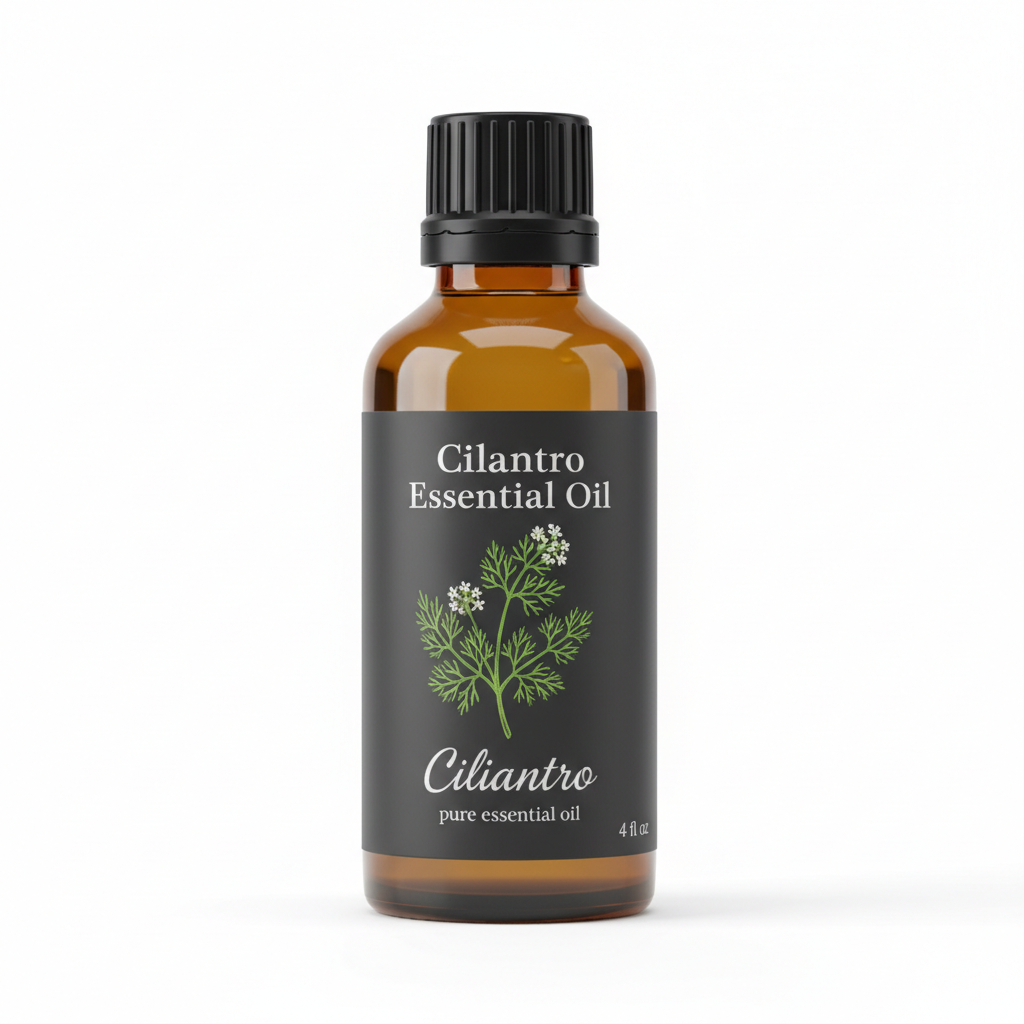
Cilantro Essential Oil
Our own Cilantro Essential Oil, in sizes from 0.5 oz to bulk.
From $13.99
Shop Now →Start with the smell test, not the recipe
The oil is pale yellow to nearly colourless, thin and watery, and green, bright and herbaceous with a citrus edge. Some people read cilantro as soap (our explainer on why cilantro smells like soap to some people covers that), and a beard oil gives you no distance from it. So buy the smallest bottle first, as our oils page suggests, and wear a single drop on a tissue taped near your collar for a day before you mix anything. If you are still fine with it by the afternoon, continue.
Facial skin gets a lower ceiling than body skin
The Tisserand Institute dilution article (Robert Tisserand, no publication date shown) lists 0.5% to 1.2% for facial cosmetics and deodorants, 0.2% to 1% for sensitive or impaired skin, and 1% to 3% for body oils. It also says commercial facial products often contain about 0.5% fragrance. Our shop's skin range is 0.5% to 2%. For the face the two overlap only at 0.5% to 1.2%, so we would not use anything above 1% here, and 0.5% is the sensible first batch. The skin under a beard is facial skin that is also being rubbed, combed and sometimes shaved around, which is our reasoning for staying low, not a finding from a study.
The arithmetic for a 30 ml bottle
Beard oil usually comes in 30 ml dropper bottles, so that is the batch size. At the usual convention of 20 drops per millilitre (approximate, as Tisserand notes; no two drops are identical), 30 ml holds 600 drops of liquid, and each drop of essential oil is 0.05 ml, about 0.17% of the bottle.
| Target | Essential oil in 30 ml | Drops at 20 per ml |
|---|---|---|
| 0.2% (sensitive skin band) | 0.06 ml | 1.2 |
| 0.5% | 0.15 ml | 3 |
| 1% | 0.3 ml | 6 |
| 1.2% (top of facial band) | 0.36 ml | about 7 |
The table shows why we say 3 drops: it lands exactly on 0.5% and leaves room, where 7 drops reaches the ceiling of the published facial band. Our shop's own 3 to 12 drops per ounce is the same convention. Our oil is sold undiluted, so the dilution maths is yours. If your dropper gives bigger drops, the real percentage is higher than the table, so count with a pipette marked in millilitres if you can.
Building it from the carrier up
We sell no carrier oils, bottles or other oils; use any reputable supplier. Two facts we could source:
- Jojoba is mainly liquid wax esters with a structure described as similar to human sebum wax, and in Tsuchimoto et al., BPB Reports, 2022, crude and refined jojoba oils held up better than olive oil and squalene after 60 days at 60 degrees C, though stability differed between producers and years (the page does not state a sample count). That was a heating test of the carrier alone; it says nothing about cilantro oil in it.
- Argan is a popular beard carrier, but Paris et al., Allergy, 2016 reported three occupational asthma cases and one probable rhinitis among nine cosmetic factory workers exposed to argan powder, with in vitro cross-reaction to hazelnut allergens. That was inhaled powder, not oil on skin, so it does not show that argan oil on a beard causes reactions. If you have a tree nut allergy, ask an allergist before choosing it.
We found no independent source on how particular carriers feel in a beard or how they affect grooming, so we do not rank them for that. A reasonable formulation for a first test is a single carrier, because every additional ingredient makes any reaction harder to trace.
A formulation, with what it does not tell you
- Pour 30 ml of carrier into a clean amber glass dropper bottle.
- Add 3 drops of cilantro leaf essential oil (0.5%). Cap, and turn the bottle over a few times.
- Label it with the date, the carrier and 0.5%.
- Patch test the finished oil on a small area of skin, following our patch test guide, before it goes near your face.
This is not a tested recipe. If you want a second oil to take the edge off the green note, our blending shortlist lists candidates, and the roller article works out how to split a small drop budget; remember the percentage is the total of all essential oils, so every drop you add comes out of the same 0.5% to 1.2% band. Those pairings include cold-pressed citrus such as bergamot, which the Tisserand Institute phototoxicity article says contains furanocoumarins and can be phototoxic, with an IFRA guideline of 0.4% for bergamot in leave-on products on sun-exposed skin. A face is sun-exposed skin, so we would leave expressed citrus out of a beard oil.
Shelf life, eyes, mouth and who should skip
Carrier oils oxidise too. The Tisserand Institute names oxygen, light and heat as the causes of oxidation in essential oils, and our shop page gives 1 to 2 years unopened for the oil, tightly capped, away from heat and sunlight. The same habits sensibly apply to the finished bottle: keep it capped and out of the bathroom heat, and make small batches rather than a year's supply. Discard a bottle whose smell has changed.
- Keep it away from the eyes, and from the lips and mouth. Our oil is not for internal use, and a beard moves oil toward the mouth more than most places.
- If your skin under the beard is red, flaking or inflamed, see a dermatologist before adding an essential oil; the cause may not be dryness.
- If you react to coriander or celery-family foods, speak to an allergist first. A 2025 review by Berghea et al. lists coriander among spices implicated in allergic reactions in children, with pollen cross-reactivity common; it is about eating, so skin is an inference.
- Not for children, pregnancy or pets: ask a pediatrician, an OB-GYN or midwife, or a veterinarian. The dilution article has our full chart.
If the smell test passes, make the 3-drop bottle, wear it for a week and decide from there.
Cilantro Essential Oil
Cilantro Essential Oil from our own shop, in sizes from 0.5 oz to bulk.
From $13.99
Shop Now →Sources & Further Reading
- Tisserand R., Tisserand Institute, undated page. Dilution ranges by use. tisserandinstitute.org/safety/dilution
- Tisserand Institute, undated page. Phototoxicity of citrus oils. tisserandinstitute.org/safety/phototoxicity
- Tisserand Institute. Oxidation and the Shelf Life of Essential Oils. tisserandinstitute.org/oxidation-shelf-life-essential-oils
- Tsuchimoto S., Sakai H., Fukui K., 2022. Oxidative Stability and Antioxidant Activity of Crude Jojoba Oil. BPB Reports 5(6):121-124. jstage.jst.go.jp/bpbreports/5/6/5_121
- Paris C. et al., 2016. First evidence of occupational asthma to argan powder in a cosmetic factory. Allergy 71(4):550-555. PubMed 26606505
- Berghea E.C. et al., 2025. Spices, herbs and allergic reactions in children: myth or reality. Front Allergy. PubMed 41306764