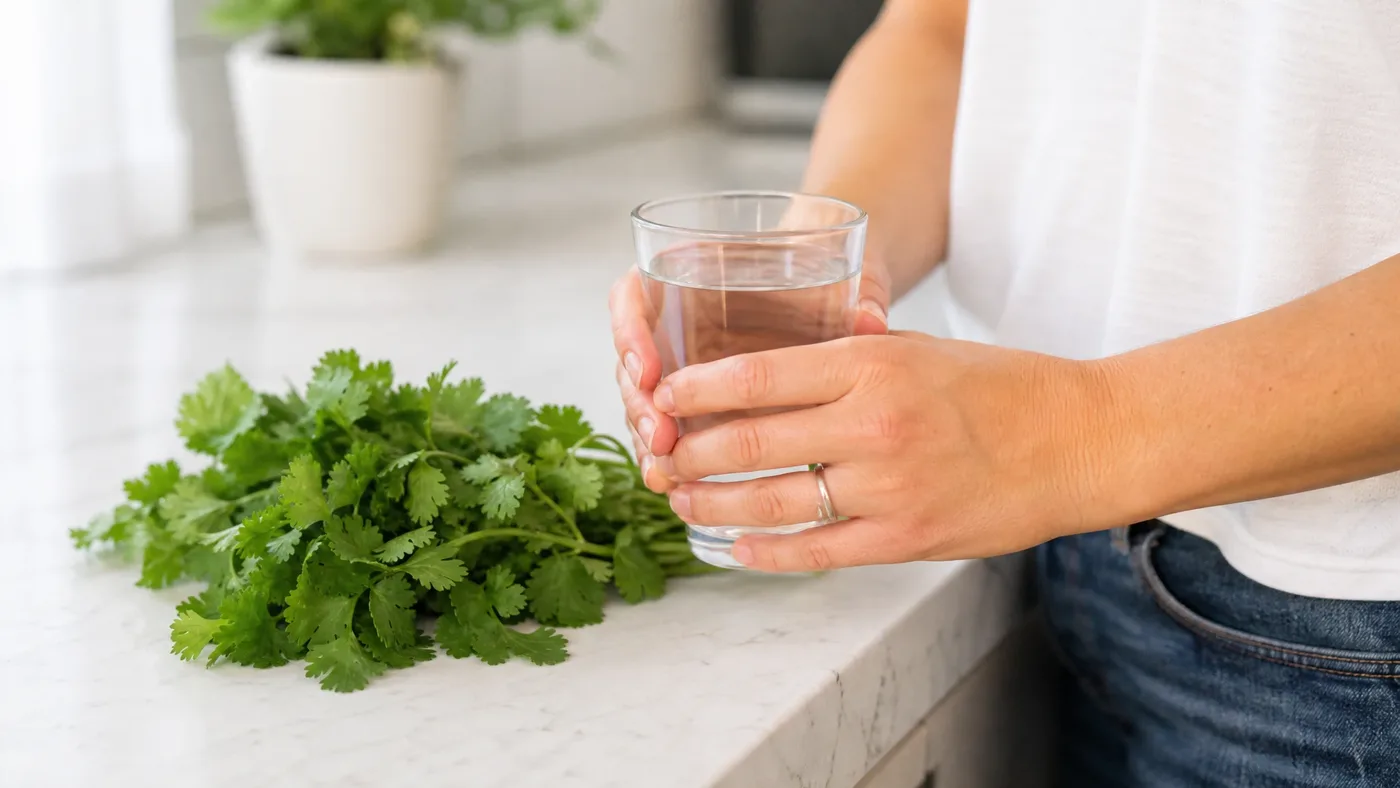
Does Cilantro Essential Oil Detox Heavy Metals? The Evidence
No. We could find no study showing that cilantro essential oil removes heavy metals from a human body, and the studies behind the "cilantro detox" idea used the whole herb, a plant-derived sorbent in water, or a plant preparation fed to mice, not a steam-distilled oil. Our cilantro leaf oil is a perfumery oil sold undiluted, and we make no detox claim for it. Here is where the idea came from and what each piece of evidence actually did.
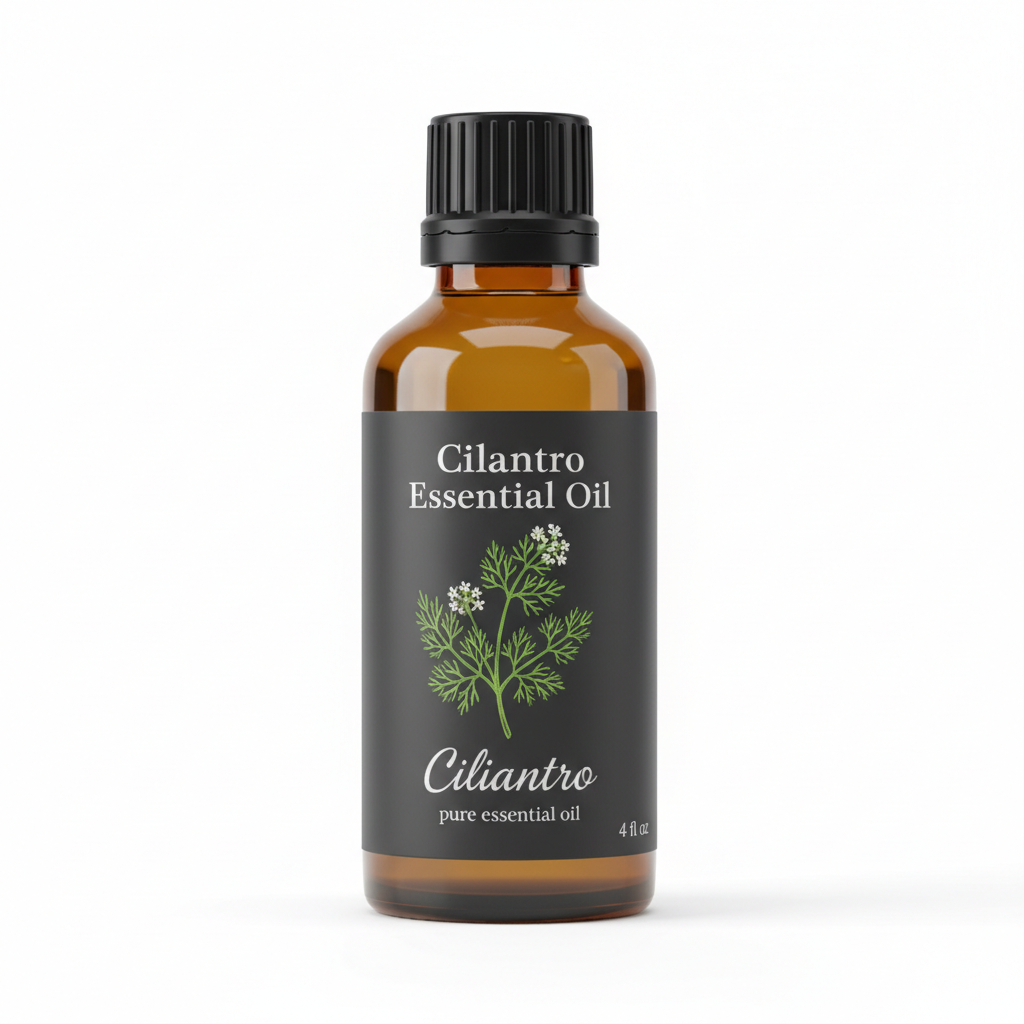
Cilantro Essential Oil
Our own Cilantro Essential Oil, in sizes from 0.5 oz to bulk.
From $13.99
Shop Now →Where the claim comes from, one study at a time
The 1996 case report. The idea is usually traced to the physician Yoshiaki Omura. The paper we could read, Omura et al., Acupuncture & Electro-Therapeutics Research, 1996, is a clinical case report about one person who had three dental amalgam fillings removed. The abstract says mercury deposits found afterwards were eliminated by 100 mg tablets of Chinese parsley (cilantro) four times a day, together with "drug-uptake enhancement methods" that include a technique called the Bi-Digital O-Ring Test. One subject, no control group, no randomisation, and a co-intervention that is itself unvalidated: this cannot show that cilantro did anything. It was also tablets of herb, not essential oil. (The brief for this article mentioned an Omura 1995 paper; we could not retrieve that one, so we are not describing it.)
The mouse study. Aga et al., Journal of Ethnopharmacology, 2001 gave male ICR mice lead acetate in drinking water (1000 ppm) for 32 days. From day 7 they also received "Chinese parsley" by gastric intubation for 25 days. A chelating drug, DMSA, served as the positive control. Lead deposition in the femur and kidney injury were lower in the parsley group, and urinary delta-aminolevulinic acid fell. The authors concluded the effect was "probably" due to chelation by some substances in the plant. Three limits matter. It was mice. It tested preventing deposition during ongoing exposure, which is not the same as clearing metal a person already carries. And the abstract does not describe an essential oil; the one fraction it names is a methanol extract used in a test-tube enzyme assay.
The water-treatment study. Karunasagar et al., Journal of Hazardous Materials, 2005 made a sorbent from the coriander plant and showed it removed inorganic and methyl mercury from spiked water; the authors point to carboxylic acid groups as the main binding sites, and they also immobilised the plant material on silica for column experiments. That is plant biomass acting like a filter medium in a beaker. It says nothing about what happens in a person.
Why an essential oil is the weakest candidate of all
Reasoning from those abstracts, the practical consequence is this. The mercury work credits carboxylic acid groups in plant material, which are part of the water-insoluble biomass left behind in the still. Steam distillation carries over the volatile fraction instead. A 2023 analysis of an essential oil from coriander leaves, Barbosa et al., Brazilian Journal of Biology, reported the major constituents as octanal, decanal, dec-(2E)-enal and dodecanal: aldehydes. Aldehydes are not carboxylic acids, and none of the three studies above tested them. So even taking the plant-material findings at face value, there is no stated reason to expect them to carry over to a distillate. That is an inference, not a finding, and nobody has tested it.
| Evidence | Preparation | Subject | What it can and cannot show |
|---|---|---|---|
| Omura et al., 1996 | Herb tablets, 100 mg four times daily | One person | A report, not a test; combined with other methods |
| Aga et al., 2001 | "Chinese parsley" by gastric tube; methanol extract in vitro | Mice | Less lead in bone and kidney injury during exposure; says nothing about people |
| Karunasagar et al., 2005 | Sorbent made from the plant | Spiked water | Mercury binding to biomass in a lab |
| Barbosa et al., 2023 | Leaf essential oil | Composition analysis (antifungal tests in vitro) | Describes what is in a leaf oil; not a metal study |
On the human question specifically: we searched PubMed for trials of cilantro in people with measured metal burdens and did not find a controlled one. Absence from a search is not proof that none exists, so read this as "we did not find one", but the three pieces above are the ones the claim is repeatedly traced to, and none of them is a human trial. A claim that needs a randomised, controlled trial and has a mouse study and a single case report standing in for it is a claim waiting for evidence, not one with evidence.
What the regulators say about "chelation" products
FDA's questions and answers on unapproved chelation products state that FDA "has never approved any chelation product for OTC use for any health condition." It says approved chelation products require a prescription, that chelation can cause "dehydration, kidney failure, and death," and that home test kits promoted alongside these products are not cleared by FDA and "may offer false or misleading results." FDA also says there is no proof that this kind of detoxification does anything for a medical condition, and it flags delayed care for serious heart and blood vessel conditions as a concern. We are a cosmetic-oil shop, and that last point is one reason we do not use detox language about our oil: a product marketed for detoxification is, in FDA's framing, being sold for a drug use. Our article on cosmetic versus drug claims explains how that line is drawn.
If you are actually worried about a metal exposure
That is a question for a physician, or a medical toxicologist for anything serious, not for an oil seller or a hair-analysis kit. CDC's clinical guidance on lead says exposure is diagnosed by measuring a blood lead level, first by finger or heel prick and then confirmed on a venous sample, and it mentions chelation, a medication to remove lead, only for children with very high levels (45 µg/dL or more), started while consulting a medical toxicologist or a pediatrician experienced with lead poisoning (CDC clinical guidance). The measurement comes first, and the action depends on the number and the person. If you suspect a source, such as old paint, a work process or a contaminated product, say so when you ask for the test.
Who should skip this idea, and what our oil is for
- Anyone considering swallowing cilantro essential oil for this purpose. We do not advise ingesting any essential oil, ours is labelled not for internal use, and the studies above give no basis for it. See can you ingest cilantro essential oil.
- Anyone postponing a blood test, or stopping a prescribed medication, because of something read online.
- Anyone buying a "detox" product that pairs the oil with a home test kit.
What we sell is a bright, green, citrus-edged cilantro leaf oil for diffusing, diluted skin products and craft use. The shop page gives 0.5% to 2% in a carrier for skin, which our dilution guide works out in drops, and the oil is undiluted so the maths is yours. For the wider picture of what has and has not been studied, see our overview of cilantro oil evidence and the safety notes.
Cilantro Essential Oil
Cilantro Essential Oil from our own shop, in sizes from 0.5 oz to bulk.
From $13.99
Shop Now →Sources & Further Reading
- Omura Y et al., 1996. Significant mercury deposits in internal organs following the removal of dental amalgam (clinical case report). pubmed.ncbi.nlm.nih.gov/8914687
- Aga M et al., 2001. Preventive effect of Coriandrum sativum (Chinese parsley) on localized lead deposition in ICR mice. pubmed.ncbi.nlm.nih.gov/11535365
- Karunasagar D et al., 2005. Removal and preconcentration of inorganic and methyl mercury from aqueous media using a sorbent prepared from Coriandrum sativum. pubmed.ncbi.nlm.nih.gov/15721537
- Barbosa et al., 2023. Coriandrum sativum L. essential oil obtained from organic culture shows antifungal activity against planktonic and multi-biofilm Candida. pubmed.ncbi.nlm.nih.gov/36651450
- FDA. Questions and answers on unapproved chelation products. fda.gov
- CDC. Lead prevention, clinical guidance. cdc.gov