Cilantro Oil as a Natural Deodorant: What the Evidence Covers
Cilantro leaf oil can be a fragrance in a homemade deodorant. It should not be sold to yourself as the thing that controls odour, and no lab result on coriander oil supports that. If you want a scented underarm product at a low percentage in a base you already tolerate, read on; if you want odour or sweat control, this oil is the wrong place to look.
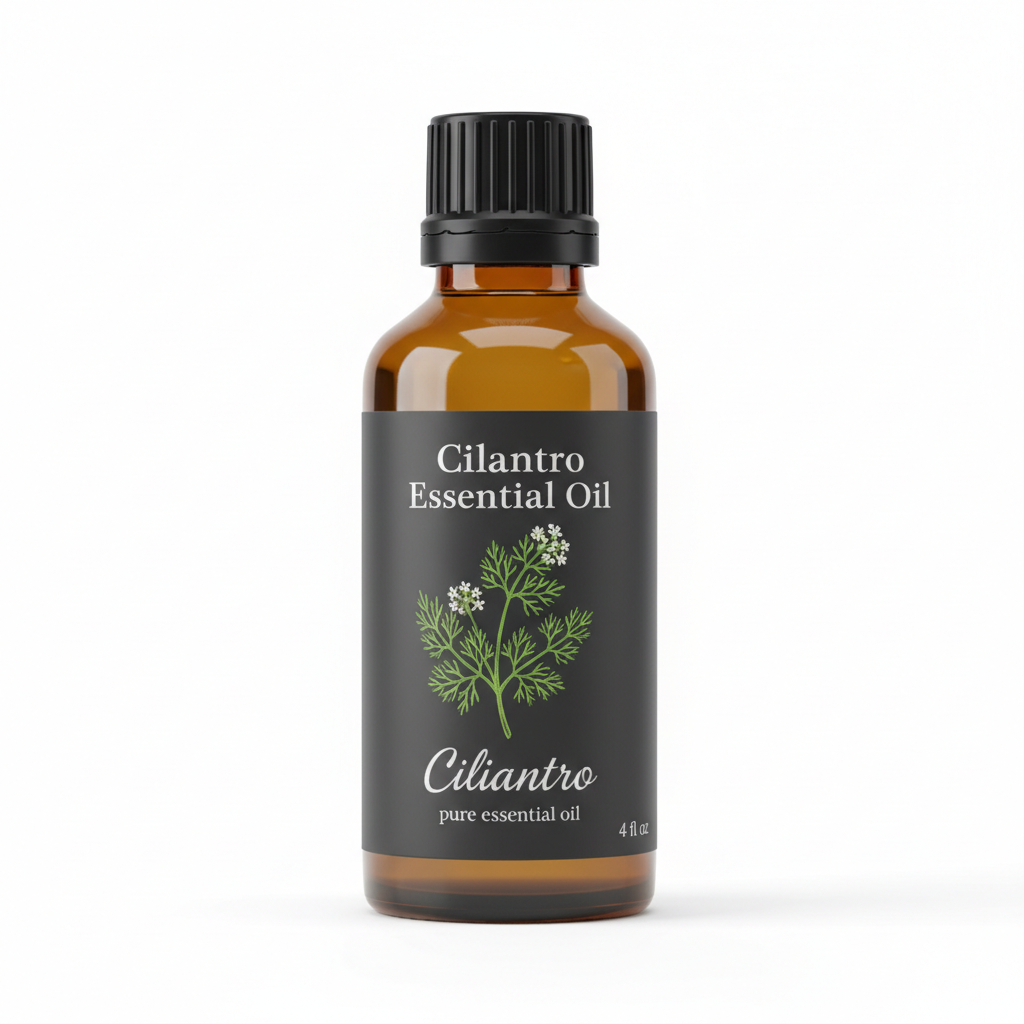
Cilantro Essential Oil
Our own Cilantro Essential Oil, in sizes from 0.5 oz to bulk.
From $13.99
Shop Now →What produces underarm odour
A 2013 review in FEMS Microbiology Ecology by James and colleagues (Unilever researchers, so an industry-authored review) says odour comes from microbes converting odourless secretions from eccrine, apocrine and sebaceous glands into volatile molecules. The underarm flora is mostly Gram-positive bacteria of the genera Staphylococcus, Micrococcus, Corynebacterium and Propionibacterium, and "most of the available evidence" points to Corynebacterium as the main causal agents, with the key substrates believed to come from apocrine glands. The molecules implicated include short and medium chain fatty acids, 16-androstene steroids and thioalcohols. Note the hedging: the authors say "most of the available evidence", not settled fact.
What the coriander antimicrobial data does and does not mean
The coriander study people usually point to is Casetti et al., Phytotherapy Research, 2012, from a dermatology department in Freiburg. Three things to read precisely. First, it used the oil of the fruits, meaning seed, not our leaf oil. Second, it was a standardised macrodilution test on clinical isolates of skin bacteria: the oil's mean minimum inhibitory concentrations were 0.04% v/v for Streptococcus pyogenes and 0.25% v/v for methicillin-resistant Staphylococcus aureus. The abstract does not name Corynebacterium among its results, and those are skin-infection bacteria, not the odour microbes in James's review. Third, it also put a cream and a lotion with 0.5% and 1.0% of the oil on 40 healthy volunteers under an occlusive patch and saw no irritation. That is a skin tolerance result for seed oil in a cream, not an odour result.
A 2022 study by Kumar et al. did test leaf oils, steam-distilled from four cultivars, and reported anti-microbial potential through minimum inhibitory concentrations, with (E)-2-decenal, decanal, (E)-2-dodecenal and (E)-2-tetradecenal as the main components. It was a laboratory comparison between cultivars, not a test on skin. Our article on the lab research goes deeper into this; our position here is narrower. A tube result at a concentration needed to stop growth in broth is not a deodorant claim. Nobody has run, as far as we found, a trial of cilantro leaf oil on underarm odour, and we have not either. Saying it "fights odour bacteria" would be inventing a result.
Reasoning from James's mechanism, odour is a product of microbes working on secretions. A fragrance in a deodorant changes what you smell at the surface; it does not change the secretions or the flora, and nothing we read shows that a 0.5% to 1.2% leaf oil does. Cilantro's green, citrusy edge is also a top note, so the scent you add is the sort that fades first. For a sweat-heavy day, that is a poor match for the job. It does suit a light scent on a day when odour is not the issue.
Why the claim line matters: deodorant versus antiperspirant
The FDA page "Is It a Cosmetic, a Drug, or Both?" lists deodorants among cosmetics and says deodorants that are also antiperspirants are cosmetic/drug products that must meet the requirements for both. Antiperspirants themselves are covered by an over-the-counter drug monograph (21 CFR 350.1). So the practical line is intended use: a product that makes you smell of cilantro is a cosmetic; one that claims to stop sweat or to act against microbes starts to look like a drug. This is the reason our articles stay on scent. Our cosmetic versus drug claims article covers the wider rule, and for what your particular product may say, ask a cosmetic regulatory adviser.
The underarm is where fragrance reactions show up
A 2024 dermatology review in Cutis (Musicante, Cohen and Milam) names deodorants, antiperspirants, detergents, soaps and clothing as frequent sources of axillary contact dermatitis, and says fragrance is a common cause. In the German IVDK data set (Uter et al., 2007), 1,468 patients were patch tested with 2,557 of their own products, 1,094 of them deodorants; 129 patients reacted to at least one product. That data came from patients already suspected of dermatitis, not the general population, so it does not give a rate for healthy users. It shows that the product you apply under your arm is a plausible suspect when a rash appears.
We looked for a primary source quantifying baking soda irritation in deodorants and did not find one. We therefore do not cite a figure, and the recipe below leaves baking soda out. That is our choice, not a finding.
If you still want a scented underarm product
The Tisserand Institute gives 0.5% to 1.2% for face products and deodorants, and 0.2% to 1% for sensitive or damaged skin. Our shop page says 0.5% to 2%. The two sources disagree on the top end; use the lower one, because underarm skin is shaved, folded and occluded. Our shop copy implies about 20 drops per millilitre (3 drops in 30 ml is 0.5%); Tisserand notes that drop conversions are only approximate.
- 30 ml (1 oz) of base at 0.5%: 0.15 ml, about 3 drops.
- 30 ml at 1%: 0.3 ml, about 6 drops.
- 30 ml at 1.2%, the top of Tisserand's range: 0.36 ml, about 7 drops.
- 10 ml roll-on at 0.5%: 0.05 ml, about 1 drop, which is hard to measure; make 30 ml or more.
This is arithmetic from the cited guidance on a base of your choice (we sell no bases or roller bottles), untested by us. Count other fragrance oils toward the same percentage. Do not apply right after shaving or to broken skin, and run the patch test on the inner forearm first; our dilution guide explains the mixing. Our roller blend recipes cover roll-on mechanics.
Who should skip this
If you sweat heavily or have a persistent odour change, see a physician or dermatologist; both are medical questions we cannot answer. Skip it with eczema, a history of fragrance allergy, or an existing underarm rash, and see a dermatologist. Ask a pharmacist or paediatrician before any essential oil product for a child, and an OB-GYN or midwife in pregnancy.
Our cilantro leaf oil is sold undiluted, so every percentage above is yours to calculate; smaller bottle first, as the aroma divides people.
Cilantro Essential Oil
Cilantro Essential Oil from our own shop, in sizes from 0.5 oz to bulk.
From $13.99
Shop Now →Sources & Further Reading
- James AG et al., 2013. Microbiological and biochemical origins of human axillary odour. pubmed.ncbi.nlm.nih.gov/23278215
- Casetti F et al., 2012. Antimicrobial activity against bacteria with dermatological relevance and skin tolerance of the essential oil from Coriandrum sativum L. fruits. pubmed.ncbi.nlm.nih.gov/21815228
- Kumar S et al., 2022. Chemical composition of fresh leaves headspace aroma and essential oils of four coriander cultivars. pubmed.ncbi.nlm.nih.gov/35251089
- U.S. FDA. Is it a cosmetic, a drug, or both? fda.gov/cosmetics
- eCFR. 21 CFR 350.1, Scope (antiperspirant drug products). ecfr.gov/title-21/part-350
- Musicante MJ, Cohen DE, Milam EC, 2024. Axillary contact dermatitis: an update on potential allergens and management. pubmed.ncbi.nlm.nih.gov/38478935
- Uter W et al., 2007. Patch test results with patients' own perfumes, deodorants and shaving lotions: IVDK 1998-2002. pubmed.ncbi.nlm.nih.gov/17309462
- Tisserand Institute. Essential oil dilution. tisserandinstitute.org/safety/dilution