
Cilantro Essential Oil for Sleep and Stress: Leaf vs Seed
If you came here because coriander is described as calming, the calming story belongs mostly to the seed. Coriander seed oil is dominated by linalool, the same molecule people point to in lavender. Cilantro leaf oil, which is what we sell, is dominated by fatty aldehydes and smells green, sharp and citrus-edged, which in our reasoning makes it an odd choice for a bedside table. We make no sleep or stress claim for it.
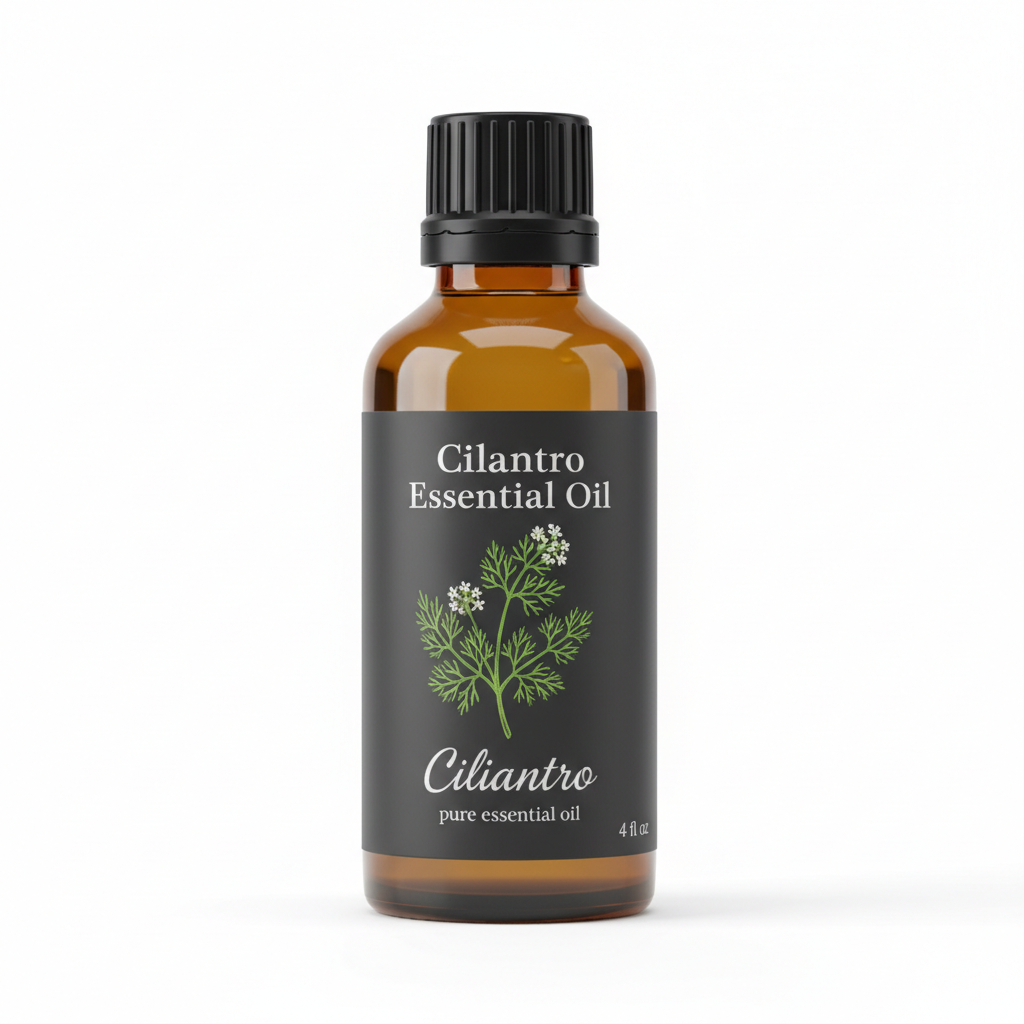
Cilantro Essential Oil
Our own Cilantro Essential Oil, in sizes from 0.5 oz to bulk.
From $13.99
Shop Now →Step one: which oil is the study about?
Almost every "coriander" finding on anxiety involves seed. The comparison below uses only sources we read.
| Coriander seed (fruit) oil | Cilantro leaf oil | |
|---|---|---|
| Main constituent reported | Linalool, 83.6% in one Italian analysis of fruit oil (Benelli et al., Parasitology Research, 2013); a 2025 review also calls seed oil "predominantly" linalool (Bano et al., 2025) | Octanal, decanal, dec-(2E)-enal and dodecanal in a Brazilian leaf oil (Barbosa et al., 2023) |
| Where the anxiety studies sit | Mouse studies, below | None found |
| Character | Not our product; we sell leaf and seed as separate products per our oil page, and this shop sells only the leaf oil | Green, bright, herbaceous with a citrusy edge (our shop description) |
Composition varies with origin, harvest stage and plant part, so these are single examples, not a specification. Our own batches carry a Certificate of Analysis on the shop page, and that, not a paper from another country, is the document that describes our oil. Our guide to reading a GC-MS report explains the columns.
What the coriander anxiety studies did
- Emamghoreishi et al., 2005. An aqueous extract of coriander seed, injected intraperitoneally into male albino mice at 10 to 100 mg/kg. At 100 mg/kg the mice spent more time on the open arms of an elevated plus-maze, the standard anxiety model. Doses of 50, 100 and 500 mg/kg also reduced spontaneous activity and coordination, so the authors raised sedation and muscle relaxation as possible explanations for the maze result (PubMed 15619553).
- Mahendra and Bisht, 2011. A hydroalcoholic extract of coriander fruit in mice, at 50, 100 and 200 mg/kg, with diazepam as the comparison. The 100 and 200 mg/kg doses showed effects "almost similar to diazepam" across four anxiety paradigms; 50 mg/kg did nothing (PubMed 22022003).
Both are animal studies, both used seed or fruit extracts (aqueous or hydroalcoholic), and neither used an inhaled essential oil. Extracts are not essential oils; they contain water- or alcohol-soluble compounds that steam distillation does not carry over. Neither study is a basis for a claim about smelling a bottle of cilantro leaf oil. The authors of the 2011 paper themselves say further work is needed to identify the constituents responsible.
Two bits of arithmetic keep the numbers honest. First, the mouse doses are injected or fed extract measured in milligrams per kilogram: at 100 mg/kg, an assumed 25 g mouse receives 2.5 mg of extract into the body (our ordinary maths; the abstracts do not give mouse weights). Nobody inhales milligram quantities of extract from a diffuser, so the route and the dose are both different from anything a reader would do. Second, the 100 mg/kg dose in the 2005 study is the same dose that also cut spontaneous activity and coordination, which is why we read the maze result as possibly reflecting sedation rather than a specific anxiety effect, the authors' own caution.
What the human evidence looks like, and it is not about coriander
The best-developed human literature is for lavender. A systematic review and meta-analysis, Donelli et al., Phytomedicine, 2019, pooled 37 randomised trials (3,964 participants) for the quantitative part and reported that lavender inhalation lowered anxiety scores (Hedges' g of -0.73, 95% CI -1.00 to -0.46). That is lavender, in many different forms and settings. It does not transfer to a different plant with a different dominant constituent, and linalool-containing is not a synonym for effective: a smell is a mixture, and no trial we read isolated linalool by inhalation.
Expectation is also real. In Campenni et al., Psychological Reports, 2004, 90 undergraduate women sat in a room scented with lavender, neroli or a placebo odour, with the odour described as relaxing, stimulating or nothing at all. Heart rate and skin conductance followed the suggestion in predictable directions, and the authors concluded that expectations play a significant role in odor-evoked mood changes. Reasoning from that, the practical consequence is that if you enjoy a scent and it is part of your wind-down routine, the routine may be doing real work, and that is not a reason to buy a particular oil on a chemistry argument.
What would a fair test of cilantro leaf oil need? Reasoning from the Campenni design, it would need a comparison odour, and an aldehyde-rich green scent is hard to disguise, so participants would know which room they were in and their expectations would colour the result. To our knowledge no such trial exists, and this paragraph is about study design, not about anything we have run.
Decide: should cilantro leaf oil be your bedtime oil?
- Do you like the smell? Our own page calls the aroma divisive and suggests the smallest bottle first. A scent you dislike is a poor candidate for winding down, whatever the paper says.
- Do you want calming specifically? The documented calming literature is about lavender and about seed extracts in mice. We sell neither, so for that goal we are not the right shop. We sell one oil, cilantro leaf.
- Do you want green and fresh in a room? Then it is a fair choice. Reasoning from the shop guidance that it dominates a blend quickly, start with less than you expect. See diffusing cilantro oil.
Limits, and when to see someone
Trouble sleeping for weeks, constant worry, or low mood deserve a conversation with a physician or a psychologist, not a new bottle. If you are in distress right now, the 988 Suicide & Crisis Lifeline is reachable by call or text to 988, free and confidential, 24 hours a day. FDA's own page on cosmetic and drug claims uses a fragrance marketed with "aromatherapy" claims such as helping someone sleep as an example of a product that becomes a drug by its intended use, which is why a cosmetic-oil shop like ours stays out of sleep and stress claims; see cosmetic versus drug claims. For the seed-versus-leaf difference in more detail, see cilantro vs coriander oil. As with any essential oil, keep ours off the skin undiluted, out of reach of children and pets, and not for internal use.
Cilantro Essential Oil
Cilantro Essential Oil from our own shop, in sizes from 0.5 oz to bulk.
From $13.99
Shop Now →Sources & Further Reading
- Benelli G et al., 2013. Larvicidal and repellent activity of the essential oil of Coriandrum sativum L. fruits against Aedes albopictus. pubmed.ncbi.nlm.nih.gov/23263388
- Barbosa et al., 2023. Coriandrum sativum L. essential oil obtained from organic culture shows antifungal activity against planktonic and multi-biofilm Candida. pubmed.ncbi.nlm.nih.gov/36651450
- Bano et al., 2025. From Flavor to Medicine: a review of phytochemistry and potential applications of Coriandrum sativum. pubmed.ncbi.nlm.nih.gov/40849763
- Emamghoreishi M et al., 2005. Coriandrum sativum: evaluation of its anxiolytic effect in the elevated plus-maze. pubmed.ncbi.nlm.nih.gov/15619553
- Mahendra P, Bisht S, 2011. Anti-anxiety activity of Coriandrum sativum assessed using different experimental anxiety models. pubmed.ncbi.nlm.nih.gov/22022003
- Donelli D et al., 2019. Effects of lavender on anxiety: a systematic review and meta-analysis. pubmed.ncbi.nlm.nih.gov/31655395
- Campenni CE et al., 2004. Role of suggestion in odor-induced mood change. pubmed.ncbi.nlm.nih.gov/15362382
- FDA. Is it a cosmetic, a drug, or both? (Or is it soap?). fda.gov
- 988 Suicide & Crisis Lifeline. 988lifeline.org