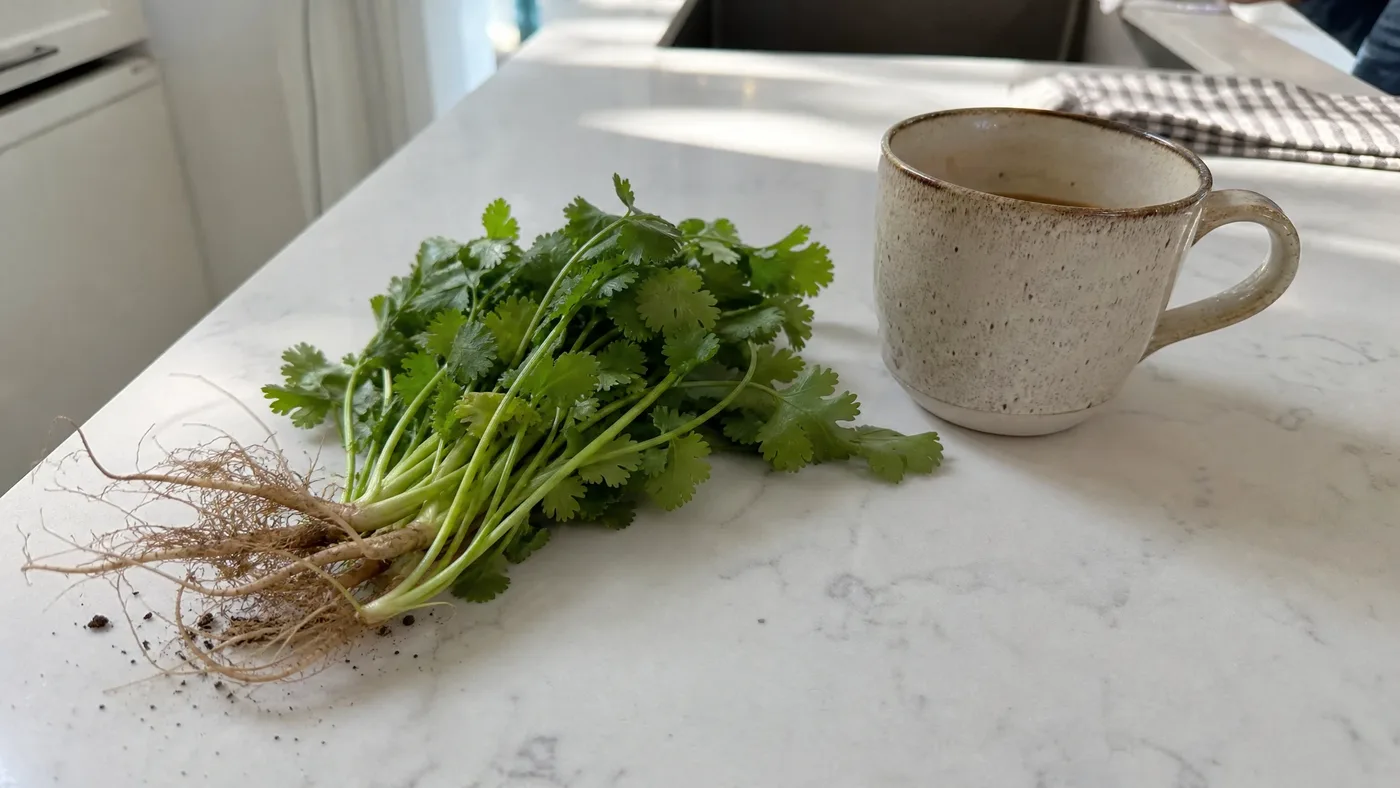
Organic vs Conventional Cilantro Oil: What the Word Covers
"Organic" on an essential oil label describes how the plants were farmed and handled. It does not describe how the oil smells, how concentrated it is, or whether it contains pesticide residue, and for a cilantro leaf oil the useful question is usually not "is it organic?" but "can the seller show me a certificate, and can they show me a batch report?" Our own position is narrower than the word might suggest, and we set it out below.
Cilantro Essential Oil
Our own Cilantro Essential Oil, in sizes from 0.5 oz to bulk.
From $13.99
Shop Now →Where we stand, stated plainly
Our /our-oil/ page says we buy in bulk direct from farms that grow the crop organically. That is a statement about the growing. The site does not publish an organic certificate, a certifier's name or a certificate number, so we do not call the oil "certified organic" or "USDA Organic", and you should not read those words into ours. If organic certification is a requirement for you, ask for the certificate before you buy, from us or from anyone else. A claim you cannot check is a description, not a credential.
Question 1: do you need the word on your own label?
This is the question that turns "organic" from a preference into a legal matter. Under the USDA's organic regulation, a production or handling operation that sells, labels or represents agricultural products as "100 percent organic," "organic" or "made with organic" must be certified, unless an exemption applies (7 CFR 205.100, eCFR). The main exemption is for operations with gross agricultural income from organic sales of five thousand dollars or less a year. Exempt operations skip certification, but they must still follow the production, handling and labeling rules, and they must keep records for at least 3 years that show the product was organically produced (7 CFR 205.101, eCFR).
Reasoning from those two sections, two consequences matter if you make soap, candles or sprays. First, an organic claim on your finished product has to be supportable through the chain behind it, which means a supplier's certificate you can produce, not a supplier's word. Second, the claim attaches to operations as well as farms: our oil is distilled in our own still, so even a certified farm would not by itself settle the certification status of the distilled oil. We are not lawyers and the regulation has more exemptions than we list here (the eCFR page runs from (a) to (h)), so if the label claim matters commercially, read the section or ask the USDA's National Organic Program, or a certifier.
For cosmetics specifically, the FDA says it has no definition of "organic," that the USDA's National Organic Program sets the meaning for agricultural ingredients, and that products labeled organic must comply with both agencies' rules (FDA, "Organic" Cosmetics). Anything the FDA considers a drug claim is a separate matter; our oil is sold as a fragrance material and we make no medical claims.
Question 2: what do you think organic guarantees?
Here is what the regulation actually requires of the land. A field whose harvest will be marketed as organic must have had no prohibited substances applied for the 3 years before harvest, and must have borders and buffer zones to keep prohibited substances from neighbouring land away from the crop (7 CFR 205.202, eCFR). That is a restriction on inputs and history. It is not a purity specification for the finished oil, and it sets no minimum for the compounds in it.
The FDA's wording is blunter: "An ingredient's source does not determine its safety," and many plants, organic or not, can be toxic or allergenic. For an aldehyde-rich oil that is worth remembering, because the skin-sensitivity questions about cilantro oil are about the oil's own chemistry, and organic farming does not change that. Dilution, a patch test and a conversation with a dermatologist or allergist if you react are the controls, not the farm. See our safety article for how we frame that.
Organic farming does not change the aroma story either. Leaf oil composition in the published papers varies with cultivar, growing conditions and method: in two studies we compare in our GC/MS reading guide, 2-decenal ranged from 15.7 to 25.1% in four steam-distilled cultivars and from 37 to 63% in Portuguese aerial-part oils. Neither paper compares organic with conventional farming (one compares cultivars, the other field accessions), so neither supports a claim that organic leaf oil smells or measures differently.
Question 3: is residue your real worry?
If the worry behind "organic" is pesticide residue, the direct answer is a residue screen on the batch. Organic status lowers the expected exposure to prohibited inputs on the farm. It does not measure what is in the bottle. We searched for a peer-reviewed study that measured whether pesticide residues carry from cilantro leaf into steam-distilled leaf oil and did not find one we could open and read, so we make no claim either way about the size of that effect. The practical course is to ask the seller whether a residue screen exists for the lot.
Our shop page publishes a Certificate of Analysis, and we do not describe its contents here. Check what it covers: a composition report (the kind in the GC/MS guide) is a different test from a pesticide screen, and a composition report does not show residues. If you want a residue result and the certificate does not include one, ask us for it, and treat the absence of an answer as an answer.
What a Tisserand-style supplier check looks like
The Tisserand Institute's supplier guide treats organic sourcing as a bonus green flag when it is backed by an independent, verifiable certificate, and as a question mark when every oil on a list is claimed to be organic or wild-crafted and no certificates exist, especially where the claim makes no sense (Tisserand Institute, supplier guide). Put into steps for a single-oil seller like us:
- Ask for the certificate, not the word. It should name the operation, the certifier and what the certificate covers.
- Check the operation in the USDA's public Organic Integrity Database. The certificate and the database should agree.
- Check scope: farm certified, handler certified, or both. Ask who distilled the oil.
- Ask for a residue screen on the lot, if residue is the concern.
- Ask for the batch composition report and match the lot number to your bottle.
Who should pick a certified oil, and who can skip the question
Choose a certified oil if you must label your own product organic, if a retailer or marketplace requires the certificate, or if you simply want the farming restrictions in 7 CFR 205.202 behind your supply. Those are legitimate reasons, and we do not argue against them. Our oil does not currently meet the first two because no certificate is published on our site.
If you are making a scented candle, soap or room spray for your own use, "organic" will change your result less than the dilution maths and the batch report will. Remember that we sell the one leaf oil only, so for a certified alternative you would go to another supplier. For adjacent reading, see what "therapeutic grade" means on a label, where the same logic applies: the word on the bottle is not the evidence.
Cilantro Essential Oil
Cilantro Essential Oil from our own shop, in sizes from 0.5 oz to bulk.
From $13.99
Shop Now →Sources & Further Reading
- U.S. eCFR, Title 7 Part 205.100, What has to be certified. ecfr.gov, 7 CFR 205.100
- U.S. eCFR, Title 7 Part 205.101, Exemptions and exclusions from certification. ecfr.gov, 7 CFR 205.101
- U.S. eCFR, Title 7 Part 205.202, Land requirements. ecfr.gov, 7 CFR 205.202
- FDA. "Organic" Cosmetics. fda.gov/cosmetics/cosmetics-labeling-claims/organic-cosmetics
- Tisserand Institute. Eight green and red flags when looking for your ideal essential oil supplier. tisserandinstitute.org/essential-oil-suppliers
- USDA Agricultural Marketing Service. Organic Integrity Database. organic.ams.usda.gov/integrity
- Machado AM et al., 2023, Plants 12(14):2749 and Kumar S et al., 2022, Frontiers in Plant Science 13:820644 (composition ranges quoted in the GC/MS guide). PMC10384636, PMC8891447