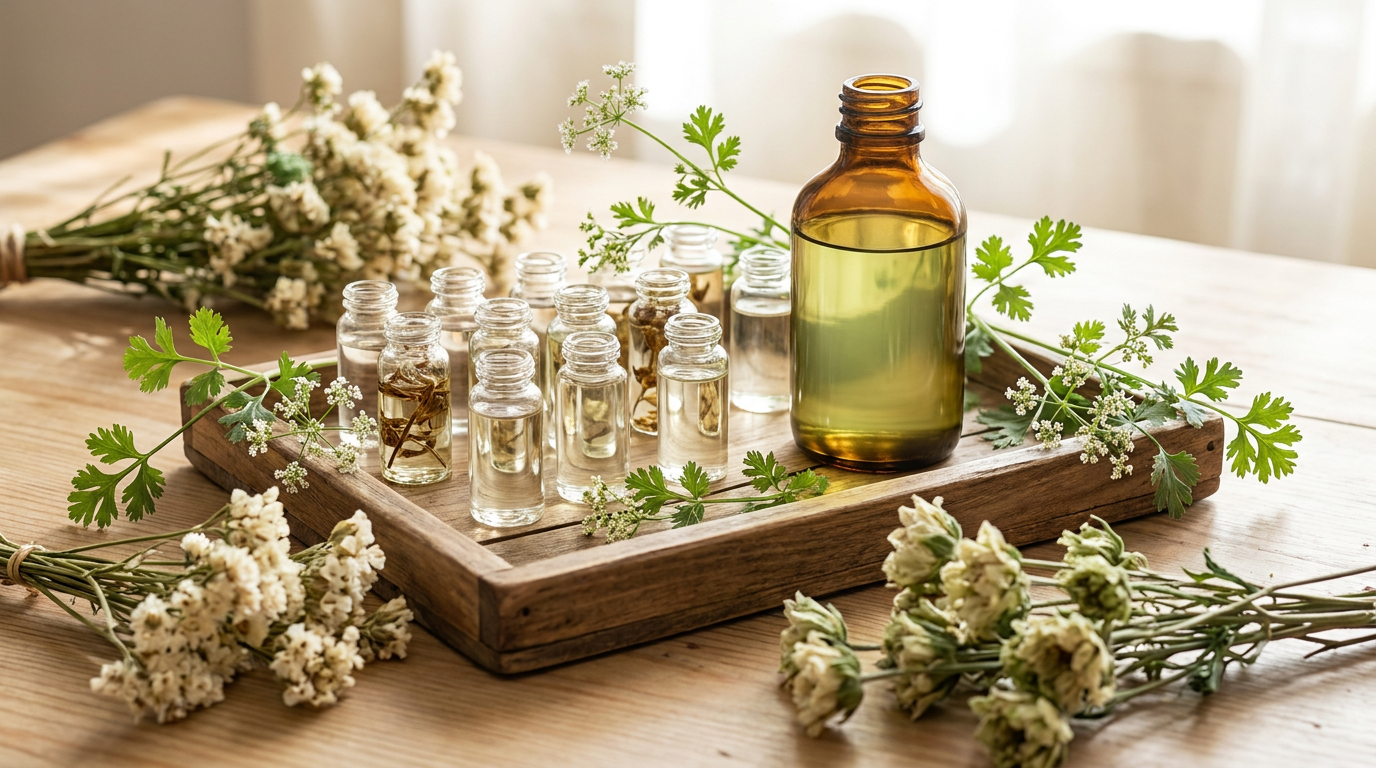
Cilantro Essential Oil Myths: Potency, Sourcing and Perfumery Use
Cilantro essential oil has a devoted following and a reputation problem in equal measure. People either love its green, slightly peppery brightness or wrinkle their nose the moment the bottle opens. Somewhere between those two camps, a handful of myths have taken root: that every bottle labeled "cilantro essential oil" is functionally identical, that more drops always means a stronger effect, and that this oil has no real place in fine perfumery. We wanted to sort fact from assumption, using what research suggests and what evidence indicates about how this oil is actually produced, priced, and used. Below, six common myths, examined one at a time.
Cilantro Essential Oil
Our own Cilantro Essential Oil, in sizes from 0.5 oz to bulk.
From $11.99
Shop Now →Myth 1: Cilantro Essential Oil Is the Same Everywhere It's Grown
The myth: A bottle of cilantro essential oil is a bottle of cilantro essential oil, no matter where the plant was grown or who distilled it.
The truth: This is one of the most persistent misunderstandings in the essential oil world, and it doesn't hold up. Cilantro (Coriandrum sativum) is an annual herb, and like most annuals, its chemistry shifts with growing conditions. Soil composition, rainfall, harvest timing, and even the specific cultivar all influence the plant's aromatic compound profile before it ever reaches a still. Research on Coriandrum sativum has repeatedly shown variation in linalool and decanal content between harvests from different regions, and even between different fields in the same region during different growing seasons. Distillation method matters too: steam distillation temperature and duration change which volatile compounds make it into the final oil in what proportion.
So is cilantro essential oil the same everywhere? No. Two bottles labeled identically can smell and perform noticeably differently depending on origin, harvest year, and the distiller's process. This is why reputable suppliers publish batch-specific testing (often called a certificate of analysis) rather than a single static spec sheet for the product line.
Why the myth exists: Retail labeling rarely communicates this nuance. A bottle simply says "cilantro essential oil," with no mention of harvest year or growing region, so shoppers reasonably assume uniformity across brands and batches. The oil industry's own marketing habits are partly to blame here: standardized-sounding labels imply standardized product, even when the underlying agriculture is anything but standardized.
Myth 2: More Drops Always Means More Potency
The myth: If a little cilantro essential oil is good, a lot must be better, so heavier dilution or higher drop counts will always produce a stronger, more noticeable result.
The truth: Essential oils, cilantro included, don't scale linearly the way this myth assumes. Aromatic compounds have a scent threshold, meaning our noses can only distinguish so much intensity before additional oil simply reads as "more of the same" rather than meaningfully stronger. Past a certain concentration, adding more oil also increases the likelihood of skin sensitivity for topical use, without a proportional gain in aromatic impact.
For context on how much cilantro essential oil to use, most aromatherapy and formulation guidance suggests starting low and adjusting upward slowly. A common general dilution range for topical blends is 1 to 2 percent essential oil in a carrier oil, which works out to roughly 6 to 12 drops of essential oil per ounce of carrier. For diffuser use, most manufacturers recommend just 3 to 5 drops per standard reservoir of water. These are starting points, not fixed prescriptive rules, and the right amount depends on the size of the room, the diffuser type, and personal sensitivity.
Why the myth exists: It's an intuitive but flawed extension of "more ingredient equals more flavor" thinking borrowed from cooking. With food, doubling an ingredient often does intensify the result in a fairly predictable way. Essential oils behave differently because they are far more concentrated, and the nose adapts to strong aromas quickly through a phenomenon called olfactory fatigue, which can make an overdosed blend seem no stronger, or even less pleasant, than a well-measured one.
Myth 3: Cilantro Oil Smells Exactly Like Fresh Cilantro Leaves
The myth: Cilantro essential oil smells just like a handful of fresh cilantro from the produce aisle, so if you love or hate that smell, you already know how you'll feel about the oil.
The truth: This one surprises a lot of first-time buyers. Cilantro essential oil is typically distilled from the seeds of the plant, which is technically coriander seed rather than the leafy herb, though commercial labeling around "cilantro oil" varies and sometimes the leaf itself is used in specialty distillations. Leaf-derived cilantro oil does carry some of that same green, slightly soapy-to-some quality associated with fresh leaves, largely due to aldehyde compounds. But distillation concentrates and transforms the aromatic profile compared to the raw plant, often bringing out warmer, spicier, almost citrus-adjacent notes that aren't as prominent when you're simply chopping the herb for a recipe. Evidence indicates the aromatic chemistry of the essential oil and the fresh plant overlap significantly but are not identical experiences.
Why the myth exists: The name itself does the damage. "Cilantro" is such a distinct, polarizing flavor and scent in the popular imagination (thanks in part to a well-documented genetic variation that makes some people perceive it as soapy) that people assume the essential oil must be a one-to-one aromatic match. In practice, people who dislike fresh cilantro sometimes find they don't mind the essential oil's aroma at all, and vice versa.
Myth 4: Coriander Oil and Cilantro Oil Are Interchangeable
The myth: "Coriander oil" and "cilantro oil" are just two names for the same product, so it doesn't matter which one you buy.
The truth: They come from the same plant, but not the same plant part, and that distinction matters more than most casual buyers realize. Coriander essential oil is distilled from the dried seeds and tends to have a warm, slightly woody, faintly citrus character, largely attributed to its linalool content. Cilantro essential oil, when distilled from the fresh leaf and stem, carries a sharper, greener, more herbaceous profile driven by different aldehyde compounds. Some suppliers use the names loosely or even interchangeably, which only deepens the confusion. If a specific aromatic profile matters for a blend or a perfume project, it's worth confirming with the supplier exactly which plant part was distilled rather than trusting the label name alone.
Why the myth exists: Botanically, both names refer to Coriandrum sativum, so from a taxonomy standpoint the confusion is understandable. But aromatic chemistry cares about plant part, not just species, and marketing copy rarely draws that line clearly.
Myth 5: In Perfumery, Cilantro Oil Only Appeals to People Who Like the Herb
The myth: Because cilantro is such a love-it-or-hate-it flavor, cilantro oil in perfume is a niche curiosity that only appeals to a narrow audience.
The truth: This is one of the more persistent cilantro oil in perfume myths, and perfumers tend to disagree with it. In small, carefully balanced quantities, cilantro and coriander-derived oils are valued in perfumery precisely because they don't read as literally "cilantro" to most noses. Used as a top or heart note alongside citrus, spice, or green florals, the oil contributes a bright, slightly peppery lift rather than an obvious herb smell. This is a well-established technique in aromatic formulation: individual raw materials rarely smell in a finished blend the way they smell straight from the bottle, because surrounding notes shift how a compound is perceived. Several fine fragrances across niche and mainstream perfume houses have used coriander-derived materials as supporting notes for exactly this reason, without customers necessarily identifying cilantro or coriander by name.
Why the myth exists: People experience the raw, undiluted oil (often by opening the bottle and smelling it directly) and extrapolate that a finished fragrance built around it would smell the same way at full strength. That's not how blended perfumery works. A skilled formulation uses the oil as one voice in a larger composition, not the whole performance.
Myth 6: A Higher Price Always Means a Higher Quality Oil
The myth: When comparing bottles, the more expensive cilantro essential oil is automatically the better, more potent, more "pure" option.
The truth: Price correlates with quality more often than not, but it isn't a reliable stand-alone signal. Cost is affected by harvest yield that year, currency fluctuations, packaging, brand overhead, and marketing spend, none of which directly measure the oil's aromatic quality or how it was tested. A lower-priced oil from a transparent small distiller with a current certificate of analysis can be a more honest product than a premium-priced bottle from a brand that won't share testing data. The most useful indicators of quality aren't price at all: batch-specific testing, a stated country of origin, harvest date, and a distiller willing to answer direct questions about their sourcing.
Why the myth exists: Price-as-quality-signal is a heuristic that works reasonably well across many consumer categories, so people bring it to essential oil shopping by default. It's a shortcut that once in a while gets things badly wrong, and essential oils are a category where it's worth doing the extra step of checking documentation rather than trusting the price tag alone.
How Much Cilantro Essential Oil to Use: A Practical Overview
Since "how much cilantro essential oil to use" is one of the most common questions we hear, here's a general reference table. These are commonly cited starting points, not fixed rules, and individual sensitivity varies:
| Use Case | General Starting Point | Notes |
|---|---|---|
| Diffuser (standard size) | 3 to 5 drops | Adjust for room size and ventilation |
| Topical blend (body) | 1 to 2% dilution (roughly 6 to 12 drops per ounce of carrier oil) | Always dilute in a carrier oil before skin contact |
| Facial blend | 0.5 to 1% dilution | Facial skin is generally more sensitive than body skin |
| Perfume or solid fragrance base | Small percentage of total formula, often under 5% | Best balanced alongside citrus, spice, or floral notes |
A few safety notes are worth repeating regardless of how experienced you are with essential oils. Always dilute cilantro essential oil in a suitable carrier oil before applying it to skin, and do a patch test on a small area of the inner forearm, waiting 24 to 48 hours, before using a new blend more broadly. Discontinue use if any irritation develops. Essential oils are not appropriate for internal use without qualified guidance, and pregnant or nursing individuals, as well as those with sensitive skin, should check with a qualified healthcare provider before introducing a new essential oil into a routine. This article is educational and does not replace personalized guidance from a healthcare provider.
Sorting the Signal from the Noise
Most cilantro essential oil myths trace back to a reasonable assumption applied a little too broadly: that labels mean uniformity, that more equals stronger, that a raw material smells in a blend the way it smells alone, or that price tracks quality on a straight line. None of those assumptions are unreasonable on their face. They just don't hold up once you look at how this particular oil is actually grown, distilled, and formulated. Buying from a supplier that shares batch testing, starting with modest dilution amounts, and thinking of the oil as one voice in a larger aromatic composition rather than a soloist will serve most people better than any of the myths above.