Cilantro Essential Oil in Candles: One Studio's Batch Notes
Most herbal candle lines lean on the same handful of notes: rosemary, mint, basil, maybe a sprig of thyme for depth. A small independent candle studio wanted something sharper, greener, and a little more divisive, so cilantro essential oil in candles became the subject of an informal testing round. This case study walks through how that testing was set up, what the batch notes recorded, and what a working candle maker might take away from the results. None of what follows is a guarantee of outcome in your own workshop; wax, wick, and room conditions all shift the results, and this is one studio's experience, not a laboratory study.
Cilantro Essential Oil
Our own Cilantro Essential Oil, in sizes from 0.5 oz to bulk.
From $11.99
Shop Now →Why Cilantro Showed Up on the Testing Bench
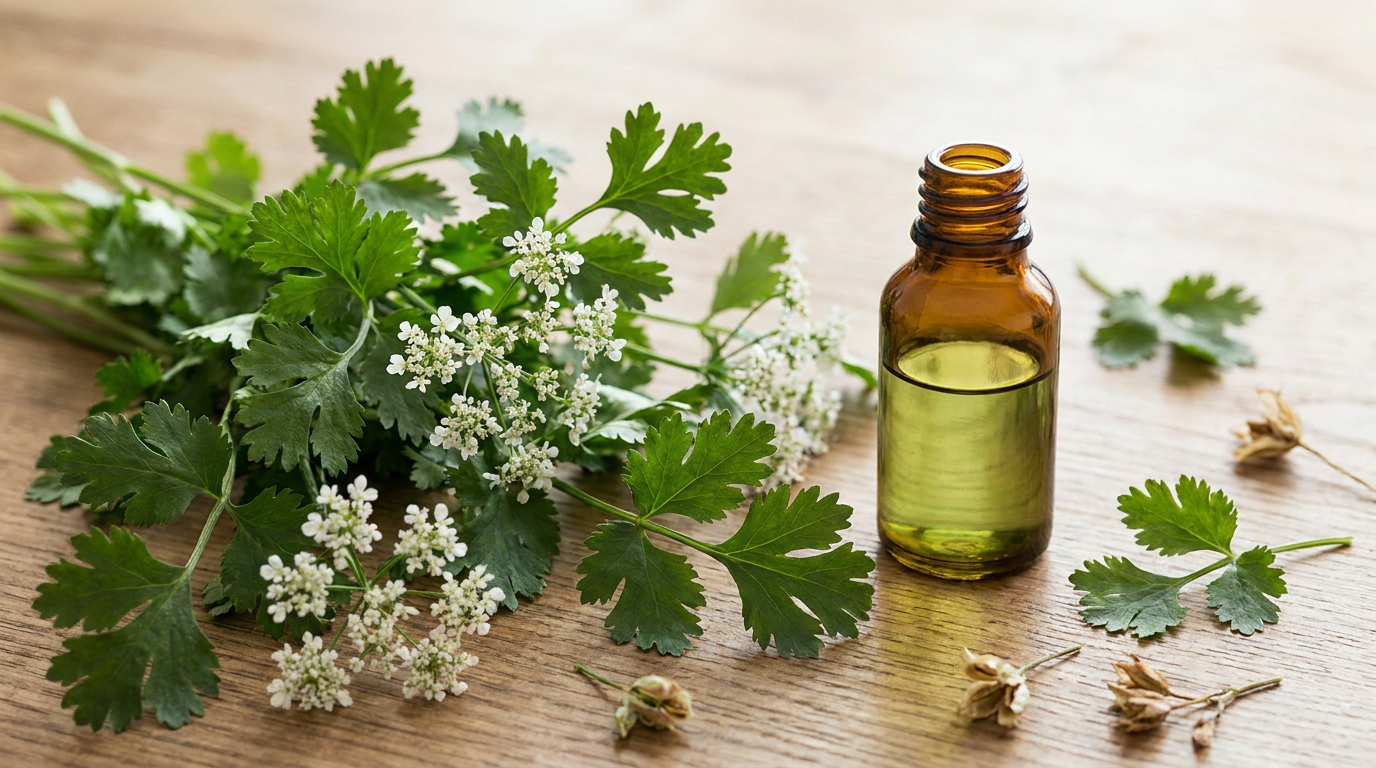
Cilantro essential oil is steam distilled from the fresh leaf and stem of Coriandrum sativum, which sets it apart from coriander seed oil, a different extraction from the same plant with a warmer, spicier profile. Leaf-derived cilantro oil tends to read as green, slightly citrusy, and unmistakably herbaceous, closer to what you'd smell crushing the fresh leaf between your fingers than to a dried spice cabinet.
That polarizing quality is part of what made the studio curious. Cilantro is famously a love-it-or-leave-it scent for a portion of the population, and the team wanted to see whether that same split reaction would show up once the oil was diffused through wax rather than smelled straight from the bottle. A candle scent behaves differently than a raw oil: heat changes volatility, wax can mute or round out sharper top notes, and a blend can shift how a single ingredient reads entirely.
Setting Up the Batch Notes
The studio's approach was straightforward and intentionally low-tech: small test batches, a shared log for candle studio batch notes, and a rotating panel of five in-house testers who smelled and burned each candle without knowing the load rate in advance. The goal wasn't to publish a scientific paper; it was to build a working reference for whether cilantro essential oil in candles was worth developing further.
Wax and Load Rates
Three load rates were tested across a coconut-soy blend, chosen for its reputation for holding scent well relative to straight soy:
| Batch | Fragrance Load | Wick | Rest Time |
|---|---|---|---|
| A | 6% | Cotton, medium | 7 days |
| B | 8% | Cotton, medium | 7 days |
| C | 8% | Cotton, medium | 14 days |
| D | 10% | Cotton, large | 14 days |
The studio stayed within its wax supplier's recommended fragrance load ceiling throughout, and every batch was tested in a well-ventilated room with a fresh burn each session. Essential oils and fragrance oils can carry different flashpoints, and cross-referencing the oil's safety data sheet against the wax manufacturer's guidance was handled as a required first step before any burn testing began, not an afterthought.
Blending Partners Tried
Cilantro on its own, in early single-note tests, read as thin once diffused through wax. The green top note came through clearly in cold throw (the scent a candle gives off unlit) but faded quickly once lit, which lines up with what's commonly reported about leaf-derived oils that lean heavily on lighter, more volatile aromatic compounds. To round it out, the studio ran a small herbal candle scent throw test across four blend directions:
- Cilantro + bergamot: brightened the top note but testers described the combination as reading "more salad than candle" in early feedback, an observation the studio noted rather than disputed.
- Cilantro + cedarwood: the pairing testers responded to most consistently. The woody base seemed to anchor the green top note and slow its fade, at least anecdotally.
- Cilantro + lime: citrus-forward and lively in cold throw, but two testers noted it lost most of its identity within the first thirty minutes of burning.
- Cilantro + vetiver: a deeper, earthier direction that a couple of testers preferred for evening use, though the group was split on whether it still read as "herbal" once vetiver took over.
Observations and Outcomes
Because this was a small internal panel rather than a controlled sensory study, the studio's notes are best read as impressions, not conclusions. A few patterns did show up consistently across batches, and they're recorded here as reported, with the understanding that scent perception varies from person to person and room to room.
Batch log, day 9: "Cilantro + cedarwood at 8% load is the one people keep walking back to smell again without being asked. Cold throw is strong, hot throw fades by the second hour but doesn't disappear. Worth a second rest-time round."
Load Rate
Testers generally rated the 8% batches as having the best balance between throw and complexity. The 6% batch read as pleasant but faint once lit, and the 10% batch pushed the green top note into territory a couple of testers described as sharp or a little soapy, an association some cilantro-sensitive smellers report even outside of candle contexts.
Rest Time
The two-week rest period (Batch C) was preferred over the one-week rest period at the same load rate (Batch B) by four of the five testers, who felt the extra time allowed the blend to smooth out rather than presenting the cilantro note as sharply upfront. This tracks with general candle-making guidance that longer rest periods let fragrance oils bind more evenly into the wax matrix, though the studio didn't test beyond fourteen days in this round.
Cold Throw vs. Hot Throw
Cold throw was consistently rated stronger and more distinctly "cilantro" than hot throw across every batch. This is a common pattern with green, leaf-derived aromatics in candle applications, and it's one reason the studio leaned toward blending partners with more staying power under heat, like cedarwood and vetiver, rather than trying to carry the scent on cilantro alone.
Key Learnings for Other Candle Makers
The studio's notes, read together, suggest a few practical starting points for anyone curious about testing cilantro essential oil in candles on their own bench. These are offered as observations from one small test run, not as fixed rules.
- Start closer to 8% than 6% or 10%. The middle load rate was the most consistently well-received across the panel, though your own wax and wick combination may shift that number.
- Don't test cilantro alone and stop there. On its own it faded quickly under heat; pairing it with a woodier or earthier base extended how long the scent held up once lit.
- Give it real rest time. A two-week rest outperformed a one-week rest at the same load rate in this round. If your timeline allows it, the extra patience seemed worth it.
- Expect a split reaction. A portion of any testing panel is likely to respond to cilantro's green, slightly soapy-adjacent note less favorably than the rest, independent of blend or load rate. Building that into your expectations upfront, rather than treating it as a surprise, kept the studio's notes more useful.
- Cross-check flashpoint and load ceilings before you burn anything. Wax suppliers publish maximum fragrance load recommendations for a reason, and essential oils don't always behave like the fragrance oils a wax was originally tested with.
- Keep the log honest. The studio's batch notes recorded disagreement among testers rather than smoothing it into a single verdict, which made the notes more useful for future formulation decisions than a simple thumbs up or down would have been.
Sourcing and Consistency
One thread that ran through every batch discussion: the quality and freshness of the cilantro essential oil itself shaped the results as much as the wax or the load rate did. Leaf-derived oils can vary noticeably batch to batch depending on harvest timing, distillation method, and how the oil was stored before it reached the studio. A cilantro oil that's been sitting under poor storage conditions for months is likely to smell flatter and less true to the fresh-leaf character that made it interesting in the first place. For a studio building a repeatable product line, sourcing from a supplier who can speak clearly to harvest and distillation practices, rather than viewing essential oil as an interchangeable commodity, made the difference between batch notes that held up over time and ones that didn't.
Where This Leaves the Studio's Testing
Cilantro didn't become the studio's best-selling note overnight, and it isn't positioned as one here. What the batch notes do suggest is that cilantro essential oil in candles has a real, distinct place in an herbal candle lineup for the right audience: testers who responded to it responded strongly, the cedarwood pairing earned a second and third round of testing, and the load-rate and rest-time findings gave the team a clearer starting point than guessing would have. The studio's plan going forward is to run a second herbal candle scent throw test focused specifically on the cedarwood and vetiver pairings at slightly longer rest periods, and to bring in a larger, more varied panel before treating any of these early notes as settled.
For candle makers weighing whether to run their own version of this test, the honest takeaway is that cilantro rewards patience and thoughtful blending more than it rewards using it as a standalone note. Small, well-documented batches, a panel willing to disagree with each other, and a supplier you trust for consistent leaf oil seem to matter more than any single formula.